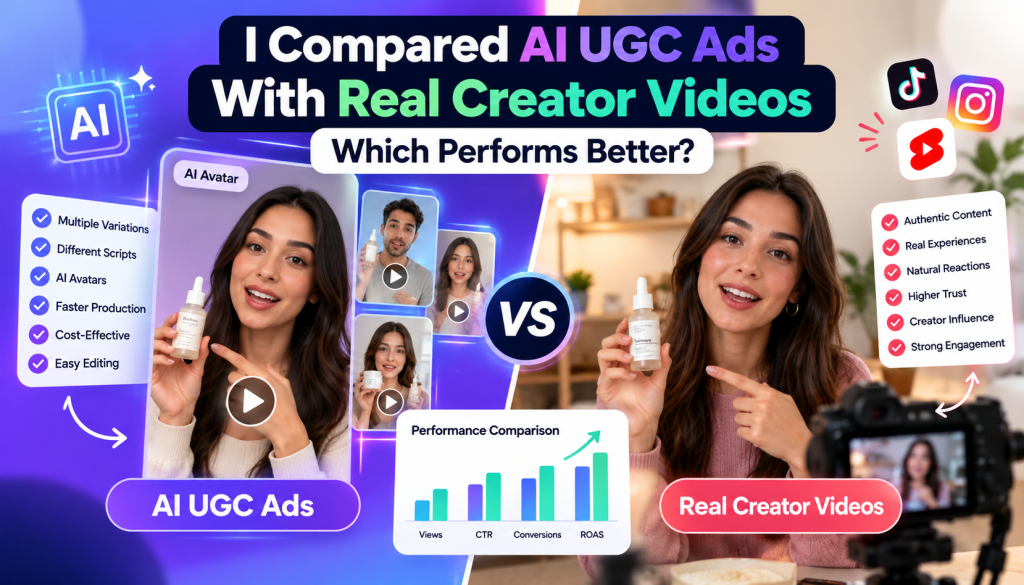
User-generated content (UGC) has become an important part of digital advertising. Brands use creator-style videos to showcase products, explain benefits, build trust, and connect with potential customers on platforms such as TikTok, Instagram Reels, YouTube Shorts, and Facebook.
However, producing traditional UGC ads can involve finding creators, negotiating prices, sending products, coordinating shoots, and editing videos. AI-powered UGC tools offer another option by helping marketers create creator-style advertisements using AI avatars, generated scripts, product images, and automated video production.
This raises an important question: Are AI UGC ads better than real creator videos, or does authentic human content still have the advantage?
To understand the differences, let’s compare AI UGC ads with real creator videos across production costs, authenticity, scalability, creative control, advertising performance, and practical use cases. We’ll also explore how tools like Tagshop AI can help brands create AI-powered UGC-style video ads.
Note: This article provides a practical comparison of the two production approaches rather than claiming results from a controlled advertising experiment. Actual performance depends on the product, audience, creative quality, platform, and campaign setup.
What Are AI UGC Ads?
AI UGC ads are advertisements designed to resemble user-generated content but created with the help of artificial intelligence. They can feature digital presenters, AI-generated voiceovers, product visuals, automated scripts, and video editing tools.
Unlike traditional UGC production, AI-generated ads do not necessarily require a human creator to record every scene. Marketers can use product information and existing assets to develop different video concepts and adapt them for multiple advertising campaigns.
For example, an online skincare store could use an AI UGC video generator to create a product introduction featuring a digital presenter, followed by a product demonstration and a call to action.
AI-generated videos can also support creative testing. Brands can experiment with different hooks, scripts, presenter styles, and product benefits without organizing a new shoot for every variation.
However, AI UGC ads should not automatically be considered genuine customer testimonials. If a digital presenter describes a personal experience that never happened, the advertisement could mislead viewers.
What Are Real Creator Videos?
Real creator videos are recorded by human content creators who demonstrate products, share opinions, explain features, or create sponsored content for brands.
These videos can include product unboxings, tutorials, lifestyle demonstrations, reviews, and personal recommendations. Depending on the campaign, creators may receive payment, free products, or another form of compensation.
One of the biggest advantages of real creator videos is their ability to communicate genuine human experiences. A creator can demonstrate how a product feels, explain what they like or dislike, and share authentic reactions.
For instance, a beauty creator might record a skincare routine featuring a moisturizer, show its texture on camera, and explain their actual experience using it.
When the creator’s experience is genuine and relevant to the audience, the video can offer a level of credibility that a fully AI-generated presenter cannot independently establish.
AI UGC Ads vs. Real Creator Videos: Key Differences
| Comparison factor | AI UGC ads | Real creator videos |
| Production speed | Often faster to generate and revise | Depends on creator availability and production |
| Production costs | Can reduce recurring production expenses | May involve creator fees, products, and editing |
| Authenticity | Depends on presentation and transparency | Can communicate genuine experiences |
| Scalability | Easier to produce many variations | Additional variations may require more creator work |
| Creative control | High control over scripts and generated elements | Depends on the creator and agreed brief |
| Product demonstrations | Depends on available assets and AI capabilities | Can show real product handling and use |
| Localization | Can simplify adapting scripts and voiceovers | May require additional recordings |
| Creative testing | Convenient for testing numerous concepts | Useful for testing creator styles and real testimonials |
| Trust | Cannot substitute for genuine customer experience | Can provide firsthand opinions when truthful |
Neither approach wins in every situation. The right choice depends on what the advertisement needs to communicate.
1. Production Speed: AI UGC Ads Have an Advantage
Traditional creator campaigns often require several stages before a video is ready for advertising. Brands must identify suitable creators, agree on deliverables, share product information, arrange filming, review footage, and request revisions.
These steps can introduce delays, particularly when a campaign requires multiple creators or several rounds of creative testing.
AI UGC tools can simplify parts of this process by generating scripts, producing digital-presenter videos, and helping marketers create alternative versions from existing product information.
For example, an eCommerce team could develop several creative concepts for a new product without arranging a separate filming session for each one.
Real creator videos still have an advantage when a campaign requires genuine product interaction, spontaneous reactions, or footage from a specific location.
Verdict: AI UGC ads are generally more convenient for rapid creative iteration, while real creator videos are valuable when filming authentic experiences is essential.
2. Production Costs: Which Option Is More Affordable?
Cost is another major difference between AI UGC ads and real creator videos.
Working with human creators may involve content fees, product samples, shipping, editing, usage rights, and paid advertising licensing. Premium creators or complex productions can increase these expenses.
AI-powered video tools may reduce some recurring costs because marketers can generate additional concepts using existing assets and software subscriptions.
However, AI production is not necessarily free. Costs may include subscription plans, usage credits, editing time, creative review, and the effort required to create high-quality source material.
The fairest comparison considers the total cost of producing usable advertising assets rather than looking only at the initial video price.
For example, if a brand needs many script and hook variations, AI production may offer better production economics. If a campaign depends on a creator’s reputation and genuine product experience, paying a suitable creator may provide greater value.
Verdict: AI UGC can be more cost-efficient for producing multiple variations, but actual savings depend on the production requirements and tool pricing.
3. Authenticity and Trust: Real Creators Have an Important Advantage
Authenticity is one of the most important considerations in creator-style advertising.
Real creators can demonstrate how they use a product, share genuine opinions, and explain personal experiences. Their expressions, reactions, and communication styles can help viewers understand how a product fits into everyday life.
AI-generated presenters can look convincing and communicate product information clearly, but realistic visuals do not automatically create genuine experience.
Consider two advertisements for a fitness product.
The first features an AI avatar explaining the product’s specifications and showing approved product visuals. The second features a real customer demonstrating how they use the product and describing their actual experience.
The AI version may communicate information efficiently, while the customer video can provide firsthand evidence of product use.
This does not mean every real creator video is trustworthy or every AI video is ineffective. Poorly produced creator videos can feel scripted, while transparent AI-generated advertisements can still be useful and engaging.
Verdict: Real creators are particularly valuable when firsthand experience, genuine demonstrations, or personal recommendations are central to the message.
4. Scalability: AI UGC Makes Creative Testing Easier
Producing a single video is different from developing an entire library of advertising creatives.
Brands often need multiple versions to test different audience segments, product benefits, opening hooks, and calls to action. Creating every variation through traditional filming can require additional coordination and production work.
AI UGC ads make it easier to explore creative directions from a common starting point.
For example, a fashion brand might develop these variations:
- A problem-focused ad highlighting a common clothing concern.
- A product-focused ad showing material, design, and features.
- A lifestyle ad demonstrating how the product fits into everyday wear.
- A benefit-focused ad explaining relevant product advantages.
- A promotional ad highlighting a verified offer.
These variations can be created around the same product while changing the message and visual presentation.
Real creators can also produce multiple versions, especially when the brand agrees on several hooks or deliverables in advance. However, extensive revisions and additional filming may require more time and budget.
Verdict: AI UGC is particularly useful when a campaign requires many creative variations quickly.
5. Creative Control: AI Offers More Flexibility
With real creators, brands usually provide a creative brief covering the product, key messages, target audience, and deliverables. The creator then interprets the brief and produces the content.
This approach can lead to original ideas and natural storytelling, but the final video may not match every detail of the brand’s initial vision.
AI video production gives marketers more direct control over generated scripts, presenters, voiceovers, scenes, and other supported creative elements.
If the first version needs improvement, the team can revise the script, adjust the hook, or try another presentation style.
However, creative control does not guarantee creative quality. AI-generated videos may contain awkward phrasing, unnatural movements, inaccurate product details, or inconsistent visuals.
Human review remains important for both approaches.
Verdict: AI offers convenient control over repeatable creative elements, while real creators bring their own personality, interpretation, and spontaneous ideas.
6. Advertising Performance: Which Generates Better Results?
There is no universal answer to whether AI UGC ads or real creator videos generate more conversions.
Performance depends on factors such as the product, audience, advertising objective, creative quality, offer, landing page, targeting, and campaign budget.
An AI-generated video may perform well when it communicates a clear benefit, captures attention quickly, and presents relevant information. A real creator video may perform better when the audience values genuine experiences or recognizes the creator.
For a fair comparison, run a structured test.
Start by choosing one product and one target audience. Create an AI-generated ad and a real creator ad with comparable messaging, offers, and calls to action.
Then evaluate relevant metrics, including:
- Hook retention: How effectively does the opening capture attention?
- Watch time: How long do viewers continue watching?
- Click-through rate: How frequently do viewers click the advertisement?
- Conversion rate: How effectively does the campaign generate desired actions?
- Cost per acquisition: How much does each conversion cost?
- Return on ad spend: How much attributed revenue is generated relative to advertising spend?
Where possible, use comparable placements, budgets, attribution settings, and audience conditions. Avoid drawing conclusions from a small number of impressions or a short testing period.
Also distinguish between production efficiency and advertising effectiveness. AI may help a team create videos faster, but only campaign data can show whether those videos achieve the desired business outcomes.
Verdict: Test both approaches using your own campaign data instead of assuming one format will always perform better.
How Tagshop AI Helps Create AI UGC Ads
For brands looking to explore AI-powered video production, Tagshop AI offers workflows designed to help marketers create UGC-style video advertisements.
Depending on the available features and plan, marketers can explore different ways to produce video concepts and adapt creative assets without arranging a separate shoot for every variation.
Key capabilities to explore include:
AI avatars: Create presenter-led video concepts using available digital presenters.
URL-to-video: Start with a product URL and use available product information and imagery to develop video content.
AI Video Agent: Explore conversational video creation workflows for developing creative concepts.
AI voice features: Experiment with supported voice options for different presentation styles.
Video editing: Refine generated videos, adjust creative elements, and prepare content for advertising placements.
For example, an online store could start with its product page, develop a benefit-focused video, and then create alternative scripts for different customer needs.
The resulting videos should be reviewed for product accuracy, natural presentation, and compliance with relevant advertising requirements.
You can explore Tagshop AI to see whether its current features fit your production workflow.
When Should You Use AI UGC Ads vs. Real Creator Videos?
The best approach depends on the campaign objective.
Use AI UGC ads when:
- You need to produce multiple creative variations.
- You want to test different hooks and messaging angles.
- You need to adapt videos for multiple languages or markets.
- Your campaign relies on product information and approved visual assets.
- You want to streamline repetitive video production.
Use real creator videos when:
- You need genuine product demonstrations.
- The campaign depends on real customer experiences.
- You want to collaborate with a creator who has an established audience.
- The product requires physical handling or firsthand evaluation.
- Human personality and spontaneous reactions are central to the creative concept.
You can also combine both approaches. Use real creator videos to establish genuine product experiences and customer perspectives, then use AI-generated creatives to explore additional messaging angles and produce supporting advertising variations.
This hybrid approach allows brands to balance authenticity with production flexibility.
Best Practices for Creating Effective AI UGC Ads
To get better results from AI UGC tools, start with accurate product information and a clear advertising objective. Generate scripts that address specific customer needs rather than producing generic sales messages.
Keep the opening concise, make the product’s value clear, and use a relevant call to action. Test different hooks and storytelling approaches instead of changing only superficial elements.
Review every generated video before publishing. Check the accuracy of product details, captions, voiceovers, visuals, and promotional claims.
Be transparent about AI-generated presenters where appropriate, and never present fictional testimonials as genuine customer experiences. Follow applicable advertising laws, endorsement guidelines, and platform disclosure requirements.
Finally, maintain a record of your creative tests. Track which messages attract attention, which videos generate qualified traffic, and which variations produce conversions. Use those insights to improve future campaigns.
Final Verdict: AI UGC Ads or Real Creator Videos?
AI UGC ads and real creator videos serve different purposes. AI offers speed, flexibility, and the ability to generate multiple creative variations, while real creators can provide genuine experiences, physical demonstrations, and human perspectives.
For brands focused on scaling creative production, AI UGC tools can simplify the process of developing and testing advertising concepts. For campaigns that depend on authentic recommendations and firsthand product use, real creator videos remain highly valuable.
The most practical strategy is to select the format that fits your objective, test both approaches when feasible, and let performance data guide your decisions.
Rather than treating AI as a complete replacement for creators, consider it another tool in your advertising workflow. When used responsibly alongside human creativity and genuine customer feedback, it can help brands produce more varied content and make better-informed marketing decisions.
Frequently Asked Questions
1. Are AI UGC ads better than real creator videos?
Neither format is always better. AI UGC ads are useful for scalable production and creative testing, while real creator videos can offer genuine product experiences and personal recommendations. The best option depends on your audience, campaign objective, and results.
2. Are AI UGC ads cheaper to produce?
They can be less expensive when a brand needs many video variations, but total costs depend on software subscriptions, usage credits, editing requirements, and quality control. Compare the cost per usable video rather than assuming AI production is always cheaper.
3. Can AI UGC ads convert customers?
Yes, AI-generated advertisements can support conversion campaigns when they communicate relevant benefits and provide a clear customer journey. However, conversion performance varies, so brands should test the ads against suitable alternatives.
4. Can I use AI UGC ads on TikTok and Instagram?
AI-generated video advertisements may be suitable for these platforms if they meet current creative specifications, advertising policies, and applicable disclosure requirements. Review the latest platform rules before publishing.
5. Can Tagshop AI replace real UGC creators?
Tagshop AI can help with certain video production tasks, but it does not replace every benefit of working with real creators. Brands may still need human creators for genuine testimonials, physical product demonstrations, and authentic firsthand experiences.
6. Should brands combine AI UGC and real creator videos?
Yes. A hybrid strategy can combine genuine creator content with AI-generated variations for creative testing. Brands should keep customer experiences truthful and clearly distinguish generated content from authentic endorsements.


Leave a Reply