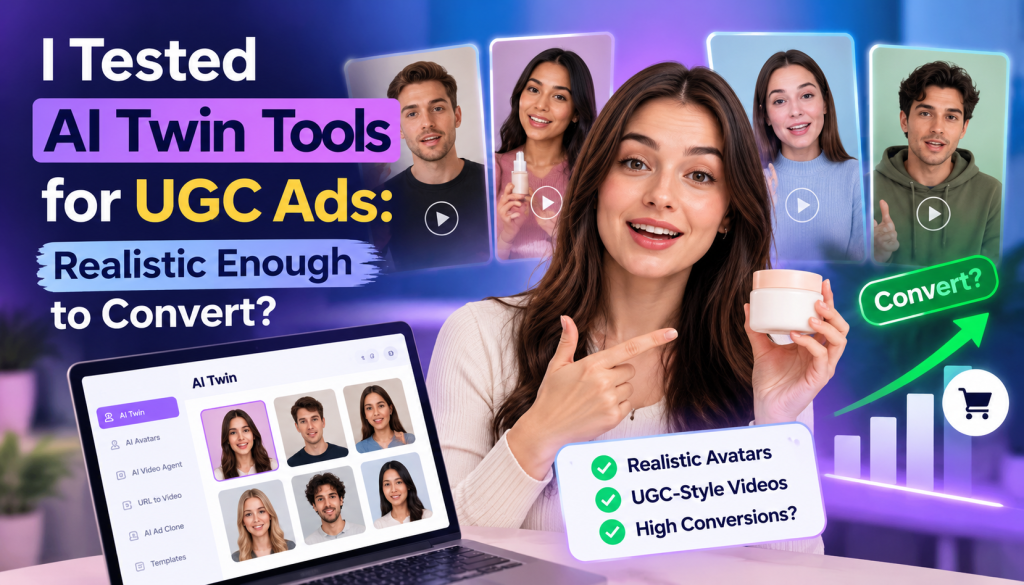
AI is changing how brands create user-generated content (UGC) ads. Instead of hiring creators, arranging product shoots, and spending days editing videos, marketers can now use AI Twin tools to generate digital versions of real people and produce advertising content at scale. But an important question remains: Are AI Twins realistic enough to create UGC ads that convert viewers into customers?
To explore this question, I looked at how AI Twin tools work, what makes their videos convincing, and where they still fall short. I also examined the features marketers should evaluate when choosing an AI Twin platform for paid advertising, social media campaigns, and eCommerce promotions.
The results suggest that AI Twins can be valuable for brands that need consistent, scalable video content. However, realistic appearance alone does not guarantee conversions. Authentic messaging, product demonstrations, audience trust, and a strong call to action remain essential.
In this guide, we will explore the benefits and limitations of AI Twin technology, how to use it for UGC advertising, and why platforms such as Tagshop AI are worth considering.
What Are AI Twin Tools?
AI Twin tools create digital representations of real people using artificial intelligence. Depending on the platform, users can generate a digital avatar from a photograph, video footage, voice samples, or other reference materials.
Once created, an AI Twin can deliver scripts, speak in different languages, present products, and appear in marketing videos without requiring the original person to record every new version.
For example, an eCommerce brand selling skincare products might create an AI Twin of a consenting creator to produce several advertising variations. One video could introduce a moisturizer, another could explain its ingredients, and a third could demonstrate how to incorporate it into a daily skincare routine.
Instead of coordinating multiple recording sessions, the marketing team can generate different scripts and creative variations using the same digital presenter.
AI Twin technology is particularly useful for:
- UGC-style video advertisements
- Product explainers and demonstrations
- Social media campaigns
- Localized video advertising
- Personalized marketing content
- Short-form videos for TikTok, Instagram Reels, and YouTube Shorts
The main advantage is efficiency. Brands can experiment with more creative concepts while reducing the time and logistical effort associated with traditional video production.
Why I Wanted to Test AI Twins for UGC Ads
UGC advertising works because it often feels more personal than conventional brand advertising. Viewers see someone speaking directly to the camera, discussing a product, or explaining how a solution fits into everyday life.
However, producing authentic-looking UGC videos consistently can be expensive and time-consuming. Brands may need to recruit creators, ship products, negotiate usage rights, review footage, and request revisions.
AI Twin tools promise to simplify this process.
I wanted to understand whether these tools could address three important challenges:
Realism: Can an AI-generated person look and sound natural enough to hold attention?
Scalability: Can marketers create multiple versions of an advertisement without repeating the entire production process?
Conversion potential: Can AI Twin videos communicate product benefits convincingly enough to encourage viewers to click, sign up, or purchase?
These questions matter because a video can look impressive while still failing to generate meaningful business results.
Testing note: This article evaluates the capabilities and practical marketing applications of AI Twin technology. It does not claim to report a controlled experiment, verified conversion rates, or firsthand performance measurements that have not been independently established.
How Realistic Are AI Twin Videos Today?
AI Twin technology has improved significantly, particularly in facial animation, lip synchronization, voice generation, and script delivery. Nevertheless, video quality varies depending on the platform, input footage, script, and generation settings.
Here are the main factors that influence realism.
1. Facial Expressions and Lip Synchronization
Facial movement is one of the first things viewers notice in an AI-generated video. When a digital presenter speaks naturally, maintains appropriate eye contact, and uses believable expressions, the result can look convincing.
Poorly synchronized lips, repetitive facial expressions, unnatural blinking, or a frozen smile can quickly make the video feel artificial.
For short product explainers and educational advertisements, these limitations may be less noticeable when the script is concise. Longer videos require more attention to expression, pacing, and natural delivery.
2. Voice Quality and Speaking Style
A realistic face is only one part of a convincing AI Twin. The voice also needs to sound appropriate for the intended audience.
Some AI voices can sound overly polished, emotionless, or mechanically consistent. This can be a problem for UGC ads because audiences often expect conversational language rather than a formal commercial presentation.
To improve delivery, marketers should write scripts the way people actually speak. Short sentences, contractions, natural pauses, and familiar expressions can help the final video feel less robotic.
Voice cloning may provide a more consistent identity when used with appropriate permission, although the quality depends on the recording samples and the platform.
3. Body Language and Gestures
Human creators communicate through more than words. They use hand gestures, facial expressions, posture, and subtle changes in tone to emphasize important points.
AI Twins may reproduce some of these behaviors, but unnatural movements can still reduce credibility. This is especially important when an advertisement involves holding a product, applying skincare, demonstrating a device, or showing how an item works.
When the product itself is central to the video, marketers should carefully review the generated footage rather than assuming the avatar will interact with it correctly.
4. Backgrounds and Product Presentation
An AI Twin can appear convincing while the surrounding scene looks artificial. Inconsistent lighting, distorted product packaging, incorrect labels, and unrealistic shadows can undermine the entire advertisement.
Brands should check every generated video for visual errors, particularly when advertising products with recognizable packaging, detailed instructions, or specific physical features.
A realistic presenter cannot compensate for a misleading product demonstration.
Can AI Twin UGC Ads Actually Convert?
The short answer is yes, they can—but their effectiveness depends on the creative execution, audience, offer, and distribution strategy.
There is no universal conversion rate for AI Twin UGC ads, and realistic avatars do not automatically outperform human creators.
Conversion performance depends on several factors.
The First Three Seconds Matter
The opening seconds of a short-form advertisement determine whether viewers continue watching or scroll away.
An AI Twin can deliver a strong hook without requiring a new recording session for every variation. For example, a skincare brand could test these openings:
- “Struggling to build a simple skincare routine?”
- “Here is what to check before buying your next moisturizer.”
- “Looking for a lightweight moisturizer for everyday use?”
Each hook addresses a slightly different audience motivation. Marketers can compare performance to understand which message generates the strongest engagement.
The Script Must Focus on Customer Problems
A technically impressive avatar cannot rescue a weak script.
Effective UGC ads usually connect a recognizable problem with a relevant product benefit. Instead of listing features, explain why those features matter to the customer.
For example, a travel accessory brand could focus on organizing luggage, reducing packing frustration, or making frequently used items easier to reach.
The AI Twin should communicate the message naturally rather than simply reading a list of product specifications.
Product Demonstrations Build Confidence
People often want evidence before purchasing a product. They may want to see its size, texture, packaging, functionality, or appearance in real-world conditions.
AI Twin videos work best when the digital presenter is supported by accurate product footage, authentic product images, or clearly labeled demonstrations.
For products that require hands-on interaction, combining an AI presenter with real product footage can be more persuasive than relying entirely on a generated scene.
Testing Matters More Than Appearance Alone
A realistic video is not necessarily a high-performing video. Marketers should measure actual campaign results rather than judging creative quality by appearance alone.
Useful metrics include:
- Hook rate: The percentage of viewers who continue watching beyond the opening.
- Video retention: How long viewers remain engaged.
- Click-through rate (CTR): The percentage of impressions that generate clicks.
- Conversion rate: The percentage of visitors who complete the desired action.
- Cost per acquisition (CPA): The cost of acquiring a customer or qualified lead.
- Return on ad spend (ROAS): Revenue attributed to advertising relative to ad spend.
Compare AI Twin ads with human-created UGC using similar audiences, offers, placements, and budgets. This helps separate the effect of the creative format from other campaign variables.
Best Use Cases for AI Twin Tools in UGC Advertising
AI Twins are not equally suitable for every advertising scenario. Their strongest applications often involve repeatable content, multiple creative variations, and clear product messaging.
eCommerce Product Ads
Online stores can use AI presenters to introduce products, explain features, and highlight use cases. A single approved digital presenter can deliver several product-focused scripts.
For example, a clothing retailer might create separate videos covering fit, styling ideas, fabric features, and seasonal collections.
Actual product visuals should remain accurate, particularly when customers need to evaluate color, material, or dimensions.
SaaS Product Demonstrations
Software companies can use AI Twins to explain product features, introduce new functionality, or guide potential customers through common workflows.
These videos can be useful for social media advertising, landing pages, and short educational campaigns.
For SaaS brands, clear explanations and relevant use cases are often more important than elaborate facial expressions.
Multilingual Advertising
Brands targeting several countries may need advertisements in different languages. AI Twin tools can help adapt scripts and voice delivery for multiple markets.
However, translation alone is insufficient. Idioms, cultural expectations, pronunciation, and product terminology should be reviewed by someone familiar with the target audience.
Creative Testing at Scale
Paid advertising teams frequently need new hooks, offers, and messaging angles to reduce creative fatigue.
AI Twin tools can make it easier to produce variations featuring the same presenter. Instead of arranging a new shoot for each concept, marketers can focus on testing different messages and creative structures.
This can improve workflow efficiency, although the resulting videos still require quality checks and performance analysis.
Tagshop AI: An AI Twin Tool Worth Considering
For marketers exploring AI-powered UGC production, Tagshop AI is one platform worth evaluating.
Tagshop AI focuses on creating AI-generated video advertisements and UGC-style content. Its workflow-oriented features can help brands develop promotional videos without organizing a traditional creator shoot for every campaign variation.
Depending on the available features and plan, marketers can explore the following capabilities.
AI Twin and Avatar-Based Videos
Digital presenters can help brands create scripted promotional content while maintaining a consistent on-screen identity.
This approach can be useful for product introductions, educational videos, and short advertising concepts. Marketers should evaluate avatar realism, voice quality, available customization options, and commercial usage rights before selecting a workflow.
AI Video Agent
Tagshop AI’s AI Video Agent is designed to support conversational video creation. Rather than manually configuring every part of a video, users can describe the creative they want and work through the generation process with AI assistance.
This type of workflow can help simplify ideation and reduce the effort involved in moving from a concept to a draft advertisement.
URL-to-Video Creation
Tagshop AI also offers a URL-to-video workflow that can use product-page information as the starting point for video creation.
For eCommerce marketers, this can reduce the amount of manual preparation required to develop initial product video concepts.
Generated details should still be checked against the original product page to prevent incorrect claims, outdated prices, or inaccurate descriptions.
AI Ad Clone
The AI Ad Clone feature can help marketers recreate the structure of an existing advertisement and adapt the creative for their own brand.
For example, a marketer might study an advertisement’s opening hook, pacing, and messaging structure before developing a new version for a different product.
The goal should be to learn from effective creative patterns rather than copy another brand’s protected assets or impersonate its creator without permission.
Is Tagshop AI Suitable for AI Twin UGC Ads?
Tagshop AI is worth considering if your team wants to combine AI presenters with a broader AI advertising workflow.
Before committing to a paid plan, evaluate a representative product, generate several creative variations, and check the final output for realistic speech, accurate product visuals, and natural delivery.
You should also verify current avatar capabilities, pricing, usage limits, and licensing terms directly on the platform, as these details can change.
AI Twins vs. Human UGC Creators
Both formats have advantages, and the right choice depends on the campaign.
| Factor | AI Twin UGC Ads | Human UGC Ads |
| Production speed | Can be fast after setup | Depends on creator availability |
| Creative variations | Easier to generate at scale | Often requires additional recording |
| Presenter consistency | High across generated videos | Natural variations between shoots |
| Emotional authenticity | Depends on avatar and script quality | Benefits from genuine human expression |
| Product interaction | May require additional real footage | Can demonstrate physical products directly |
| Localization | Can simplify multilingual production | May require different creators or recordings |
| Conversion performance | Must be validated through testing | Must also be validated through testing |
AI Twins are particularly attractive for repeatable, script-driven content. Human creators may remain preferable when genuine personal experiences, spontaneous reactions, or complex physical demonstrations are central to the advertisement.
A hybrid approach can offer a practical balance: use AI presenters for introductions and explanations, then incorporate authentic product footage, customer testimonials, or creator demonstrations where appropriate.
Common Mistakes to Avoid When Creating AI Twin Ads
Even the best tools can produce disappointing results when the creative strategy is weak.
Using overly promotional scripts: UGC-style advertising should sound conversational. Avoid excessive superlatives and unnatural sales language.
Ignoring product accuracy: Check product names, features, packaging, prices, and claims before publishing.
Making unsupported claims: Never invent testimonials, customer experiences, clinical benefits, or performance statistics. A digital presenter should not be portrayed as a real customer sharing a genuine experience unless that representation is accurate.
Publishing without human review: Inspect facial movements, pronunciation, captions, transitions, and visual inconsistencies.
Testing too many variables at once: If the hook, offer, audience, and landing page all change simultaneously, it becomes difficult to identify what improved performance.
Ignoring disclosure and consent: Use AI likenesses and cloned voices only with appropriate permission. Follow applicable advertising, privacy, platform, and disclosure requirements, particularly when synthetic content could mislead viewers about a person’s identity or experience.
How to Create Better-Converting AI Twin UGC Ads
A repeatable process can help marketers get more value from AI Twin technology.
Step 1: Choose one audience problem. Identify a specific customer pain point, desire, or objection.
Step 2: Write a short script. Open with a relevant hook, explain the product’s value, provide supporting evidence, and end with a clear call to action.
Step 3: Select an appropriate AI Twin. Choose a presenter whose style and voice fit the audience and product.
Step 4: Generate the first video. Use the available avatar, voice, and video-generation features to create an initial draft.
Step 5: Add accurate product visuals. Include genuine product footage or approved images where they improve clarity and trust.
Step 6: Create controlled variations. Test different hooks or messaging angles while keeping other major variables consistent.
Step 7: Measure results. Compare retention, CTR, conversions, CPA, and ROAS against an appropriate baseline.
Step 8: Improve the next version. Use performance data to refine the script, pacing, visuals, and offer.
This approach turns AI Twin production into a measurable advertising workflow rather than a process focused exclusively on generating attractive videos.
Final Verdict: Are AI Twins Realistic Enough to Convert?
AI Twin tools are becoming useful options for brands that want to create more video advertising content without repeating the traditional production process for every variation.
They can support product explainers, social media ads, multilingual campaigns, and creative testing. Platforms such as Tagshop AI are worth exploring for marketers who want to integrate AI presenters into a broader video advertising workflow.
However, realism is only one part of conversion performance. A convincing face cannot replace a compelling offer, accurate product information, strong messaging, or credible evidence.
For many businesses, the most practical strategy is to combine AI Twin presenters with real product visuals, transparent advertising practices, and structured A/B testing.
Start with a small campaign, establish a reliable baseline, and compare the results with your existing creatives. If AI Twin videos deliver comparable or better business outcomes at an acceptable cost, you can gradually expand their role in your advertising strategy.
The real opportunity is not simply replacing human creators. It is making high-quality video experimentation faster, more consistent, and easier to scale.
Frequently Asked Questions
1. What is an AI Twin tool?
An AI Twin tool creates a digital representation of a person using AI. Depending on the platform, the digital presenter can deliver scripts, reproduce aspects of a person’s voice, and appear in marketing or educational videos.
2. Can AI Twin videos convert customers?
Yes, AI Twin videos can generate conversions, but results vary by product, audience, script, creative quality, and campaign execution. Performance should be measured against comparable human-created advertisements rather than assumed.
3. Are AI Twin UGC ads better than human UGC?
Neither format is universally better. AI Twins can make repeatable video production and creative testing easier, while human creators can offer genuine personal experiences and natural product demonstrations.
4. Which AI tool can help create AI Twin UGC ads?
Tagshop AI is one option to evaluate for AI-powered UGC-style video creation. Compare its current avatar features, video quality, customization, pricing, and commercial licensing with your requirements before choosing a tool.
5. Can AI Twin tools create videos for TikTok and Instagram?
Many AI video platforms support short-form advertising workflows. Check the selected platform’s current aspect ratios, export options, captioning features, and supported formats before creating videos for TikTok, Instagram Reels, or other channels.
6. How can I improve AI Twin ad conversion rates?
Use a strong opening hook, conversational scripts, accurate product visuals, and a clear call to action. Test creative variations systematically and track metrics such as CTR, conversion rate, CPA, and ROAS.
7. Should brands disclose AI-generated UGC ads?
Brands should follow applicable laws, advertising rules, and platform policies. Disclosure is particularly important when synthetic content could mislead viewers into believing a digital presenter is a real customer or that a fabricated testimonial represents a genuine experience.


Leave a Reply