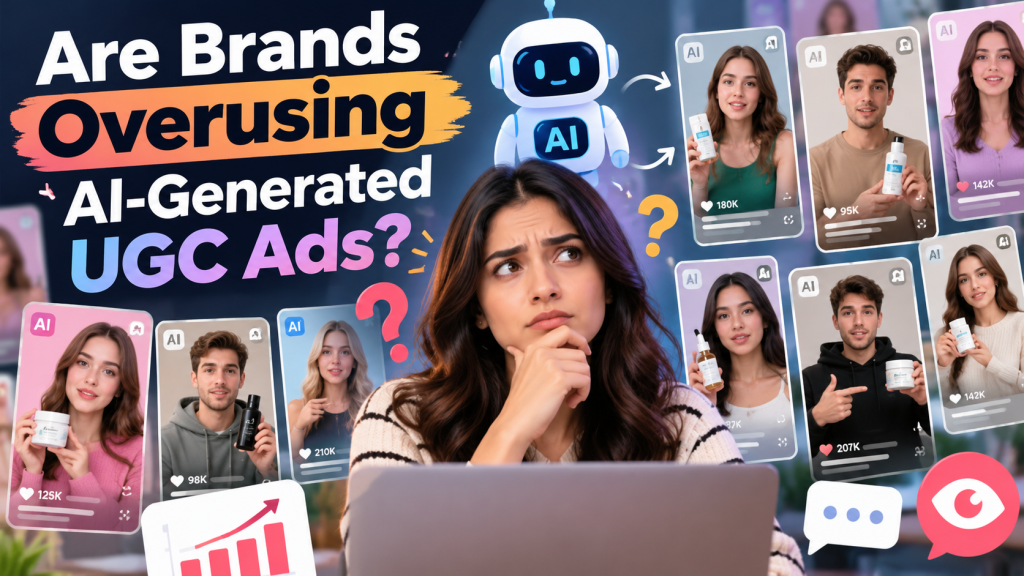
The rise of artificial intelligence has transformed how brands create video advertisements. From realistic AI avatars to automated scripts and product demonstrations, businesses can now produce hundreds of video ads without organizing traditional shoots or hiring multiple creators. This shift has made AI-generated user-generated content (UGC) an attractive option for eCommerce businesses, SaaS companies, and digital marketers.
However, as more brands adopt this technology, an important question is emerging: Are brands overusing AI-generated UGC ads?
While AI-powered video creation helps businesses save time, reduce production costs, and scale advertising campaigns, excessive reliance on similar AI-generated content can make advertisements feel repetitive, impersonal, and less trustworthy. Consumers increasingly encounter videos featuring similar hooks, scripted testimonials, artificial expressions, and predictable storytelling patterns.
The solution is not to stop using AI. Instead, brands need to understand how to use AI-generated UGC video ads strategically while preserving authenticity, creativity, and audience trust.
In this article, we explore why brands are adopting AI-generated UGC, the potential problems of overuse, how it affects advertising performance, and how businesses can create more engaging campaigns with tools such as Tagshop AI.
What Are AI-Generated UGC Ads?
AI-generated UGC ads are video advertisements created with artificial intelligence to replicate the style and format of user-generated content. Traditional UGC typically involves customers or creators sharing their experiences with a product through reviews, demonstrations, tutorials, or personal recommendations.
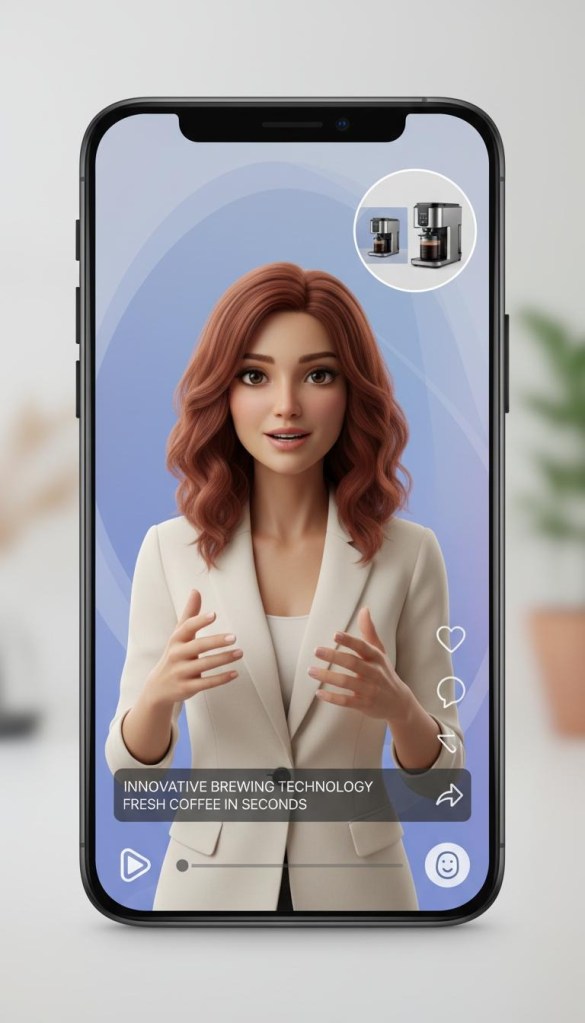
AI technology allows brands to recreate aspects of this format using digital avatars, AI-generated scripts, synthetic voices, product images, and automated video editing.
For example, a skincare brand can create a video featuring an AI avatar explaining how to use a moisturizer. An eCommerce business can turn its product page into a short promotional video, while a SaaS company can generate a presenter-style advertisement explaining its software features.
An AI UGC video generator can help marketers produce multiple variations of these advertisements for platforms such as TikTok, Instagram Reels, YouTube Shorts, and Facebook.
The main difference is that traditional UGC generally features real people creating content from their own experiences, whereas AI-generated UGC uses artificial intelligence to simulate the style of creator-led content.
Although both approaches can support marketing campaigns, they are not identical. Brands should never present fabricated AI-generated testimonials as genuine customer experiences.
Why Are Brands Increasingly Using AI-Generated UGC Ads?
The growing popularity of AI-generated UGC is driven by the need for faster, more affordable, and scalable advertising production.
1. Lower Video Production Costs
Traditional video production may involve hiring creators, arranging locations, purchasing equipment, coordinating shoots, and managing editing. These expenses can make it difficult for small businesses to produce new advertisements regularly.
AI tools simplify many of these tasks. Marketers can generate video scripts, select digital presenters, add product visuals, and create advertisements through a single workflow.
This makes AI-generated UGC video ads particularly useful for businesses working with limited advertising budgets.
2. Faster Creative Testing
Advertising performance depends on multiple variables, including the opening hook, messaging, visuals, offer, and call to action.
Creating every variation manually can slow down campaign optimization. AI tools help marketers generate different versions of an advertisement and test them across relevant audiences.
For example, a fashion brand might test three different hooks:
- A problem-focused opening about finding comfortable everyday clothing.
- A product-focused opening highlighting fabric quality.
- A benefit-focused opening emphasizing convenience and style.
By testing these variations, marketers can identify which message resonates most effectively with their target audience.
3. Easier Content Scaling
Brands advertising across several platforms need a consistent supply of fresh creatives. AI-powered production makes it easier to adapt video length, format, language, and messaging for different campaigns.
Instead of producing one advertisement for every channel from scratch, marketers can create multiple variations from the same product information and creative concept.
However, producing more content does not automatically mean achieving better results. Quality, relevance, and originality remain essential.
4. More Accessible Video Advertising
AI-generated UGC tools have reduced the technical barriers associated with video creation. Businesses without professional production teams can experiment with presenter-led advertisements, product demonstrations, and promotional videos.
This accessibility is beneficial, but it also makes it easier for brands to publish large volumes of similar content without considering whether each video offers something valuable to viewers.
Are Brands Overusing AI-Generated UGC Ads?
The answer depends on how brands use the technology.
AI-generated UGC is not inherently a problem. It becomes counterproductive when businesses prioritize content volume over creativity, authenticity, and audience needs.
When multiple brands use similar avatars, generic scripts, exaggerated claims, and identical video structures, their advertisements can begin to look interchangeable.
Consider scrolling through Instagram Reels and encountering five consecutive advertisements that begin with a similar hook, feature a nearly identical digital presenter, and end with the same promotional message.
Even if each advertisement promotes a different product, the overall experience can feel repetitive.
This is the central challenge of AI-generated advertising: when everyone can create content quickly, originality becomes an even more important competitive advantage.
Brands that rely entirely on automation risk losing the distinctive voice, personality, and creative thinking that make their marketing memorable.
5 Signs Your Brand May Be Overusing AI-Generated UGC Ads

1. Every Advertisement Looks the Same
If your videos repeatedly use identical presenters, backgrounds, camera angles, and editing patterns, audiences may struggle to distinguish your brand from competitors.

2. Engagement Is Declining
If watch time, completion rates, or meaningful interactions decline across your campaigns, your creative approach may need refreshing. AI overuse is only one possible explanation, so review targeting and frequency as well.
3. Your Videos Lack Original Experiences
Generic statements such as “This product changed my life” offer little value without supporting details. Strong advertising explains specific features, use cases, benefits, and limitations.

4. You Prioritize Quantity Over Performance
Publishing dozens of videos means little if none generates qualified traffic, product interest, or conversions. Every creative should have a clear purpose.

5. Your Brand Is Losing Its Personality
If automated scripts replace your distinctive tone and customer insights, your advertisements may become less recognizable. AI should support your brand identity rather than erase it.
How Overusing AI UGC Video Ads Can Affect Consumer Trust
Trust is one of the most important factors in digital advertising. Consumers want to understand what a product does, how it works, and whether its benefits are relevant to their needs.
AI-generated content can support this process when it presents accurate product information and useful demonstrations. Problems arise when brands use AI to simulate experiences that never happened.
For example, a company might create an AI avatar that says, “I used this supplement for 30 days, and it completely changed my life.” If no real customer had that experience, the advertisement creates a misleading impression.
Similarly, using synthetic presenters without appropriate disclosure when necessary can create confusion about whether the content depicts a real person or a genuine testimonial.
Brands should establish clear guidelines for AI-generated advertising. Product claims must be substantiated, synthetic endorsements should not misrepresent real experiences, and applicable platform rules and advertising regulations must be followed.
Transparency is not simply a compliance concern. It helps brands build long-term relationships with their audiences.
Does AI-Generated UGC Perform Worse Than Human-Created UGC?
Not necessarily. Neither format automatically guarantees better results.
Human-created UGC can provide genuine personal experiences, spontaneous reactions, and distinctive creator personalities. These qualities may be especially valuable for products that depend on trust, community, or personal recommendations.
AI-generated UGC can offer speed, consistency, creative flexibility, and easier production at scale. It can be effective for product explainers, feature demonstrations, localized advertisements, and rapid creative experimentation.
Performance depends on factors such as audience expectations, product category, message quality, distribution, creative execution, and campaign objectives.
For example, an AI-generated video demonstrating how a productivity application works may communicate its value effectively. A skincare advertisement built around a personal transformation story may require genuine customer evidence to be credible.
The best approach is to test different formats rather than assume that one will always outperform the other.
Marketers should compare meaningful metrics, including:
- Hook rate: How effectively the opening captures attention.
- Watch time: How long viewers continue watching.
- Click-through rate (CTR): How often viewers click after seeing an advertisement.
- Conversion rate: How effectively the campaign turns visitors into customers.
- Cost per acquisition (CPA): How much it costs to acquire a customer.
These metrics help identify whether AI-generated creatives contribute to business outcomes rather than merely increasing content output.
How to Create AI-Generated UGC Ads Without Losing Authenticity
Brands can use AI to improve advertising production without making every video feel artificial. The key is to combine automation with human judgment, customer insights, and original creative ideas.
1. Start With Real Customer Insights
Before generating an advertisement, understand the problems customers are trying to solve.
Review genuine customer feedback, product questions, support conversations, reviews, and common objections. These insights can inform scripts that reflect actual customer needs instead of relying on generic promotional language.
For instance, a customer who purchases a project management tool may care more about reducing repetitive work than about a long list of software features.
A video that addresses that specific problem is likely to offer more value than a generic advertisement about productivity.
2. Write Natural and Specific Scripts
AI-generated scripts often become repetitive when marketers rely on the same templates for every campaign.
Use different storytelling approaches, such as problem-solution narratives, product demonstrations, educational explainers, and comparisons. Include specific product benefits and realistic scenarios.
Avoid unsupported superlatives and fabricated first-person testimonials. If an advertisement uses an AI presenter, the script should communicate product information honestly without pretending that the presenter personally experienced the product.
3. Experiment With Different Creative Styles
Using the same digital presenter in every campaign can make your brand feel predictable.
Test different visual treatments, product-focused demonstrations, screen recordings, voiceovers, and creator-led footage where appropriate.
The goal is not to introduce random variations. Each creative should offer a distinct reason for the audience to pay attention.
4. Combine AI With Human-Created Content
AI-generated and human-created videos can complement each other.
Use AI to generate initial concepts, adapt scripts, create variations, and streamline editing. Use real customers and creators when authentic experiences, genuine reactions, or personal credibility are central to the message.
This hybrid approach gives brands the efficiency of AI without abandoning the human perspective that makes UGC valuable.
5. Test Before Scaling
Avoid producing large quantities of advertisements before understanding what works.
Start with a small group of creative variations, establish a baseline, and compare performance over a consistent period. Once you identify effective messaging and visual styles, use AI to produce additional variations.
Continue monitoring fatigue, audience response, and conversion quality. Refresh creatives when the evidence suggests that performance is weakening.
How Tagshop AI Helps Brands Create AI UGC Video Ads More Efficiently
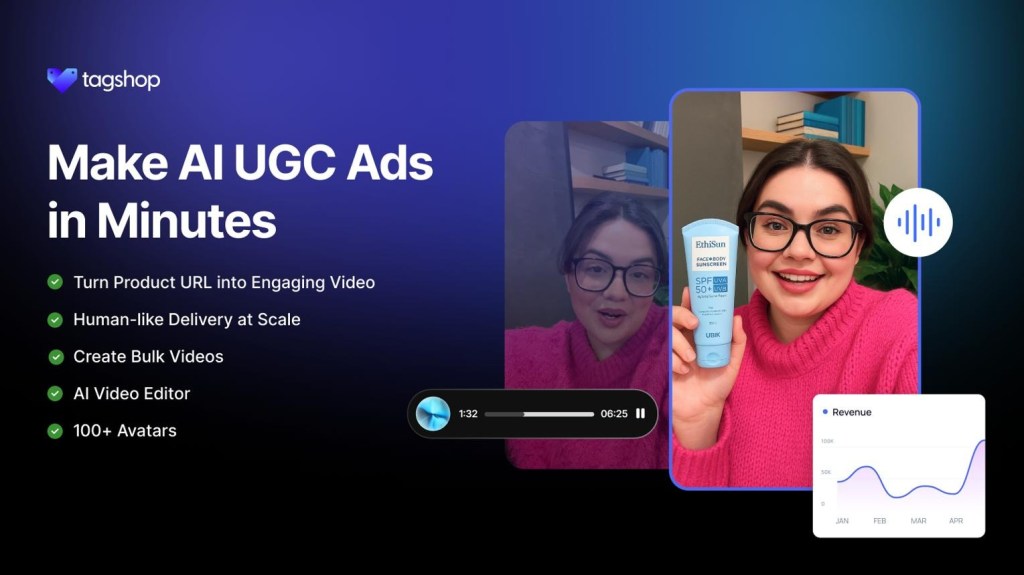
For brands looking to scale video production while maintaining creative flexibility, Tagshop AI offers an AI-powered workflow for creating promotional videos.
Instead of managing every production step manually, marketers can use its video creation capabilities to develop product-focused advertisements and experiment with different creative approaches.
Turn Product Pages Into Videos
Tagshop AI’s URL-to-video workflow allows marketers to start with a product URL and generate video content using available product information and visuals.
This can help eCommerce brands transform existing product pages into video advertisements without rebuilding every asset from scratch. Marketers should still review generated content for accuracy, visual quality, and brand consistency.
Create Videos With AI Avatars
AI avatars allow brands to create presenter-led videos without arranging a traditional shoot for every variation.
This approach can be useful for product explainers, promotional messages, and campaigns that require multiple creative versions. Choosing an appropriate avatar and writing a natural script are essential to avoiding repetitive or artificial-looking advertisements.
Experiment With Ad Clone
Tagshop AI’s Ad Clone feature is designed to help marketers recreate the structure and creative approach of an existing advertisement and customize it for their brand.
This can support creative research and faster experimentation. However, brands should develop original messaging, use authorized assets, and avoid copying another advertiser’s protected material or misleading consumers.
Use AI as a Creative Assistant
The most effective way to use Tagshop AI is to treat it as a production assistant rather than a replacement for marketing strategy.
Marketers can use AI to speed up video creation, generate variations, and test different concepts. Human review remains important for factual accuracy, brand voice, originality, and compliance.
The objective should be to create more relevant advertisements, not simply to publish more videos.
Best Practices for Balancing AI-Generated and Human-Created UGC
Brands do not need to choose between complete automation and entirely manual production. A balanced strategy allows them to use each format where it offers the most value.
| Marketing requirement | Recommended approach |
| Product feature demonstrations | AI-generated videos or screen recordings |
| Genuine customer experiences | Real customer-created UGC |
| Rapid creative testing | AI-assisted video variations |
| Personal recommendations | Authentic creators with real experiences |
| Localized campaign variations | AI-assisted translation and adaptation with human review |
| Brand storytelling | Human-led creative direction supported by AI |
Businesses should also maintain a consistent review process. Before publishing, check product claims, captions, voice quality, avatar expressions, visual accuracy, and disclosure requirements.
Where synthetic media could mislead viewers about a person’s identity, endorsement, or experience, use appropriate disclosure and follow applicable advertising and platform policies.
Most importantly, monitor audience response and use the findings to guide future creative decisions.
The Future of AI-Generated UGC Advertising
AI-generated UGC will likely remain an important part of digital advertising as video creation tools become more accessible and production workflows become more automated.
However, the ability to generate content at scale does not eliminate the need for strategic thinking. As more brands adopt similar technologies, distinctive storytelling, credible product information, and meaningful audience insights will become increasingly important differentiators.
Brands that succeed will be those that use AI to remove production bottlenecks while investing in creative experimentation and authentic communication.
AI can help businesses produce more videos, test new ideas, and adapt content for different audiences. It cannot automatically guarantee trust, originality, or commercial success.
The future of advertising will not simply belong to brands that generate the most content. It will favor brands that understand their audiences and use technology to communicate more effectively.
Conclusion
Are brands overusing AI-generated UGC ads? In some cases, yes. When companies repeatedly publish generic scripts, similar AI avatars, and artificial testimonials, their advertisements can become repetitive and undermine consumer trust.
However, the problem is not AI itself. The real issue is using automation without a clear creative strategy.
By combining genuine customer insights, original messaging, careful human review, and performance testing, brands can use AI-generated UGC video ads more effectively.
Tools such as Tagshop AI can simplify production and help marketers experiment with new creative concepts, but the strongest campaigns still depend on understanding what audiences value.
The goal is not to create more AI-generated advertisements. It is to create advertisements that are useful, credible, distinctive, and worth watching.
When brands put audience value before content volume, AI becomes a meaningful marketing advantage rather than another source of repetitive advertising.
Frequently Asked Questions
1. Are AI-generated UGC ads becoming too common?
AI-generated UGC ads are becoming more accessible as businesses adopt AI video tools. Repetitive scripts, similar avatars, and predictable formats can make advertisements feel less distinctive, so brands should prioritize originality and relevance.
2. Can AI-generated UGC ads build consumer trust?
Yes, when they communicate accurate information, demonstrate products clearly, and avoid misleading claims. Brands should not present fabricated experiences or synthetic endorsements as genuine customer testimonials.
3. Are AI-generated UGC ads better than traditional UGC?
Neither format is universally better. AI-generated ads offer production speed and scalability, while human-created UGC can provide genuine experiences and personal credibility. The best choice depends on the product, audience, and campaign objective.
4. How can brands make AI-generated UGC videos look more authentic?
Use natural scripts, realistic product demonstrations, varied creative formats, accurate product details, and appropriate disclosure. Incorporating genuine customer insights also helps make videos more relevant and specific.
5. How does Tagshop AI help create AI-generated UGC ads?
Tagshop AI helps marketers create promotional videos using AI-powered workflows, including URL-to-video generation, AI avatars, and Ad Clone. These capabilities can streamline production and creative testing while leaving marketers responsible for accuracy, originality, and final review.


Leave a Reply