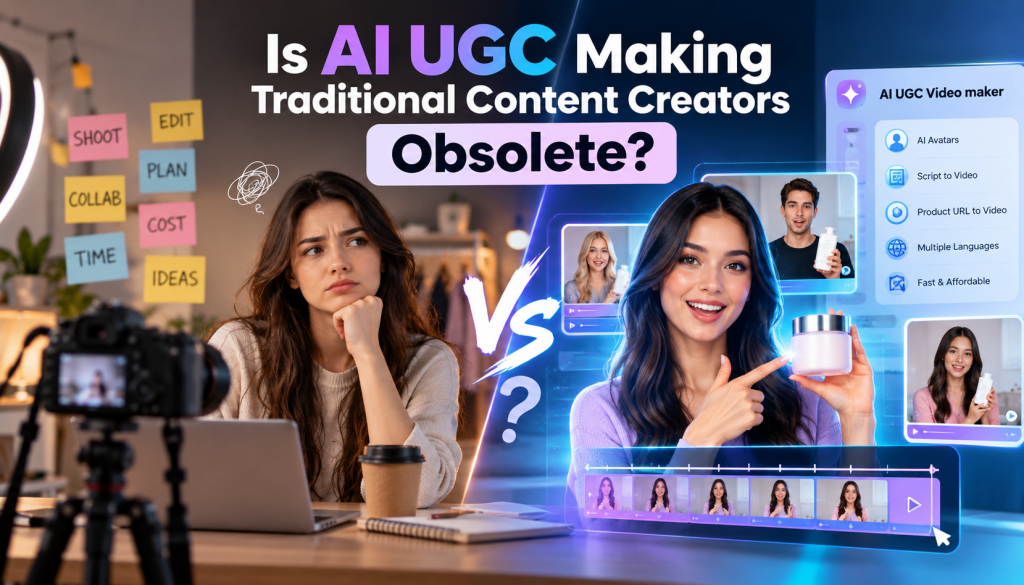
AI has changed how brands create, distribute, and scale digital content. One of the biggest developments is the rise of AI UGC Video maker tools, which can generate user-generated-content-style videos without requiring brands to organize traditional shoots, hire creators, or spend hours editing footage.
This raises an important question: Is AI UGC making traditional content creators obsolete?
The short answer is no—not completely. AI UGC is changing the role of content creators rather than eliminating it. While AI can produce videos faster and at a lower cost, human creators still offer authenticity, personal experiences, creativity, and emotional connection that AI cannot fully replicate.
The future of content creation is likely to be a combination of AI-powered production and human creativity.
What Is AI UGC?
AI UGC refers to user-generated-content-style videos created with artificial intelligence. Instead of recording a real person using a smartphone, brands can use AI tools to generate videos featuring digital avatars, AI voices, scripts, product visuals, and realistic scenes.
An AI UGC Video maker can automate several parts of the production process. Depending on the platform, marketers can enter a product description, upload product images, or provide a URL, and the AI can generate a complete video concept.
These videos are often designed to look similar to traditional UGC content, including:
- Product reviews
- Testimonials
- Unboxing-style videos
- Product demonstrations
- Problem-and-solution videos
- Social media advertisements
- TikTok-style product videos
- Instagram Reels
- Short-form promotional content
The main attraction is scalability. A brand can create multiple variations of a video without arranging separate shoots for every concept.
Why Are Brands Using AI UGC Video Makers?
Traditional content production can take significant time and resources. Brands may need to find creators, negotiate contracts, ship products, develop scripts, record footage, edit videos, and produce different versions for different platforms.
AI UGC simplifies many of these steps.
Faster Content Production
A traditional UGC campaign can take days or weeks from planning to final delivery. AI tools can dramatically reduce production time.
Marketers can generate scripts, select an avatar, create a voiceover, add product visuals, and produce a video within a much shorter workflow.
This is especially valuable for brands running paid advertising campaigns where they need fresh creatives regularly.
Lower Production Costs
Hiring multiple creators for every campaign can become expensive. Brands may need to pay creator fees, production costs, editing charges, and additional costs for revisions or usage rights.
An AI UGC Video maker can reduce some of these expenses by automating repetitive production tasks.
This doesn’t mean AI makes content completely free. Brands still need to invest in creative strategy, software, editing, advertising, and quality control. However, the cost per creative can be significantly lower.
More Creative Variations
One of the biggest advantages of AI UGC is the ability to create multiple creative variations.
For example, an e-commerce brand could test:
- Five different hooks
- Three different scripts
- Multiple AI presenters
- Different calls to action
- Different product benefits
- Several video formats
Instead of producing every variation manually, marketers can use AI to accelerate the process.
This makes AI particularly useful for creative testing.
Are Traditional Content Creators Becoming Obsolete?
Not exactly.
AI can reproduce the format of UGC, but format is not the same thing as authenticity.
A real creator can share a genuine experience with a product. They can explain how the product fits into their daily life, demonstrate unexpected use cases, and communicate emotions naturally.
These qualities are difficult for AI to replicate perfectly.
For example, imagine a skincare creator explaining how a product changed their routine after using it for several weeks. Their personal experience, facial expressions, tone, and storytelling can make the recommendation feel credible.
An AI-generated video can imitate this style, but it doesn’t actually have that personal experience.
This difference matters.
Where AI UGC Has a Major Advantage
While human creators have important strengths, AI UGC is extremely powerful for specific use cases.
1. Scaling Advertising Campaigns
Paid social campaigns require a constant supply of creative assets.
A single winning advertisement can eventually experience creative fatigue. When audiences see the same content repeatedly, performance may decline.
AI UGC allows marketers to create new versions quickly.
Instead of producing one video every few weeks, a brand can experiment with dozens of concepts.
2. Rapid Product Testing
Startups and e-commerce businesses often need to validate products before investing heavily in production.
An AI UGC Video maker allows them to create initial promotional videos without organizing a complete production.
This makes it easier to test:
- Product positioning
- Hooks
- Benefits
- Offers
- Audiences
- Calls to action
If one concept performs well, the company can invest more resources into professional creator content.
3. Localized Content
Global brands need content for different languages and markets.
Traditional production may require hiring creators from multiple countries and coordinating separate shoots.
AI can help create localized versions using different languages, voices, avatars, and messaging.
This can make international content production much more scalable.
4. High-Volume Social Content
Social media teams often need content every day.
Creating every video manually can overwhelm small teams.
AI UGC can handle repetitive production tasks while human marketers focus on strategy, creative direction, and campaign optimization.
What Human Creators Still Do Better
Despite rapid AI development, traditional creators remain highly valuable.
Authenticity
Consumers can often recognize when content feels overly scripted or artificial.
Human creators can share genuine reactions, opinions, stories, and experiences.
Authenticity is particularly important for products where trust influences purchasing decisions.
Creativity
AI can generate ideas based on existing patterns, but human creators bring personal perspectives and original experiences.
A creator may discover a unique way to demonstrate a product simply because of their lifestyle or personality.
Community
Successful creators don’t just produce videos. They build communities.
Their followers may trust their opinions, interact with their posts, and return for future recommendations.
That relationship is difficult for a purely AI-generated character to reproduce.
Real-World Experience
A human creator can physically interact with a product.
They can show what happens when a product is used incorrectly, explain how it feels, discuss its limitations, or share an unexpected benefit.
These real-world experiences can make content more persuasive.
AI UGC vs Traditional UGC
The difference becomes clearer when comparing the two approaches.
| Factor | AI UGC | Traditional UGC |
| Production speed | Very fast | Usually slower |
| Cost per creative | Often lower | Usually higher |
| Scalability | Very high | Limited by creator availability |
| Authentic personal experience | Limited | Strong |
| Creative testing | Excellent | More time-consuming |
| Localization | Easy to scale | Requires additional creators |
| Community connection | Limited | Strong |
| Human storytelling | Can simulate | Naturally available |
| Content volume | High | Moderate |
Neither approach is universally better.
The right choice depends on the campaign objective.
The Future May Be Human + AI
Instead of asking whether AI will replace creators, brands should ask how creators can use AI to become more productive.
This is where the future of content creation becomes interesting.
A creator could use AI to generate scripts, create rough concepts, produce multiple hooks, remove repetitive editing tasks, or create localized versions of their content.
The creator remains responsible for the ideas, opinions, storytelling, and authenticity.
In this model, AI becomes a production assistant rather than a replacement.
For example, a creator could record one product experience and then use AI tools to generate different versions for TikTok, Instagram, YouTube Shorts, and paid advertising.
This combination can give brands both scale and authenticity.
How Brands Can Use an AI UGC Video Maker Effectively
Simply generating AI videos isn’t enough. Brands need a clear creative strategy.
Start With the Audience
Before creating a video, identify who the content is for.
Understand their problems, motivations, objections, and buying triggers.
AI can help produce the video, but the marketing strategy should come first.
Focus on Strong Hooks
The first few seconds are critical for short-form video.
Instead of starting with a generic product introduction, experiment with hooks such as:
- “I wish I discovered this sooner.”
- “Here’s why everyone is talking about this.”
- “I tested this so you don’t have to.”
- “If you’re struggling with [problem], watch this.”
- “Three reasons I started using this product.”
AI makes it easier to test multiple hooks quickly.
Don’t Make Every Video Look the Same
One danger of AI UGC is producing dozens of videos with identical structures.
If every video uses the same avatar, voice, pacing, and script style, audiences may quickly recognize the pattern.
Use different formats, storytelling approaches, presenters, hooks, and visual styles.
Combine AI With Real Content
Brands don’t have to choose between AI UGC and traditional UGC.
A strong campaign can combine both.
For example, a company could use AI-generated videos for high-volume creative testing while using real creators for major campaigns, testimonials, and long-term brand storytelling.
Will AI UGC Replace Content Creators?
AI UGC is unlikely to completely replace traditional content creators.
Instead, it is more likely to replace some content production tasks.
Routine activities such as basic scripting, editing, voiceovers, resizing, localization, and repetitive video production can increasingly be automated.
But strategy, creativity, personal experience, storytelling, and community building remain highly valuable.
The role of the creator may evolve from being primarily a content producer to becoming a creative strategist, storyteller, and brand personality.
Creators who learn how to work with AI may actually become more valuable because they can produce more content while maintaining their unique voice.
Final Thoughts
The rise of the AI UGC Video maker doesn’t mean traditional content creators are disappearing. Instead, it signals a major shift in how content is produced.
AI offers speed, scalability, affordability, and endless opportunities for creative testing. Human creators bring authenticity, emotion, creativity, personal experience, and community.
The smartest brands won’t necessarily choose one over the other.
They will use AI for what it does best—scaling production and automating repetitive tasks—while using human creators for what people do best: telling genuine stories and building trust.
Ultimately, AI UGC isn’t making traditional content creators obsolete. It’s changing the definition of what a content creator can be.


Leave a Reply