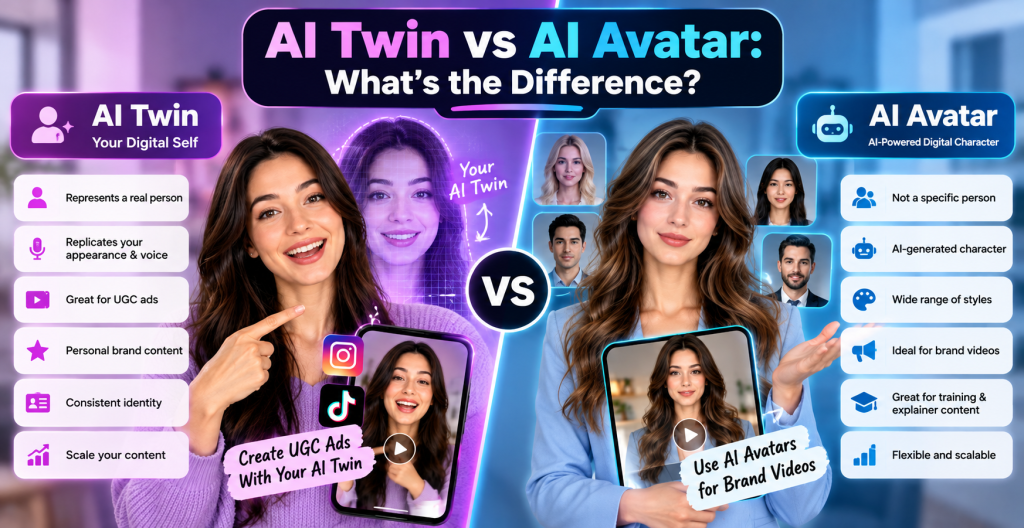
Artificial intelligence is changing the way people create videos, advertisements, social media content, and digital experiences. Two terms that are becoming increasingly common are AI Twin and AI Avatar. Although they are often used interchangeably, they are not exactly the same.
Both technologies can help brands, creators, marketers, and businesses produce videos without traditional filming. However, the purpose, level of personalization, and typical use cases can be very different.
Understanding the difference between an AI Twin vs AI Avatar can help you choose the right technology for creating UGC videos, product demonstrations, social media content, training videos, and AI-powered advertisements.
In this guide, we’ll explain what AI Twins and AI Avatars are, how they work, their key differences, advantages, limitations, and which option is better for different content creation needs.
What Is an AI Twin?
An AI Twin is an AI-generated digital representation of a specific real person. It is designed to replicate important characteristics of that individual, such as their appearance, voice, facial expressions, mannerisms, and sometimes their communication style.
The goal of an AI Twin is to create a digital version of a particular person that can generate content on their behalf.
For example, a creator could create an AI Twin using their own video, images, and voice. After the digital twin has been created, they could use it to produce videos from written scripts without recording themselves every time.
An AI Twin can be useful for:
- AI UGC videos
- Personal brand content
- Social media videos
- Product advertisements
- Creator collaborations
- Product reviews
- Educational videos
- Promotional content
- Multilingual content
- Digital marketing campaigns
The key idea is personal identity replication.
An AI Twin is generally connected to a specific person.
What Is an AI Avatar?
An AI Avatar is a digital character or virtual presenter created with artificial intelligence. Unlike an AI Twin, an AI Avatar does not necessarily represent a specific real person.
An AI Avatar can be completely fictional or can be designed to represent a particular style, demographic, or brand identity.
For example, a company might select an AI Avatar that looks like a professional presenter and use it to create marketing videos.
AI Avatars are commonly used for:
- Explainer videos
- Training content
- Corporate presentations
- Educational videos
- Social media content
- Product demonstrations
- Customer onboarding
- Marketing campaigns
- Internal communications
An AI Avatar can be thought of as an AI-powered digital presenter, while an AI Twin is more closely connected to a real person’s identity.
AI Twin vs AI Avatar: The Main Difference
The simplest way to understand the difference is this:
An AI Twin is a digital version of a specific person, while an AI Avatar is an AI-generated character or presenter.
For example, imagine a fashion creator named Sarah.
If Sarah creates a digital version of herself that looks and sounds like her, that is an AI Twin.
If a fashion brand chooses a fictional AI-generated woman to present its products, that is an AI Avatar.
Both can create videos, but the relationship with identity is different.
AI Twin vs AI Avatar Comparison
| Feature | AI Twin | AI Avatar |
| Represents a real person | Usually yes | Not necessarily |
| Personalized appearance | Very high | Variable |
| Voice replication | Often available | Usually selected/generated |
| Personal brand use | Excellent | Good |
| UGC advertising | Excellent | Good |
| Fictional characters | Less common | Excellent |
| Brand spokesperson | Excellent | Excellent |
| Creator monetization | Strong potential | Limited |
| Content scalability | High | High |
| Identity-based content | Strong | Lower |
| Product demonstrations | Excellent | Excellent |
The right choice depends on what you want your content to achieve.
How Does an AI Twin Work?
Creating an AI Twin typically starts with reference material from the person being replicated.
Depending on the platform, this might include:
- Photos
- Video recordings
- Voice recordings
- Facial expressions
- Speaking samples
- Movement references
AI technology processes this information to create a digital representation.
Once the AI Twin is generated, users can provide scripts and other instructions. The system then generates a video where the digital person delivers the content.
For example, a creator might write:
“I’ve been using this product for two weeks, and here’s what I noticed.”
The AI Twin can then deliver that message using the creator’s digital likeness and voice.
This means the creator doesn’t necessarily need to record a new video for every campaign.
How Does an AI Avatar Work?
AI Avatars generally follow a similar production process but don’t require the avatar to represent the user’s real identity.
A user can select an existing avatar or generate a new character.
They can then provide:
- A script
- Voice preferences
- Language
- Background
- Video format
- Brand assets
- Visual instructions
The AI generates the video using the selected avatar.
For example, an ecommerce company could select a professional-looking AI Avatar and use it to explain how its product works.
The avatar becomes a reusable digital presenter for the company.
AI Twin for UGC Ads
One of the most interesting applications of AI Twins is AI UGC advertising.
UGC, or user-generated content, has become an important format for social media advertising because creator-style videos can feel more natural and relatable than traditional advertisements.
However, traditional UGC production can be time-consuming.
Brands need to:
- Find creators.
- Negotiate pricing.
- Send products.
- Provide creative briefs.
- Wait for recordings.
- Review videos.
- Request revisions.
- Edit the final content.
An AI Twin can simplify the production process.
A creator can create an AI Twin and use it to generate multiple UGC-style ads from different scripts.
For example, the same AI Twin could create:
- A product review
- A problem-solution video
- A testimonial-style advertisement
- A product demonstration
- A comparison video
- A promotional video
This can make AI UGC production significantly more scalable.
AI Avatar for UGC Ads
AI Avatars can also be used to create UGC-style advertisements.
However, the content may feel more like an AI-generated spokesperson video rather than content from a specific creator.
For brands that don’t need a recognizable creator identity, this can be a major advantage.
A company could create a fictional brand ambassador and use the same avatar across multiple campaigns.
For example, an ecommerce company could have an AI Avatar introduce new products every week.
The brand doesn’t need to coordinate with an external creator for every video.
Which Is More Realistic: AI Twin or AI Avatar?
There isn’t always a simple answer.
The realism depends on the technology used, the quality of the source material, and the production workflow.
However, AI Twins generally have an advantage when the objective is to replicate a specific person.
Because an AI Twin is created using reference material from a real individual, it can be designed to maintain that person’s appearance and voice.
AI Avatars can also look extremely realistic, but they are generally designed as digital characters rather than exact representations of a particular individual.
For creator-led marketing, this distinction can matter.
Audiences may respond differently to a recognizable creator than to a generic digital spokesperson.
AI Twin vs AI Avatar for Brand Marketing
Brands can use both technologies for marketing, but their roles can be different.
An AI Twin can be useful when a campaign depends on personal identity, creator trust, or a recognizable spokesperson.
An AI Avatar can be useful when a brand wants a reusable digital presenter without relying on a specific person’s identity.
For example, a skincare brand could partner with a beauty creator and use the creator’s AI Twin to generate UGC advertisements.
Alternatively, the brand could create its own AI Avatar and use that character for product education and promotional videos.
When Should You Use an AI Twin?
An AI Twin may be the better option if:
You Are a Creator
If you already have an audience and personal brand, an AI Twin can help you scale content without personally recording every video.
You can focus on ideas and strategy while using your digital twin for selected content.
You Want Creator-Led UGC
AI Twins are particularly useful for creator-style advertisements where the person’s identity is an important part of the content.
You Need Multiple Creative Variations
If you’re testing advertising hooks, scripts, CTAs, or product angles, an AI Twin can help you generate multiple versions more efficiently.
You Want to Scale a Personal Brand
Creators, coaches, consultants, educators, and founders can potentially use AI Twins to expand their content production.
When Should You Use an AI Avatar?
An AI Avatar may be a better choice if:
You Don’t Need a Specific Person
If the content doesn’t depend on personal identity, an AI Avatar can be a practical option.
You Need a Brand Spokesperson
Companies can create an AI Avatar that represents their brand across different videos.
You Create Educational Content
AI Avatars can work well for tutorials, onboarding videos, internal training, and educational content.
You Want a Fictional Character
If you’re building a creative character or virtual influencer, an AI Avatar provides more flexibility.
Advantages of AI Twins
AI Twins can offer several benefits to creators and marketers.
More Content Without More Recording
Once an AI Twin is created, new scripts can potentially be converted into videos without recording each one manually.
Consistent Personal Branding
The same appearance and voice can be maintained across different pieces of content.
Faster Creative Testing
Marketers can create multiple versions of an advertisement and test different creative concepts.
Potential New Revenue Streams
Creators could potentially license their digital likeness for approved campaigns and partnerships.
Multilingual Content
Depending on the platform, an AI Twin may be able to deliver content in different languages, helping creators and brands reach international audiences.
Advantages of AI Avatars
AI Avatars offer a different set of benefits.
Easy Brand Representation
A company can create a digital spokesperson without hiring a full-time presenter.
Scalable Video Production
The same avatar can appear across hundreds of videos.
Flexible Creative Direction
Brands can create different characters and visual identities depending on their campaigns.
No Real Person Required
Because an AI Avatar can be fictional, brands don’t necessarily need to work with a real individual.
Potential Limitations of AI Twins
AI Twins are powerful, but they also create important challenges.
Consent and Identity
Creators should have clear control over how their likeness and voice are used.
Authenticity
Audiences may react negatively if AI-generated content is presented deceptively.
Quality
Poor source footage or low-quality AI generation can make an AI Twin look unnatural.
Brand Safety
Creators and brands should define where and how a digital identity can be used.
Contracts should clearly address usage rights, duration, platforms, geographic restrictions, and content approvals.
Potential Limitations of AI Avatars
AI Avatars also have limitations.
The biggest challenge can be authenticity.
A generic avatar may not create the same level of emotional connection as a real creator with an established audience.
Another challenge is differentiation. As more companies use AI Avatars, audiences may see many similar-looking digital presenters.
Brands therefore need to focus on storytelling, creative concepts, and strong messaging rather than relying on the avatar alone.
AI Twin vs AI Avatar for Social Media
Social media is one of the strongest use cases for both technologies.
For TikTok, Instagram Reels, YouTube Shorts, and other short-form platforms, AI Twins can help creators produce more personal content.
AI Avatars can help brands create consistent educational or promotional videos.
The best approach depends on the content strategy.
If the audience follows the person, an AI Twin may be more effective.
If the audience follows the brand, an AI Avatar may be sufficient.
AI Twin vs AI Avatar: Which Is Better for UGC?
If your main goal is UGC video creation, an AI Twin may have an advantage when the content needs to feel like it comes from a specific creator.
For example, a creator can use their AI Twin to produce product reviews, demonstrations, and testimonial-style advertisements.
However, AI Avatars can still be useful for brands that want creator-style content without partnering with a specific person.
The key question is:
Does the identity of the person matter to the campaign?
If yes, consider an AI Twin.
If no, an AI Avatar may be enough.
The Future of AI Twins and AI Avatars
The distinction between AI Twins and AI Avatars may become less obvious as AI video technology improves.
Future systems could allow users to create highly personalized digital identities with realistic voices, expressions, movements, and communication styles.
Creators may use AI Twins as extensions of their personal brands.
Brands may build persistent AI Avatars that act as digital spokespeople.
Marketing teams could create hundreds of video variations from a single creative concept.
This could make AI video production faster and more accessible than traditional production.
However, human creativity will remain important.
AI can generate the video, but the strategy, story, positioning, and creative concept still determine whether the content is effective.
How to Choose Between an AI Twin and AI Avatar
Use these questions to decide which technology is right for you:
Do you want the digital person to represent you?
Choose an AI Twin.
Do you need a fictional or generic presenter?
Choose an AI Avatar.
Are you a creator with an established personal brand?
An AI Twin may be more useful.
Are you a company creating educational or promotional content?
An AI Avatar may be a better fit.
Are you creating AI UGC ads based on creator identity?
An AI Twin is worth considering.
Do you need a permanent digital brand spokesperson?
An AI Avatar could be the better option.
Final Thoughts
The debate around AI Twin vs AI Avatar ultimately comes down to identity.
An AI Twin is designed to represent a specific real person, while an AI Avatar is generally a digital character or virtual presenter that doesn’t need to represent a particular individual.
Both technologies can transform video creation.
AI Twins can help creators scale their personal brands, produce AI UGC videos, and create more advertising variations. AI Avatars can help brands build digital spokespeople, create educational content, and produce scalable marketing videos.
Neither technology is universally better.
The right choice depends on your goals.
If personal identity, creator authenticity, and UGC-style content are central to your strategy, an AI Twin can be a powerful solution. If you need a flexible digital presenter for marketing, education, or brand communication, an AI Avatar may be more practical.
As AI video technology continues to evolve, both AI Twins and AI Avatars are likely to become important tools in the future of digital content creation.


Leave a comment