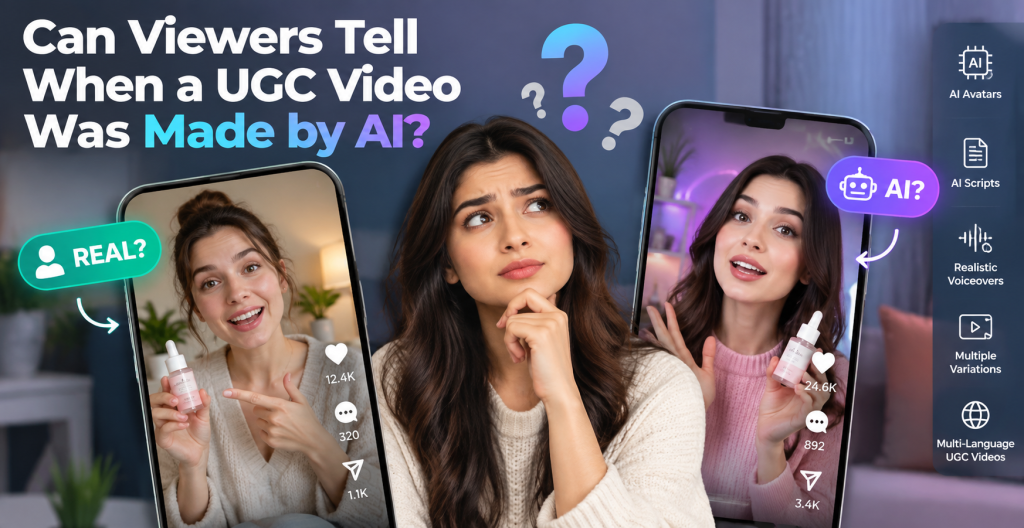
User-generated content (UGC) has become one of the most effective formats for social media advertising. Brands use UGC-style videos to showcase products, explain benefits, share customer experiences, and build trust with potential buyers. But as artificial intelligence becomes better at creating realistic people, voices, scripts, and videos, an important question is emerging: Can viewers tell when a UGC video was made by AI?
The answer is: sometimes, but not always.
A well-produced UGC AI Video can look surprisingly realistic, especially when it uses natural-looking AI avatars, believable voiceovers, realistic environments, conversational scripts, and authentic storytelling. However, viewers can still notice certain visual, audio, and storytelling signals that make a video feel artificial.
For marketers, understanding these signals is important. The goal is not simply to make AI-generated UGC look realistic. The goal is to create content that feels natural, relatable, and trustworthy.
What Is a UGC AI Video?
A UGC AI Video is a video created with artificial intelligence that follows the style and structure of traditional user-generated content.
Traditional UGC usually involves a real person filming themselves using a product, sharing an opinion, demonstrating a feature, or telling a personal story. AI can recreate many of these elements without requiring a brand to hire and coordinate with multiple creators.
AI-powered video tools can generate:
- AI avatars and digital presenters
- UGC-style scripts
- AI voiceovers
- Product demonstrations
- Different backgrounds and environments
- Multiple languages and accents
- Short-form social media videos
- Different hooks and creative variations
This makes UGC AI Video creation particularly useful for brands that need to produce large volumes of advertising content.
Instead of creating one video and running it for weeks, marketers can create dozens of variations with different hooks, scripts, avatars, products, and calls to action.
Can Viewers Actually Detect AI-Generated UGC?
Yes, but detection depends heavily on the quality of the video.
A low-quality AI video can often be identified within seconds. The avatar may have unnatural facial expressions, the voice may sound robotic, or the person’s mouth movements may not perfectly match the dialogue.
However, modern AI video generation has improved significantly.
High-quality UGC AI Video content can now include realistic facial expressions, natural gestures, convincing voices, and social-media-friendly editing. When these elements are combined with an authentic script, many viewers may not immediately recognize that the content was AI-generated.
The bigger issue is often not “Does this look like AI?” but rather:
“Does this feel like something a real person would actually say?”
That distinction is critical for marketers.
1. Unnatural Facial Expressions
One of the easiest ways viewers can sometimes recognize AI-generated UGC is through facial expressions.
Real people constantly make small facial movements while speaking. They blink, smile, raise their eyebrows, change their expressions, and react naturally to what they are saying.
AI avatars can sometimes appear too perfect or emotionally flat.
For example, an AI-generated person might say:
“I absolutely love this product!”
while maintaining almost the same facial expression throughout the sentence.
That mismatch between the words and emotions can make the video feel artificial.
A better UGC AI Video should match facial expressions with the message. Excitement should look exciting. Surprise should look surprised. A problem-focused statement should have an appropriate emotional tone.
2. Robotic or Perfect Voiceovers
Voice quality is another major factor.
Older AI-generated voices often sounded robotic and lacked emotional variation. Modern AI voice technology is much better, but certain patterns can still reveal synthetic audio.
Viewers may notice:
- Unusual pauses
- Perfect pronunciation
- Identical sentence rhythm
- Lack of emotion
- Strange emphasis
- unnatural breathing
- Inconsistent tone
Real people rarely speak perfectly.
They pause, change their speed, emphasize unexpected words, and sometimes use filler words such as “actually,” “honestly,” “like,” or “you know.”
Adding natural conversational patterns can make an AI-generated UGC video feel much more authentic.
3. Overly Perfect Scripts
This is one of the biggest problems with AI-generated UGC.
Many AI-generated scripts sound like advertisements rather than conversations.
For example:
“This revolutionary skincare product provides exceptional hydration while improving the overall appearance of your skin.”
That sounds like marketing copy.
A real creator might say:
“My skin gets super dry, especially in winter, and this is one of the few products that actually helped.”
The second version feels more personal.
The best UGC AI Video content should sound like a person talking to another person—not a company reading a product description.
4. Lack of Personal Details
Authenticity often comes from small details.
Real UGC creators naturally mention personal experiences:
- When they started using the product
- What problem they had
- What surprised them
- What they liked or disliked
- How they use the product
- Who they would recommend it to
AI-generated content can sometimes feel generic because it focuses too heavily on product features.
Adding specific experiences can make the video more believable.
For example, instead of saying:
“This moisturizer is lightweight and hydrating.”
a stronger UGC-style statement could be:
“I started using this before makeup because heavier moisturizers usually make my foundation look patchy.”
That sounds like a genuine experience.
Why Authenticity Matters in UGC Advertising
UGC works because people often trust people more than traditional advertisements.
Consumers see thousands of promotional messages every day. A polished brand advertisement can immediately feel like an advertisement.
UGC creates a different impression.
A creator speaking directly to the camera can feel more personal and relatable. This is particularly effective on platforms such as TikTok, Instagram Reels, YouTube Shorts, and other short-form video channels.
When AI is used to create UGC-style content, brands need to preserve those same characteristics.
The technology should support authenticity rather than remove it.
How to Make a UGC AI Video Feel More Human
Creating realistic AI content requires more than selecting a realistic avatar.
Here are several strategies marketers can use.
Start With a Strong Hook
Real creators usually get to the point quickly.
Instead of beginning with a long introduction, start with a statement that creates curiosity.
Examples include:
- “I didn’t expect this to work, but…”
- “If you have this problem, watch this.”
- “I wish I found this product sooner.”
- “Three things surprised me about this.”
- “Here’s what happened after using it for 30 days.”
Strong hooks can immediately make the content feel more like social media content and less like a traditional commercial.
Use Conversational Language
Avoid complicated sentences and corporate language.
Short sentences usually work better.
Instead of:
“This innovative platform enables businesses to efficiently generate high-quality video advertising content.”
Try:
“You can create these videos in minutes without filming everything yourself.”
The second version feels much more natural.
Add Natural Pauses
A UGC AI Video doesn’t need to sound perfectly scripted.
Small pauses can make speech feel more conversational.
For example:
“I honestly didn’t expect much… but this actually surprised me.”
That slight pause adds personality.
Use Different Creators
One AI avatar should not be used for every campaign.
Brands can experiment with different:
- Ages
- Appearance
- Speaking styles
- Accents
- Backgrounds
- Personalities
- Video formats
This allows marketers to create different creative variations for different audiences.
AI UGC vs. Traditional UGC
Traditional UGC still has advantages because it comes directly from real customers or creators.
However, AI-generated UGC provides significant scalability.
A traditional UGC campaign might require:
- Finding creators
- Negotiating rates
- Sending products
- Providing creative briefs
- Waiting for filming
- Reviewing videos
- Requesting revisions
- Editing content
AI can reduce much of this production complexity.
With a UGC AI Video workflow, marketers can create multiple variations much faster.
This is particularly useful when testing paid social creatives.
Can AI UGC Be Better for Creative Testing?
One of the biggest advantages of AI-generated UGC is creative testing.
Instead of investing heavily in one video, marketers can create multiple versions.
For example, a brand could test:
Hook A: Problem-focused
Hook B: Product-focused
Hook C: Curiosity-focused
Hook D: Testimonial-style
Hook E: Before-and-after focused
The brand can then compare performance and identify which creative direction generates better results.
This makes AI UGC especially valuable for performance marketing.
What Makes AI UGC Look Fake?
There are several common mistakes that can immediately reduce authenticity.
Excessive Perfection
Perfect lighting, perfect speech, perfect framing, and perfect expressions can make a video feel artificial.
Real UGC is often slightly imperfect.
Generic Backgrounds
A completely artificial-looking background can make viewers suspicious.
Natural environments such as bedrooms, offices, kitchens, gyms, stores, and outdoor spaces can create a more realistic context.
Repetitive Avatars
Using the same person repeatedly across every campaign can make the content feel automated.
Brands should build a diverse creative library.
Product Inconsistencies
AI-generated product videos can sometimes create problems with product packaging, logos, labels, or physical appearance.
For product-focused campaigns, maintaining visual consistency is essential.
Overly Promotional Messaging
If every sentence sounds like a sales pitch, viewers may lose trust.
UGC works better when the content educates, entertains, demonstrates, or tells a story before delivering the sales message.
Should Brands Disclose AI-Generated UGC?
Transparency is becoming increasingly important as AI-generated media becomes more common.
Brands should consider platform requirements, advertising regulations, and consumer expectations when using AI-generated people or synthetic content.
The specific disclosure requirements can vary depending on the platform, country, and type of content.
More importantly, transparency can help brands maintain trust.
AI does not automatically make content deceptive. The key question is how the content is presented and whether viewers are being misled.
The Future of UGC AI Video
AI-generated UGC is likely to become an increasingly important part of digital advertising.
As AI models improve, the visual difference between AI-generated and human-created content will continue to become smaller.
This means marketers will need to focus less on simply making AI look realistic and more on creating meaningful creative experiences.
The strongest UGC AI Video campaigns will likely combine:
- Realistic AI creators
- Strong storytelling
- Authentic scripts
- Product demonstrations
- Multiple creative variations
- Personalized messaging
- Fast creative testing
- Performance-based optimization
AI can handle much of the production process, but strategy still determines whether the content performs.
Final Thoughts
So, can viewers tell when a UGC video was made by AI?
Sometimes-but increasingly, not reliably.
Viewers are more likely to recognize AI when the video contains unnatural facial expressions, robotic voices, generic scripts, repetitive avatars, or overly polished messaging.
However, a well-designed UGC AI Video can feel remarkably natural when it combines realistic visuals with conversational storytelling and authentic messaging.
For marketers, the goal should not be to hide AI. Instead, the goal should be to use AI responsibly to create better, more relevant, and scalable content.
The future of UGC is unlikely to be purely human or purely AI. It will probably be a combination of human creativity and AI-powered production, allowing brands to test more ideas, reach more audiences, and create high-quality video content faster.


Leave a comment