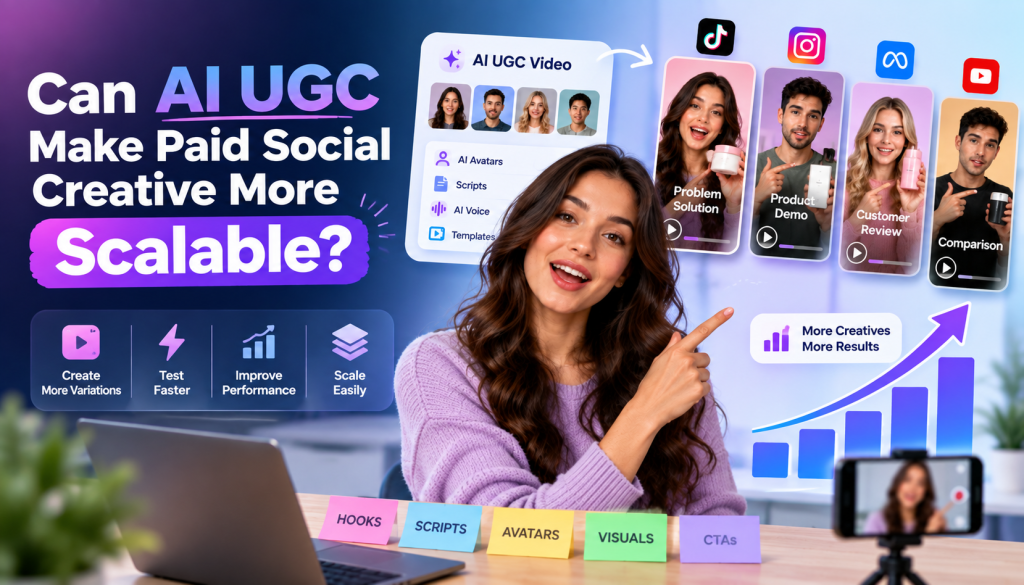
Paid social advertising has become increasingly competitive. Brands are no longer competing only on audience targeting, bidding, or budget. They are also competing for attention with a constant stream of short-form videos, creator content, product demonstrations, testimonials, and promotional ads.
This makes creative production one of the biggest challenges for performance marketers.
A single paid social campaign may require dozens of creative variations to discover which hooks, messages, visuals, and calls to action generate the best results. Traditional UGC production can make this difficult because every new creative may require a creator, product shipment, filming, editing, revisions, and additional production costs.
AI UGC offers another approach.
By using artificial intelligence to create creator-style videos, brands can produce more variations in less time. This makes UGC video for paid creative particularly useful for brands that need to test and refresh their advertising content regularly.
But can AI UGC really make paid social creative more scalable? The answer is yes—but scalability is not simply about creating more videos. Brands also need a structured creative strategy, quality control, testing framework, and clear understanding of their audience.
In this guide, we’ll explore how AI UGC can make paid social creative more scalable, where it works best, what brands should consider, and how to build an effective AI-powered paid creative workflow.
What Is AI UGC?
AI UGC refers to creator-style content produced with the help of artificial intelligence. Instead of relying entirely on a traditional creator to record a video, brands can use AI-powered tools to generate scripts, avatars, voiceovers, visuals, product demonstrations, and edited videos.
The goal is to recreate some of the characteristics that make traditional UGC effective: conversational storytelling, relatable presentation, product-focused demonstrations, and short-form video formats.
AI UGC can be particularly valuable for paid advertising because advertisers often need multiple creative variations for platforms such as Meta, TikTok, YouTube, and other social channels.
For example, an ecommerce brand could create several versions of a product advertisement with different hooks, presenters, scripts, and CTAs. Each variation can then be tested to determine which creative performs best.
Why Paid Social Needs More Creative
Paid social algorithms have become increasingly dependent on creative performance. Even when targeting and campaign settings are strong, an advertisement may struggle if the creative fails to capture attention.
This creates a continuous cycle:
Create → Launch → Test → Analyze → Refresh → Scale
Traditional video production can slow this cycle down.
Suppose a brand wants to test ten new concepts. With traditional UGC, the team may need to coordinate with several creators, prepare briefs, send products, wait for filming, review footage, request revisions, and edit the final videos.
That process can take days or weeks.
AI UGC can shorten parts of this production cycle, allowing marketers to move from an idea to multiple video concepts much faster.
How AI UGC Makes Paid Creative More Scalable
The biggest advantage of AI UGC is production flexibility.
A brand doesn’t have to create every video completely from scratch. Once the basic product information and creative direction are available, AI can help generate variations around the same campaign concept.
For example, one product could produce:
- 5 different hooks
- 3 messaging angles
- 3 AI presenters
- 2 CTA variations
- Multiple video lengths
- Different visual treatments
Instead of relying on one advertisement, marketers can create a broader creative portfolio.
This gives performance teams more opportunities to discover winning combinations.
1. Create More UGC Videos Without Traditional Production
Traditional UGC production has several physical limitations.
Creators have limited availability. Products need to be shipped. Recording schedules need to be coordinated. Revisions take time.
AI UGC removes or reduces some of these barriers.
A marketer can create UGC video for paid creative without organizing a traditional shoot for every variation. AI avatars can deliver scripts, synthetic voices can provide narration, and AI editing tools can assemble the content.
This is particularly useful for ecommerce brands with large product catalogs.
Instead of creating one or two videos for every product, marketers can experiment with multiple creative concepts.
2. Test More Hooks
The opening of a paid social video is critical.
If viewers don’t find the first few seconds interesting, they may scroll past the advertisement.
AI UGC allows marketers to test different hooks quickly.
For example:
Problem Hook:
“Still struggling to find a skincare routine that actually works?”
Curiosity Hook:
“I didn’t expect this product to become part of my daily routine.”
Benefit Hook:
“Here’s the easiest way I’ve found to simplify my morning routine.”
Experience Hook:
“I’ve been using this for 30 days, and here’s what changed.”
The product remains the same, but the opening message changes.
By testing multiple hooks, marketers can identify which messaging angle generates stronger attention and engagement.
3. Test Different Creative Angles
A scalable paid social strategy isn’t just about creating different versions of the same advertisement.
Brands should also test different reasons why customers might want the product.
For example, a software company could create one UGC video focused on saving time, another on reducing costs, and another on improving productivity.
A fashion brand might test:
- Style
- Comfort
- Price
- Quality
- Convenience
- Social trends
AI makes it easier to turn these ideas into multiple video concepts.
The result is a broader creative testing environment.
4. Adapt Creative for Different Audiences
Different audiences respond to different messages.
A single generic advertisement may not be equally effective for every customer segment.
AI UGC can help marketers create audience-specific variations.
For example, a fitness product could have separate videos for:
Beginners:
Focus on simplicity and ease of use.
Experienced users:
Focus on advanced features and performance.
Busy professionals:
Focus on convenience and time savings.
Students:
Focus on affordability and accessibility.
Each audience can receive a creative that reflects its specific needs.
This makes UGC video for paid creative useful for personalization at scale.
5. Experiment With Different AI Presenters
Another advantage of AI UGC is the ability to test different presenters.
A brand may find that a particular type of creator performs better with its target audience.
For example, marketers could test different age groups, presentation styles, personalities, and communication tones.
The objective isn’t simply to select the most visually appealing avatar.
Instead, the goal is to identify which presenter creates the strongest connection with the target audience.
This can be especially useful when a brand wants to reach multiple demographic segments.
6. Reduce Creative Production Bottlenecks
Marketing teams often have enough ideas but not enough production capacity.
A creative strategist might develop 20 advertising concepts, but the production team may only have time to produce five.
AI can help reduce this bottleneck.
Instead of spending most of the team’s time on repetitive production tasks, marketers can use AI to generate initial versions and focus human effort on creative strategy, quality control, and optimization.
This creates a more efficient workflow:
Human Strategy → AI Production → Human Review → Testing → Optimization
AI does not have to replace the creative team.
It can increase the team’s production capacity.
7. Refresh Paid Social Creative Faster
Creative fatigue is another challenge for paid advertisers.
When audiences repeatedly see the same advertisement, engagement may decline over time.
Refreshing creative can help brands maintain variety.
AI UGC makes creative refreshes easier because marketers can produce new versions of existing concepts.
For example, if an advertisement is performing well, marketers can create variations with:
- A new hook
- A different presenter
- A new opening visual
- A different product benefit
- A new CTA
- A shorter version
- A different storytelling structure
Instead of abandoning a winning concept, brands can build a creative family around it.
8. Build a Creative Testing Framework
Creating more content is only useful when there is a testing strategy behind it.
Brands should define what they want to learn from each test.
For example:
Test 1: Which hook generates the highest video engagement?
Test 2: Which product benefit generates more clicks?
Test 3: Which presenter produces better conversion rates?
Test 4: Which CTA drives more purchases?
This approach helps marketers understand why a creative performs well.
Without a structured testing framework, brands may generate hundreds of videos without learning anything meaningful from the results.
9. Measure the Right Metrics
The success of UGC video for paid creative should be measured based on campaign objectives.
For awareness campaigns, marketers may focus on:
- Video views
- Watch time
- Completion rate
- Engagement
- Reach
For traffic campaigns, useful metrics may include:
- Click-through rate
- Cost per click
- Landing-page visits
For conversion campaigns, marketers should pay closer attention to:
- Conversion rate
- Cost per acquisition
- Revenue
- Return on ad spend
A video with millions of views isn’t necessarily successful if it doesn’t contribute to the campaign objective.
AI UGC vs. Traditional UGC
AI UGC and traditional UGC can serve different purposes.
Traditional UGC can provide genuine experiences, real customer stories, and authentic product demonstrations. It can be particularly valuable when social proof is the primary objective.
AI UGC, meanwhile, offers speed, flexibility, and scalability.
The strongest paid social strategy doesn’t necessarily need to choose one over the other.
Brands can combine both.
For example, a company could use real customer testimonials as core social proof while using AI UGC to test dozens of hooks, messaging angles, and creative concepts.
This creates a hybrid approach that combines authenticity with scalability.
What Makes Effective AI UGC for Paid Ads?
Not every AI-generated video will perform well.
Successful UGC-style paid creative usually shares several characteristics.
Strong Hook
The video should give viewers a reason to keep watching.
Natural Script
The language should sound conversational rather than like a corporate advertisement.
Clear Product Benefit
Viewers should quickly understand what the product does and why it matters.
Relevant Visuals
The visuals should support the message rather than distract from it.
Strong CTA
The viewer should understand what action to take next.
Platform-Friendly Format
Short-form paid social videos should be optimized for the platform where they will appear.
Common Challenges With AI UGC
Although AI UGC can improve scalability, it also has limitations.
One major challenge is authenticity. If an AI avatar looks unnatural or the voice sounds robotic, viewers may lose trust.
Another challenge is repetitive content. If brands use the same templates, scripts, and avatars repeatedly, their advertisements can start to look generic.
Brands also need to review AI-generated product claims carefully. AI systems can sometimes produce inaccurate or exaggerated statements.
Human review remains essential.
Brands should also consider platform policies and applicable requirements around AI-generated or synthetic content.
Best Practices for Scaling UGC Video for Paid Creative
To scale effectively, brands should focus on quality as well as quantity.
Start by identifying your strongest customer pain points and product benefits. Turn those insights into multiple creative angles.
Next, develop a testing matrix covering hooks, scripts, presenters, visuals, and CTAs.
Generate several variations using AI, but don’t publish everything automatically.
Review each video for accuracy, brand consistency, visual quality, and messaging.
Then launch controlled tests and analyze the results.
Finally, use winning concepts to create additional variations.
This creates a repeatable system:
Research → Strategy → AI Production → Quality Control → Testing → Analysis → Creative Refresh
The Future of AI UGC in Paid Social
As AI video technology continues to improve, creative production will become faster and more flexible.
Brands will increasingly be able to generate variations for different audiences, products, platforms, and stages of the customer journey.
The biggest opportunity isn’t simply producing thousands of AI videos.
It’s creating a system where every advertising test generates insights that improve the next round of creative.
In this environment, AI becomes part of the performance marketing feedback loop.
Conclusion
AI UGC can make paid social creative significantly more scalable by helping brands produce, test, and refresh creator-style videos faster.
For marketers, UGC video for paid creative can provide a practical way to experiment with different hooks, scripts, presenters, product benefits, visual styles, and CTAs without relying entirely on traditional production.
However, scalability should never mean sacrificing quality.
The most effective strategy combines AI-powered production with human creative direction, careful quality control, structured testing, and performance analysis.
Brands that use AI UGC strategically can move faster, test more creative ideas, reduce production bottlenecks, and continuously improve their paid social advertising.
The future of paid social isn’t necessarily about creating one perfect advertisement. It’s about building a creative system that can test, learn, adapt, and scale continuously.


Leave a comment