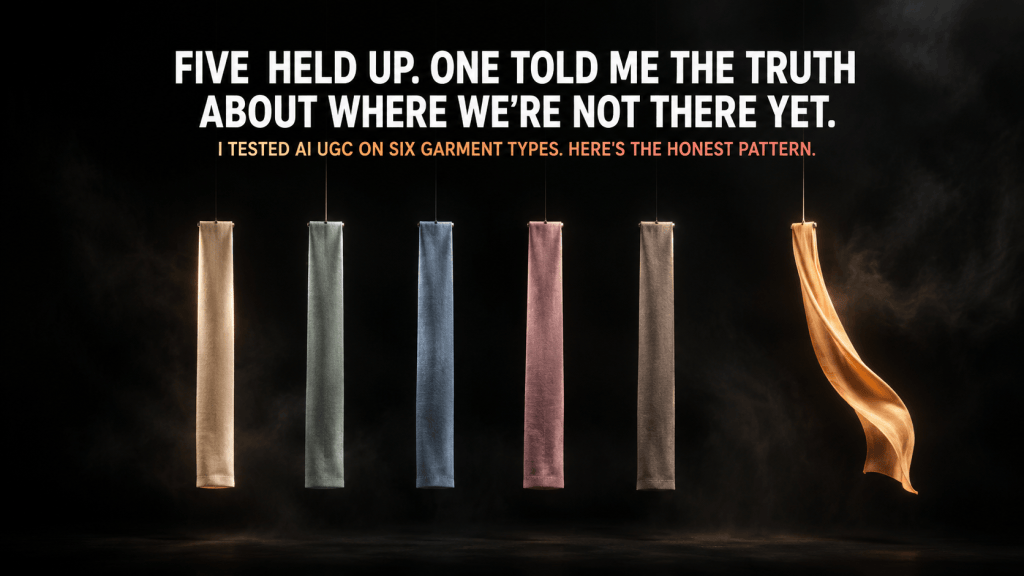
I manage a fashion account alongside a handful of other categories, and until recently I’d been treating fashion the same way I treat every other AI UGC account, generate, review quickly, publish. A closer look changed that.
I ran a real test across six garment types to see where AI UGC actually holds up for ai ugc for fashion brands and where it genuinely doesn’t yet. This piece is the honest version of that test, including the part most people don’t want to admit about this category.
Why I Ran This Test in the First Place
I’d noticed inconsistent results across my fashion content without a clear explanation. Some ads performed well. Others felt slightly off in a way I couldn’t immediately name. I decided to actually compare garment types side by side instead of continuing to guess at what was driving the gap.
The Six Garments I Tested
I picked a spread deliberately, a basic t-shirt, fitted denim, a structured jacket, a button-down shirt, a light knit sweater, and a flowy midi dress. Same basic try-on turn motion across all six, checking specifically for fabric movement, hem behavior, and pattern stability.
What Actually Held Up Well
The t-shirt, denim, and jacket rendered convincingly across the board. Minimal independent fabric movement meant fewer opportunities for anything to look off. The button-down came close behind, with only a slight stiffness in the collar area on close inspection.
Where It Started Breaking Down
The knit sweater showed some inconsistency in how the fabric settled after movement, subtle, but noticeable once I was specifically looking for it. The flowy midi dress was where things genuinely fell apart. The hem moved almost in lockstep with the rest of the fabric instead of trailing independently the way real flowy fabric does during a spin turn. It looked stiff, almost plastic, in a way that would be obvious to any customer who’s actually worn a flowy dress before.
Why I’m Being Direct About This
I could have written this piece as a generic “AI UGC works great for fashion” post. I don’t think that’s honest, and I don’t think it’s useful to anyone actually trying to decide whether to trust this format for their own catalog. Fabric physics, specifically how a garment drapes and moves independently on a real body, is a genuine, current limitation across AI video generation broadly. This isn’t specific to one tool. It’s a category-wide gap right now.
What This Means Practically
I’ve started sorting my fashion catalog by garment complexity before deciding how much to lean on AI UGC for a given product. Structured pieces get full AI UGC treatment with confidence. Flowy, complex fabrics get a closer review, and in some cases I’ve reverted to real creator content specifically for those products until rendering quality improves.
The Simple Test I Now Run on Every New Garment
Before publishing anything for a flowy or complex fabric, I generate a spin-turn test specifically. I check whether the hem moves independently from the rest of the fabric, whether the pattern stays stable without warping, and whether the overall weight looks appropriate for the material. If it fails any of these checks, that garment goes on my “needs real creator” list instead of my AI UGC list.
Why the Script Side Actually Got Easier, Not Harder
Here’s something that surprised me running this test. While the production side of fashion got harder to trust unconditionally, the script side got easier once I stopped over-engineering it. Fashion is mostly a low-consideration category. A casual, native-feeling script consistently outperformed anything more heavily structured, since fashion buyers don’t need much convincing for most purchase decisions in this category.
What I’d Tell Anyone Managing a Fashion Account Right Now
Don’t assume uniform performance across your entire catalog. Test by garment complexity, not by brand or campaign. Structured pieces are genuinely reliable right now. Flowy, complex fabrics need a closer look before you commit budget behind them, and being honest about that upfront saves you from discovering the gap after a customer notices it instead of before.
The Bottom Line
AI UGC works well for fashion, but not uniformly, and pretending otherwise does a disservice to anyone relying on this format for a catalog spanning multiple garment types. Test each garment complexity level honestly, lean into what works, and treat the genuine current limitation as a real constraint worth planning around rather than an inconvenient detail to ignore.
A Closer Look at Why Structured Garments Render So Reliably
It’s worth understanding exactly why structured pieces held up so well in my test, rather than just accepting it as an observed pattern. A t-shirt, denim, and a jacket all share something in common, minimal independent fabric movement relative to the body underneath. The fabric largely moves with the body rather than trailing, swaying, or settling independently, which means there’s simply less for any rendering system to get wrong in the first place.
This matters practically because it means a brand’s structured product lines are genuinely safe to lean on heavily for AI UGC right now, not as a cautious hedge, but as a confident, tested conclusion based on actually watching the output closely across multiple garment types side by side.
Why the Knit Sweater Result Surprised Me Specifically
I expected the knit sweater to render somewhere between the structured pieces and the flowy dress, and that’s roughly what happened, but the specific way it fell short surprised me. It wasn’t the overall movement that looked wrong. It was how the fabric settled after a motion completed, a slight unnatural smoothness in the moment right after a turn, rather than the fabric continuing to settle gradually the way real knit fabric actually does.
This is a subtler failure mode than the flowy dress’s more obvious stiffness, and I think it’s exactly the kind of detail that’s easy to miss on a first pass review. I only caught it because I was specifically watching for settling behavior after motion, not just during it, which tells me a lot of subtle rendering issues in this middle complexity tier probably go unnoticed in normal production review.
The Specific Moment Where the Dress Test Failed Most Obviously
I want to describe the flowy dress failure in more concrete detail, since “it looked stiff” undersells exactly what happened. During the spin turn, the hem of the dress moved as if it were a single rigid piece attached directly to the body’s rotation, rather than trailing slightly behind and swishing outward the way a real flowy hem does when someone spins. There was no visible lag, no independent swaying, just a uniform rotation that matched the body’s movement almost exactly.
This is the single clearest tell I’ve found for identifying AI generated fashion content, at least with current rendering capability. A real customer who’s worn a flowy dress before will notice this immediately, even if they couldn’t articulate exactly why it looks off. That gut-level recognition of “something’s not quite right” is exactly the outcome a brand wants to avoid, since it undermines trust in the ad regardless of how good the rest of the content looks.
Why I Decided to Actually Change My Workflow Rather Than Just Note the Finding
It would have been easy to write this test up as an interesting observation and continue producing AI UGC across my entire fashion catalog unchanged. I decided that was the wrong call specifically because the failure mode I found isn’t subtle to an actual customer, even if it might seem like a minor technical detail from a production standpoint.
Continuing to publish flowy fabric content without addressing this risked a slow erosion of trust across my fashion accounts, a customer noticing something felt slightly artificial about an ad, even without being able to name it precisely, and that vague unease translating into lower conversion or, worse, a specific negative comment calling it out publicly.
How I Actually Sorted My Catalog After This Test
I went through my active fashion catalog and sorted every product into one of three buckets based on what I’d learned. Structured pieces, t-shirts, denim, jackets, structured button-downs, stayed fully in my AI UGC production pipeline without any additional caution. Moderate complexity pieces, knits, lighter fabrics with some drape, moved into a “review closely before publishing” bucket, where I now specifically watch for the post-motion settling issue I described earlier. Flowy, complex fabrics moved into a separate bucket entirely, where I’m currently defaulting to real creator content until I see rendering quality improve enough to justify moving them back into the AI UGC pipeline.
This sorting took a genuine afternoon of work, going through every active product and actually testing a spin-turn render rather than assuming based on fabric type alone. I think that afternoon was worth it, given what it’s already prevented in terms of publishing content that would have undersold these specific products.
What I’m Actually Doing for the Flowy Fabric Products in the Meantime
Moving flowy fabric products to real creator content doesn’t mean abandoning AI UGC entirely for those specific items. I’ve started using AI UGC for the script and hook testing phase even on flowy products, generating multiple angle variations quickly and cheaply, then producing the actual winning angle with a real creator once I know which specific message resonates.
This gets me the testing speed advantage AI UGC provides without asking the format to solve a rendering problem it currently can’t solve convincingly. It’s a hybrid approach, and it’s worked well enough in the few weeks I’ve been running it that I don’t think I’ll fully abandon AI UGC for flowy fabric products even once rendering improves, since the testing speed advantage is valuable independent of the final production format.
Why I Think This Kind of Honest Testing Matters Beyond Just Fashion
Stepping back from fashion specifically, I think the broader lesson here applies to any category with its own genuine technical limitation. Assuming a tool works uniformly across an entire catalog, without actually testing the specific edge cases where it might not, is a mistake that eventually surfaces the hard way, usually after a customer notices something a closer internal review would have caught first.
I’d rather find these gaps myself, through a deliberate afternoon of testing, than have a customer find them for me through a public comment calling out an ad that looked slightly off. That’s really the entire argument behind running this test in the first place, and I think it’s a habit worth building into any AI UGC process, not just for fashion, and not just for the specific fabric issue I happened to find here.
What I’d Actually Recommend to Someone Starting This Same Exercise
If you’re managing a fashion account and haven’t run this kind of test yet, start with the same basic structure I used. Pick a spread of garment types across your actual catalog, not a random assortment, generate the same basic motion test across all of them, and watch closely for hem behavior, pattern stability, and post-motion settling specifically. Sort your results into confident, cautious, and needs-real-creator buckets, the same way I did, and revisit that sorting periodically as rendering technology continues to improve.
This isn’t a one-time exercise either. I plan to re-run this same test in a few months to see whether the flowy fabric gap has narrowed, since this is clearly an area of active development across the broader AI video category, not a fixed, permanent limitation. For now, though, I’d rather work within the honest boundaries of what currently renders well than oversell a capability that isn’t quite there yet for every garment type in my catalog.
A Note on How This Changed My Client Conversations Too
Beyond the internal workflow change, this test also changed how I talk to clients about fashion UGC specifically. I used to present AI UGC as a uniformly capable solution across an entire catalog, the same pitch I’d give for any other category. I don’t do that anymore for fashion clients specifically.
I now walk new fashion clients through the same three-bucket sorting I described earlier, upfront, before any production starts. This has actually improved client trust rather than undermining it, since being direct about a real limitation before it surfaces on its own reads as more credible than discovering it together after something’s already gone live and underperformed. A client who understands the honest boundaries of the format going in is far less likely to feel misled later, and far more likely to trust my judgment on which specific products to push toward AI UGC versus real creator content.
Closing Thought
Running this test took a single afternoon, and it’s changed how I approach an entire category I’d been treating too generically before. I think that’s a reasonable trade for anyone managing a fashion account at any real volume, a small, deliberate investment of time that prevents a much larger, slower erosion of trust across a catalog treated as more uniformly capable than it currently is. If you manage even one fashion account right now, the fastest way to know where your own catalog actually stands is running this same six-garment test yourself, rather than assuming your results will match mine exactly across every product you carry.


Leave a comment