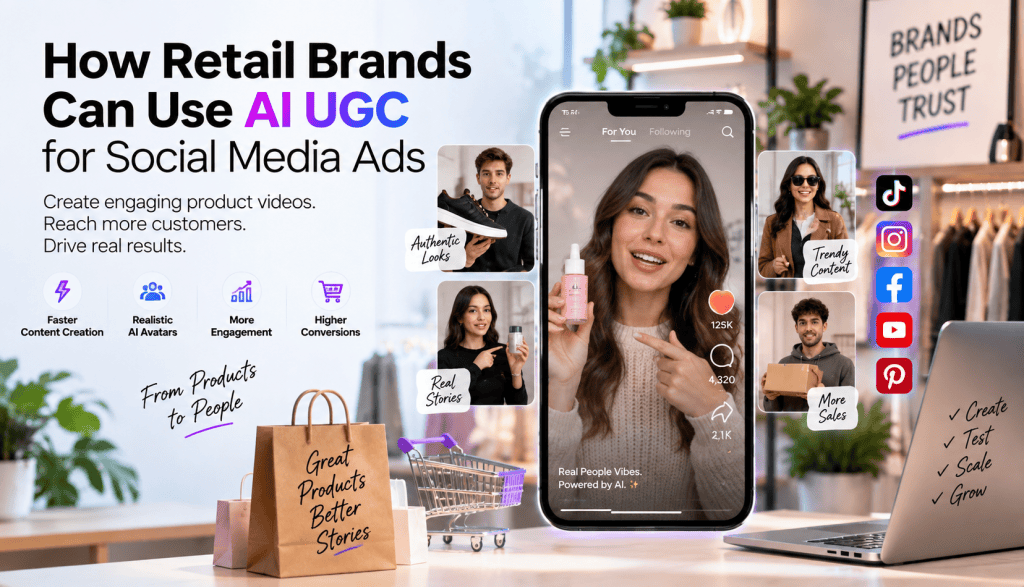
Retail brands are under constant pressure to create fresh, engaging content for social media. From Instagram Reels and TikTok videos to Facebook and YouTube ads, brands need a steady stream of creative assets to capture attention and drive conversions. Traditional video production can be expensive, time-consuming, and difficult to scale.
This is where AI UGC is changing the way retail brands create social media advertising content.
AI UGC, or AI-generated user-generated content, allows brands to create authentic-looking product videos using artificial intelligence. Instead of organizing a traditional photoshoot, hiring multiple creators, or waiting weeks for edited content, retailers can use AI-powered tools to generate videos featuring AI avatars, product demonstrations, voiceovers, scripts, and different creative concepts.
For retail businesses managing multiple products and advertising campaigns, AI UGC can make social media content production faster and more scalable. What is AI UGC?
What Is AI UGC?
AI UGC refers to user-generated-style content created or assisted by artificial intelligence. It is designed to replicate the conversational, relatable style commonly associated with traditional UGC videos.
Traditional UGC often includes customers or creators talking about a product, demonstrating how it works, sharing opinions, or explaining why they like it. AI UGC can recreate similar formats using AI-generated avatars, voices, scripts, scenes, and product visuals.
For example, a clothing retailer could create a short video featuring an AI avatar wearing or discussing a product. A beauty brand could generate a testimonial-style video explaining how a skincare product fits into a routine. An electronics retailer could create a product demonstration explaining key features.
The goal is not simply to generate another advertisement. The goal is to create social-first content that feels natural, informative, and engaging.
Why Retail Brands Are Turning to AI UGC
Retail advertising requires a high volume of creative content. A single product may need multiple videos for different audiences, platforms, hooks, and stages of the customer journey.
AI UGC can help solve several common challenges.
Faster Content Production
Traditional UGC production can involve finding creators, sending products, coordinating shoots, reviewing footage, and editing multiple versions.
AI-powered workflows can significantly reduce these production steps. Retailers can start with a product description, product URL, images, or campaign brief and turn that information into video concepts much faster.
This is particularly useful for brands launching new products or running frequent promotional campaigns.
More Creative Variations
Social media advertising depends heavily on creative testing. One hook may work well while another may receive very little engagement.
Instead of creating one video and using it repeatedly, retailers can develop multiple variations featuring different:
- Hooks
- Scripts
- AI avatars
- Voiceovers
- Product benefits
- Calls to action
- Video formats
- Visual styles
This gives marketers more creative options to test across social platforms.
Lower Production Complexity
Creating professional product videos traditionally requires cameras, lighting, actors or creators, editing software, and production teams.
AI UGC can reduce the complexity involved in producing certain types of social media content. Retail teams can create videos without organizing a physical shoot for every creative variation.
This can be especially valuable for smaller retailers and growing eCommerce brands working with limited content budgets.
How Retail Brands Can Use AI UGC for Social Media Ads
AI UGC can be applied to different stages of a retail advertising strategy. Here are some practical ways brands can use it.
1. Create Product Explainer Videos
Consumers often need to understand what a product does before purchasing it.
Retail brands can use AI UGC to create short product explainer videos that highlight important features, benefits, and use cases.
For example, a home appliance retailer could create a video explaining three features of a new air fryer. A fashion brand could showcase the material, fit, and styling options of a new jacket.
Instead of presenting product information like a traditional commercial, the content can be structured like a creator recommendation.
A simple format could be:
Hook → Problem → Product → Benefits → Call to Action
This structure works particularly well for short-form social media advertising.
2. Turn Product Pages Into Video Ads
Many retail websites already contain valuable information such as product descriptions, pricing, images, specifications, and customer-focused benefits.
AI-powered video tools can use this information as a starting point for creating video content.
For example, retailers can provide a product URL and use an AI video workflow to generate a social media video based on the available product information.
This can reduce the time required to manually write scripts and assemble product assets.
A retailer with hundreds of products could potentially use this approach to build a much larger video creative library.
3. Create UGC-Style Product Reviews
Product reviews are powerful because they help consumers understand how a product fits into real-world situations.
Retailers can use AI UGC formats to create review-style videos that explain product benefits from a conversational perspective.
For example:
“I was looking for a lightweight everyday backpack, and these are the three things I liked about this one.”
The video can then highlight practical product benefits.
Brands should ensure that AI-generated reviews do not falsely represent fabricated experiences as genuine customer testimonials. Instead, the content should be clearly positioned as branded or AI-generated promotional content where appropriate.
Authenticity should come from the format, storytelling, and usefulness of the content—not from misleading viewers.
4. Create Multiple Ad Hooks
The first few seconds of a social media video are critical.
Retail brands can use AI UGC to test multiple hooks for the same product.
For example, a skincare product could have different opening lines:
Problem-focused hook:
“Struggling with a complicated skincare routine?”
Benefit-focused hook:
“This is how you can simplify your daily skincare routine.”
Curiosity-focused hook:
“Three things I wish I knew before buying skincare products.”
The remainder of the video can remain similar while the opening changes.
This approach allows advertisers to identify which messaging resonates with their target audience.
5. Localize Ads for Different Markets
Retail brands selling internationally often need to create content for different languages and audiences.
AI video tools can help brands create localized versions of their social media advertisements using different languages, voices, scripts, and presenters.
For example, a global fashion retailer could create separate versions of an advertisement for English-speaking, Spanish-speaking, and other target markets.
Localization can go beyond translation. Brands can adjust examples, messaging, tone, and calls to action to better fit each market.
6. Showcase Different Customer Personas
Different audiences may care about different product benefits.
A fitness product, for example, could be marketed differently to:
- Beginners
- Professional athletes
- Busy professionals
- College students
- Home workout enthusiasts
AI UGC allows brands to experiment with different presenters, scripts, and messaging styles without producing an entirely new campaign from scratch.
This makes it easier to build ads around specific customer segments.
7. Repurpose Existing Product Content
Retail brands often have product photography, catalog images, blog content, product descriptions, and existing advertisements.
AI UGC can help transform these assets into new video formats.
A product image could become part of a short-form video. A blog article could inspire an educational advertisement. A product description could become a conversational script.
This creates additional value from existing marketing assets.
AI UGC Formats Retail Brands Can Test
There is no single format that works for every product or audience. Retailers should test different creative structures.
Some useful formats include:
Product Demonstrations
Show how a product works and explain its main benefits.
Before-and-After Concepts
Useful for products where a visible transformation is relevant, provided claims are accurate and supported.
Problem-Solution Videos
Start with a common customer problem and introduce the product as a solution.
List-Style Videos
For example:
“3 reasons to try this new travel bag.”
Unboxing-Style Videos
Show the packaging, product details, and key features in a creator-inspired format.
Comparison Videos
Explain differences between product options without making unsupported claims.
Educational Videos
Teach consumers something related to the product category before introducing the product.
How to Create Effective AI UGC Ads
Simply generating an AI video does not guarantee strong advertising performance. Retail brands should focus on the same fundamentals that make traditional social media content effective.
Start With a Strong Hook
The opening should quickly communicate why viewers should continue watching.
Keep the Message Simple
Avoid trying to explain every product feature in one short video. Focus on one core benefit or customer problem.
Use Natural Language
AI-generated scripts should sound conversational rather than like formal corporate advertising.
Instead of:
“Our innovative solution provides superior performance and exceptional functionality.”
Use:
“Here’s why this product has become one of my favorite options for everyday use.”
The second approach feels more natural for social media.
Show the Product Clearly
AI UGC should not distract from the product itself. Make sure viewers can understand what the product looks like and why it matters.
Include a Clear CTA
Every advertisement should have a logical next step.
Depending on the campaign, the CTA could encourage viewers to:
- Shop now
- Learn more
- Explore the collection
- Visit the product page
- Try the product
- See more styles
Using AI UGC With Social Media Platforms
AI UGC can support different social advertising channels, but the creative should be adapted to each platform.
TikTok
TikTok content generally benefits from fast hooks, vertical video, strong storytelling, and native-looking creative.
Retailers can experiment with short product demonstrations, trends, list videos, and problem-solution concepts.
Instagram Reels and Stories provide opportunities for visually engaging product content.
Retail brands can use AI UGC to create product showcases, tutorials, lifestyle videos, and promotional creatives.
Facebook advertising can support a wider variety of audiences and creative formats. Retailers can test educational videos, product demonstrations, testimonials-style formats, and promotional campaigns.
YouTube Shorts
Short-form product videos can also be adapted for YouTube Shorts, particularly when the content focuses on education, product discovery, or quick demonstrations.
AI UGC and Creative Testing
One of the biggest advantages of AI UGC for retail advertising is the ability to test creative concepts at scale.
Instead of creating one advertisement, marketers can develop multiple variations.
For example:
Product: Running shoes
Version A: Comfort-focused hook
Version B: Performance-focused hook
Version C: Style-focused hook
Version D: Problem-solution hook
Version E: Beginner-focused messaging
The brand can then analyze performance metrics such as watch time, engagement, click-through rate, conversion rate, and return on ad spend.
The objective is not to assume that one creative style will always work. Instead, AI UGC makes it easier to create and test more variations.
How Tagshop AI Can Help Retail Brands
Retail marketers looking for an AI-powered workflow can use platforms such as Tagshop AI to simplify AI video creation.
Tagshop AI can help brands create UGC-style videos using AI avatars, product content, scripts, and other creative elements. Its URL-to-video workflow can also help transform product information into video concepts, making it useful for eCommerce teams managing multiple products.
Retailers can use these capabilities to experiment with product videos, social media ads, AI UGC content, and different creative variations without relying entirely on traditional video production.
The key advantage is the ability to combine product information with AI-powered creative production in a faster workflow.
Best Practices for Retail Brands Using AI UGC
Retailers should follow a few important principles when implementing AI UGC.
First, prioritize authenticity over complexity. A simple and useful video can outperform a highly produced creative if the message connects with the audience.
Second, create multiple variations instead of relying on one video. Different audiences respond to different hooks and benefits.
Third, keep product claims accurate. AI should be used to improve content production, not to create misleading promises or fake customer experiences.
Finally, measure actual advertising performance. Views and likes are useful indicators, but retailers should also monitor clicks, conversions, cost per acquisition, and revenue.
The Future of AI UGC for Retail Advertising
AI UGC is becoming an important part of the modern retail content workflow. As AI video technology improves, brands will have more ways to generate product demonstrations, social ads, localized campaigns, creative variations, and personalized marketing content.
The biggest opportunity for retail brands is not simply producing videos faster. It is creating a system where marketers can continuously generate, test, learn, and improve creative content.
For retailers with large product catalogs, this can make AI UGC particularly valuable. Instead of treating video creation as a one-time production task, brands can turn it into an ongoing creative process.
Conclusion
Social media advertising requires retail brands to constantly produce fresh and engaging content. Traditional UGC remains valuable, but producing it at scale can be challenging.
AI UGC provides retailers with a faster and more flexible way to create social media ads, from product demonstrations and review-style videos to localized campaigns and multiple creative variations.
When combined with strong hooks, clear messaging, accurate product information, and continuous creative testing, AI UGC can become a valuable part of a retail brand’s social media advertising strategy.
The brands that use AI effectively will not simply create more content. They will have more opportunities to test ideas, understand what resonates with their audiences, and build a scalable creative workflow for social media advertising.


Leave a comment