AI is changing the way people work, create content, communicate, and build their personal brands. One of the most interesting developments in this space is the AI twin—a digital version of yourself that can look, sound, and communicate like you.
Unlike a simple AI avatar, an AI twin can be designed to represent your appearance, voice, communication style, knowledge, and personality. Depending on the technology you use, your digital twin can help create videos, answer questions, deliver presentations, produce marketing content, and even support repetitive tasks.
But what exactly is an AI twin? How does it work? And more importantly, how can you create your own AI twin?
This guide explains everything you need to know, from the basics of AI twins to the tools, preparation, creation process, use cases, limitations, and best practices.
What Is an AI Twin?
An AI twin is an AI-powered digital representation of a real person. It combines technologies such as generative AI, voice cloning, avatar generation, natural language processing, and sometimes personalized knowledge bases to create a digital version of an individual.
Think of it as a virtual version of yourself that can perform certain tasks without requiring you to be physically present.
For example, instead of recording a new video every time you want to explain a product update, you could provide a script to your AI twin. The system generates a video featuring your digital appearance and voice.
An AI twin can potentially replicate several aspects of a person:
- Appearance: A digital avatar that resembles you
- Voice: An AI-generated version of your voice
- Speech: Your pronunciation, tone, and speaking patterns
- Communication style: The way you normally explain or present ideas
- Knowledge: Information you provide to the AI system
- Personality: Specific characteristics you want the digital version to represent
The exact capabilities depend on the AI twin generator or platform you use.
AI Twin vs. AI Avatar: What’s the Difference?
The terms AI twin and AI avatar are sometimes used interchangeably, but they don’t necessarily mean the same thing.
An AI avatar is usually a digital character or virtual presenter. It may look realistic, but it doesn’t always represent a specific real person.
An AI twin is more personalized.
For example:
AI Avatar:
A generic digital presenter explaining your company’s product.
AI Twin:
A digital version of you using your appearance, voice, presentation style, and potentially your personalized knowledge.
In simple terms, an AI avatar can be a virtual person, while an AI twin is designed to be a digital representation of you.
How Does an AI Twin Work?
Creating an AI twin requires multiple AI technologies working together.
1. Digital Appearance
First, the system needs to create a digital representation of your appearance. Depending on the platform, this may involve uploading photographs or recording video footage.
Advanced systems can generate a realistic talking avatar based on your facial characteristics and movements.
2. Voice Cloning
The next component is your voice.
Some AI platforms can analyze voice recordings and create a synthetic voice that resembles the original speaker. Once created, the voice can read new scripts without requiring you to record every sentence manually.
The quality depends heavily on the recording quality, training data, and technology used by the platform.
3. AI Speech Generation
After your voice is created, text-to-speech technology can generate spoken audio.
You provide a script, and the AI converts the text into speech using your digital voice.
4. Facial Animation
The generated voice is synchronized with your digital avatar.
AI models can create lip movements, facial expressions, head movements, and other visual elements so the avatar appears to be speaking naturally.
5. Personalized Intelligence
Some AI twins go beyond video generation.
You can connect an AI system to information such as:
- Your professional experience
- Frequently asked questions
- Product documentation
- Articles you’ve written
- Brand guidelines
- Personal communication preferences
- Company information
This allows the AI twin to produce responses that are more aligned with your knowledge and communication style.
How to Create Your Own AI Twin
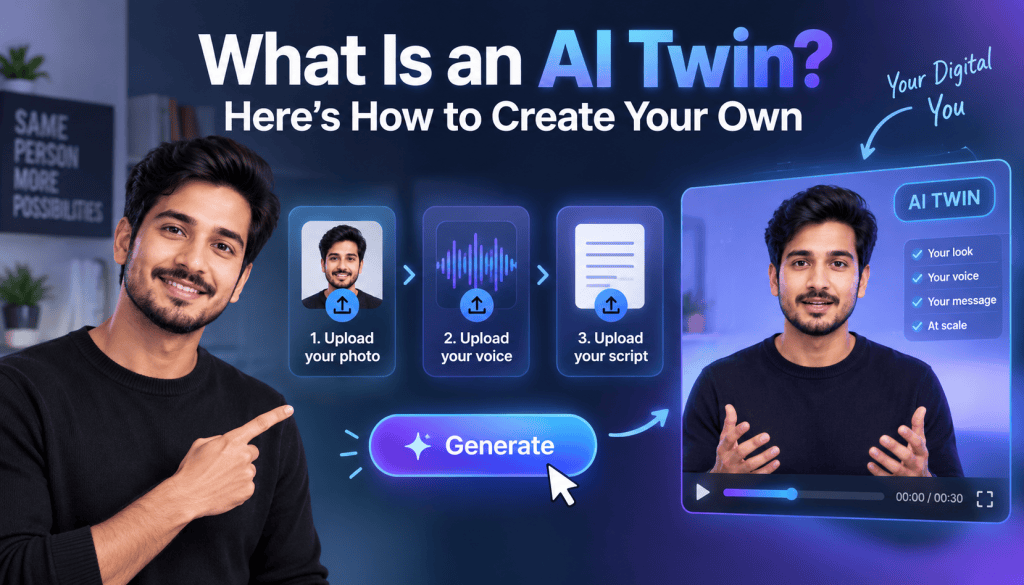
Creating an AI twin can be as simple as three basic steps:
Step 1: Upload Your Photo and Voice
Start by uploading a clear photo of yourself and a voice recording. Your photo is used to create your digital appearance, while your voice sample helps the AI generate speech that sounds like you.
For the best results, use a high-quality photo with good lighting and a clear voice recording without background noise.
Step 2: Upload Your Script
Next, enter or upload the script you want your AI twin to say. This could be a social media post, product explanation, educational lesson, marketing message, or any other type of video content.
You don’t need to record yourself saying the script. The AI uses your uploaded voice and digital appearance to deliver it for you.
Step 3: Hit Generate
Once your photo, voice, and script are ready, simply click the Generate button.
The AI processes your inputs and creates a video featuring your digital twin speaking your script. Depending on the platform, you may also be able to customize elements such as the background, voice style, language, or presentation.
In short: Upload your photo → Upload your voice → Add your script → Hit Generate → Get your AI twin video.
What Can You Use an AI Twin For?
The biggest advantage of an AI twin is scalability.
Once your digital representation is created, you can potentially produce significantly more content without appearing in front of a camera for every recording.
1. Social Media Videos
Creators can use AI twins to produce short-form videos for platforms such as LinkedIn, Instagram, TikTok, and YouTube.
Instead of recording yourself repeatedly, you can prepare scripts and generate videos using your digital presenter.
2. Marketing Content
Businesses can create:
- Product announcements
- Promotional videos
- Explainer videos
- Advertisements
- Product tutorials
- Customer education content
This can make video production faster, particularly for teams that need to create content regularly.
3. Online Courses
Educators and experts can use an AI twin to present lessons.
For example, an instructor could prepare dozens of lessons while maintaining a consistent digital presenter throughout the course.
4. Corporate Training
Companies can create employee training materials featuring a consistent AI presenter.
This can be useful for:
- Employee onboarding
- Compliance training
- Software tutorials
- Internal announcements
- Process documentation
5. Multilingual Content
Some AI video platforms can generate speech in multiple languages.
This means one AI twin could potentially be used to create localized versions of the same content.
For global businesses, this can reduce the need to record every language manually.
6. Personal Branding
An AI twin can also support personal branding.
Entrepreneurs, consultants, marketers, and creators can use a digital version of themselves to maintain a consistent presence across different channels.
Benefits of Creating an AI Twin
There are several reasons people are experimenting with AI twins.
Saves Time
Recording, editing, and re-recording videos takes time.
An AI twin can reduce the amount of manual recording required.
Improves Content Scalability
Once your digital presenter is ready, producing additional videos can become much faster.
Consistent Presentation
Your appearance, voice, and presentation style can remain consistent across different videos.
Easier Content Localization
Multilingual AI capabilities can make it easier to create versions of content for international audiences.
Reduces Production Requirements
You may not need a camera setup, studio, lighting, or recording session every time you create a video.
Makes Expert Knowledge More Accessible
A personalized AI system can potentially help transform your existing knowledge into scalable educational or informational content.
What Are the Limitations of AI Twins?
AI twins are impressive, but they’re not perfect.
They Can Still Look Artificial
Even advanced AI avatars may occasionally produce unnatural expressions, movements, or eye contact.
Voice Cloning Isn’t Perfect
Pronunciation, emotion, emphasis, and pacing can sometimes differ from the real person’s voice.
AI Can Make Mistakes
If your AI twin uses generative AI to create scripts or answer questions, it can produce inaccurate information.
Human review is still important.
Privacy Is a Major Consideration
Your face and voice are valuable biometric-like identifiers.
Before uploading them to an AI platform, understand:
- How your data is stored
- How long it is retained
- Whether it can be used for model training
- Who can access it
- Whether you can delete your data
- What happens if you cancel your account
Read the platform’s privacy policy and terms carefully.
Consent Matters
Never create an AI twin of another person without their explicit permission.
Using someone’s face or voice without authorization can create serious ethical and legal problems.
How to Make Your AI Twin More Realistic
If your goal is to create a convincing digital version of yourself, focus on quality.
Use High-Quality Source Material
Good lighting, clear video, and clean audio can make a significant difference.
Write Natural Scripts
Don’t make every sentence overly formal.
Write the way you actually speak.
Include Conversational Pacing
Short pauses, varied sentence lengths, and natural transitions can make generated speech feel less robotic.
Keep Your Branding Consistent
Use consistent:
- Colors
- Backgrounds
- Clothing styles
- Fonts
- Logos
- Messaging
This helps your AI twin feel like part of your broader brand.
Review Every Video
Don’t publish AI-generated content without reviewing it.
A realistic avatar can make incorrect information appear authoritative, so accuracy matters.
Is an AI Twin Worth Creating?
For people who regularly create video content, an AI twin can be a powerful productivity tool.
If you publish one video every few months, creating an AI twin may not provide much value.
But if you’re a creator, marketer, educator, entrepreneur, or business professional producing videos every week, the time savings can become significant.
The biggest value isn’t simply having a digital copy of yourself.
It’s being able to scale your presence.
Instead of spending hours recording the same type of content repeatedly, you can create a reusable digital presenter and focus more of your time on strategy, ideas, and creativity.
AI Twin Best Practices
Before creating your own AI twin, keep these best practices in mind:
- Start with a clear purpose.
- Choose an AI twin generator based on your actual needs.
- Use high-quality video and audio for training.
- Only clone your own face and voice or obtain explicit permission.
- Review privacy and data policies carefully.
- Create clear communication guidelines.
- Keep your AI twin’s information updated.
- Fact-check AI-generated scripts.
- Tell audiences when disclosure is appropriate or required.
- Keep a human involved in important communications.
The Future of AI Twins
AI twins are likely to become more sophisticated as generative AI, speech synthesis, computer vision, and conversational AI continue improving.
Today’s AI twin might primarily create videos from scripts. Future systems could become much more interactive.
Imagine having a digital version of yourself that can:
- Attend virtual meetings
- Answer routine questions
- Teach courses
- Create personalized videos
- Communicate in multiple languages
- Represent your brand
- Search your knowledge base
- Respond to customers
- Generate content on demand
The technology is moving toward a world where digital representations of people can perform increasingly complex tasks.
However, the most important factor will remain trust.
People need to know when they’re interacting with an AI representation, what information it can access, and who is responsible for what it says.
Final Thoughts
An AI twin is more than a digital avatar. It combines AI-generated appearance, voice, speech, and potentially personalized knowledge to create a digital representation of a real person.
Creating one doesn’t have to be complicated.
Start by defining what you want your AI twin to accomplish. Choose an AI twin generator that matches those requirements, prepare high-quality video and audio, create your avatar and voice, add relevant knowledge, establish your communication style, and test the results before publishing.
For creators and businesses, the biggest advantage is scalability. An AI twin can help transform one person’s time and expertise into a larger volume of content without requiring them to be on camera every time.
The technology still has limitations, particularly around realism, accuracy, privacy, and consent. But when used responsibly, an AI twin can become a powerful tool for video creation, personal branding, education, marketing, and digital communication.
The question is no longer whether you can create a digital version of yourself. With today’s AI tools, the real question is what will you do with it?


Leave a comment