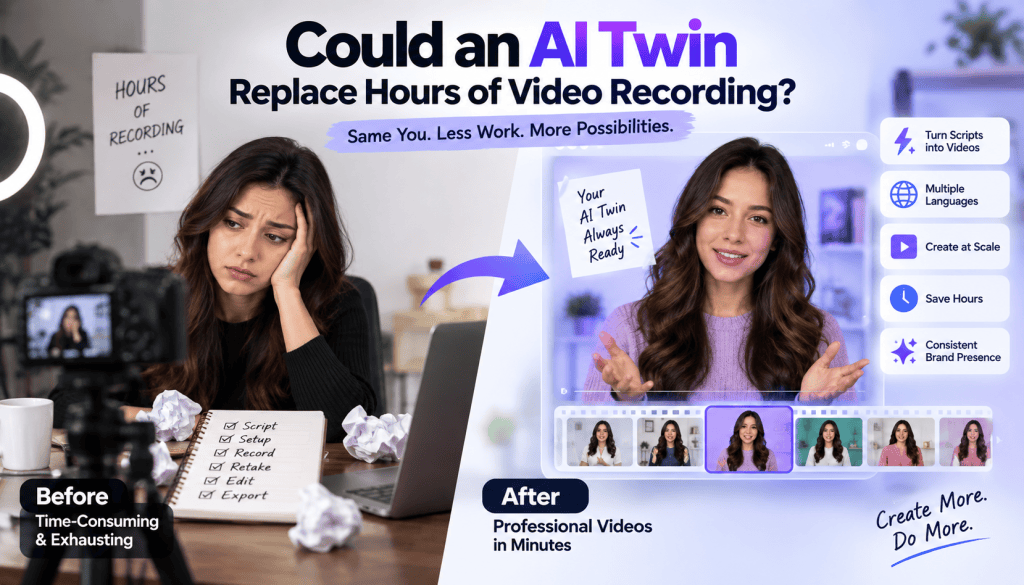
Creating video content sounds simple until you actually have to do it.
You need to prepare a script, set up your camera, adjust lighting, get the right background, record multiple takes, fix mistakes, edit the footage, add captions, and finally export the video.
Now imagine doing that several times every week.
For creators, marketers, educators, sales teams, and business owners, video recording can quickly consume hours that could be spent on more important work.
That’s where an AI twin generator comes in.
An AI twin can create a digital version of you that can deliver scripts, explain products, present educational content, or communicate messages without requiring you to physically record every video.
But can an AI twin actually replace hours of video recording?
In many cases, yes—but it doesn’t completely replace the human behind the content.
Instead, an AI twin can turn you from the person who has to record every video into the person who creates the ideas, scripts, and strategy behind those videos.
Let’s explore how it works, where it saves time, and when recording yourself is still the better choice.
What Is an AI Twin?
An AI twin is a digital representation of a person that can be used to create content that looks and sounds like that person.
Depending on the technology, an AI twin may replicate elements such as:
- Your appearance
- Your voice
- Your speaking style
- Your facial expressions
- Your delivery
- Your preferred language
- Your presentation style
Once an AI twin has been created, you can provide a script and generate a video without physically appearing in front of a camera for every recording.
For example, instead of recording:
“Here are five ways to improve your marketing strategy.”
you could provide that script to your AI twin and generate a video of your digital version delivering the message.
This changes the traditional video production process.
Traditional workflow:
Idea → Script → Camera setup → Recording → Retakes → Editing → Export
AI twin workflow:
Idea → Script → AI twin → Video
The difference can be substantial when you’re producing content regularly.
Why Video Recording Takes So Much Time
The actual act of speaking for a 60-second video might only take a minute.
The problem is everything around it.
Before recording, you may need to:
- Write the script
- Memorize talking points
- Set up your camera
- Position lighting
- Choose a background
- Check your microphone
- Fix your appearance
- Prepare the product
- Record multiple takes
Then comes post-production.
You may need to:
- Remove mistakes
- Cut pauses
- Add captions
- Add B-roll
- Insert images
- Add music
- Resize the video
- Create thumbnails
- Export different versions
A one-minute finished video can therefore require much more than one minute of work.
This is particularly frustrating when you’re creating educational videos, social media posts, product updates, internal training, or marketing content that doesn’t necessarily require you to physically appear on camera.
An AI twin addresses exactly this problem.
How an AI Twin Can Save Hours
The biggest advantage of an AI twin is repeatability.
You don’t have to recreate the filming environment every time.
Once your digital representation is ready, you can use it repeatedly.
1. No repeated camera setup
You don’t need to set up your lighting and camera every time you want to publish something.
2. Fewer retakes
If you make a mistake in the script, you can usually modify the text rather than recording the entire video again.
3. Faster content production
You can generate multiple videos from different scripts without physically recording each one.
4. Easier content localization
Some AI video platforms can create versions of content in different languages or with different voice outputs.
5. Consistent appearance
Your AI twin can maintain a consistent visual identity across videos.
6. Easier experimentation
You can test different hooks, scripts, CTAs, and video concepts without filming each variation yourself.
That’s where the technology becomes particularly useful for marketers.
AI Twins Could Change How Marketers Create Video
Marketing teams constantly need new creative.
A single campaign might require:
- Instagram Reels
- TikTok videos
- YouTube Shorts
- Product explainers
- Landing-page videos
- Email videos
- Ad variations
- Tutorials
- Customer education
Traditionally, every variation requires production time.
An AI twin generator can help marketers create multiple versions from the same basic concept.
Imagine a marketer has one product and wants to test five hooks.
Instead of recording five videos, they could create five scripts:
Hook 1:
“Here’s the mistake most people make when choosing this product.”
Hook 2:
“I tested this for 30 days, and here’s what happened.”
Hook 3:
“Three things I wish I knew before buying this.”
Hook 4:
“Is this product actually worth it?”
Hook 5:
“Here’s why everyone is talking about this.”
The same AI twin can deliver all five.
That means the team can spend more time analyzing performance and less time recording repetitive variations.
AI Twins Are Especially Useful for Short-Form Content
Short-form video creates an unusual challenge.
The videos are short, but brands often need a lot of them.
A creator may need to publish several videos each week.
A brand may need dozens of advertising variations.
A SaaS company might need frequent product education videos.
A traditional recording workflow doesn’t scale easily.
AI twins can help because the production process becomes closer to text-to-video creation.
You can write the message once and use the AI twin to turn it into a presenter-led video.
This makes the technology particularly useful for:
- TikTok content
- Instagram Reels
- YouTube Shorts
- LinkedIn videos
- Product announcements
- Educational clips
- Marketing campaigns
- Internal communications
AI Twin vs. Traditional Video Recording
So, which approach is better?
The answer depends on the type of content you’re creating.
| Feature | Traditional Recording | AI Twin |
| Camera required | Yes | No |
| Physical recording | Yes | Usually no |
| Retakes | Often required | Mostly script-based |
| Production speed | Slower | Faster |
| Consistency | Depends on recording | High |
| Personal presence | Very high | Digital representation |
| Content volume | Limited by time | Easier to scale |
| Spontaneous content | Excellent | Less natural |
| High-emotion videos | Strong | Can vary |
| Educational content | Excellent | Excellent |
| Repetitive updates | Time-consuming | Very efficient |
The biggest advantage of traditional recording is authenticity.
The biggest advantage of an AI twin is scalability.
That’s why the best strategy isn’t necessarily to choose one over the other.
When You Should Still Record Yourself
AI twins are powerful, but there are situations where the real you is still better.
Personal announcements
If you’re sharing something deeply personal, audiences may prefer seeing the real person.
Emotional content
Human emotion can be difficult to reproduce perfectly.
Behind-the-scenes videos
Audiences often enjoy seeing genuine, spontaneous moments.
Live content
Live streams, interviews, and real-time conversations naturally benefit from a real person.
Major brand moments
For important announcements, having the founder or spokesperson appear personally can create stronger trust.
The key is to identify where your physical presence adds value.
If your presence isn’t essential to the message, an AI twin can handle the repetitive work.
The Best Approach: Hybrid Video Creation
Instead of asking:
“Should I use an AI twin or record myself?”
A better question is:
“Which videos actually need me?”
You could record yourself for your most important content and use your AI twin for everything else.
For example:
Record yourself
- Major announcements
- Personal stories
- Interviews
- Customer conversations
- Important launches
Use your AI twin
- Tutorials
- Product explainers
- FAQs
- Social media variations
- Educational clips
- Internal training
- Routine updates
This hybrid strategy can significantly reduce the amount of time spent in front of a camera while preserving authentic human content where it matters most.
AI Twins Can Make Content Localization Easier
Another major advantage is localization.
Imagine creating a product video for an international audience.
Traditionally, you might need to:
- Translate the script.
- Hire another presenter.
- Record the new version.
- Edit it.
- Add captions.
- Repeat the process for another language.
AI video technology can make parts of this workflow much faster.
Depending on the platform, your AI twin may be able to deliver localized versions of the same message.
That means one piece of content can potentially become multiple language versions without requiring a separate filming session for each market.
For global brands, this can be a major productivity advantage.
What About Authenticity?
This is probably the biggest question surrounding AI twins.
If people know that a video is AI-generated, will they trust it?
The answer depends heavily on how the technology is used.
AI-generated video shouldn’t be used to deceive viewers.
Brands should consider transparency, consent, and responsible disclosure, particularly when the AI twin is presented as a real person.
The goal should be:
Use AI to reduce production work—not to mislead the audience.
An AI twin should represent the person who authorized it and should be used consistently with that person’s identity and brand.
When used responsibly, the technology can function as another content-production tool.
How to Get Started With an AI Twin Generator
If you’re considering creating an AI twin, start with your content requirements.
Step 1: Identify repetitive videos
Look for content you create repeatedly.
Examples include:
- Weekly updates
- Tutorials
- FAQs
- Product explanations
- Educational videos
Step 2: Create a strong script library
Your AI twin is only as useful as the content you give it.
Create reusable scripts and frameworks.
Step 3: Choose your visual identity
Decide how you want your AI twin to appear.
Think about:
- Clothing
- Background
- Camera framing
- Branding
- Presentation style
Step 4: Create the AI twin
Use an AI twin generator that supports your desired appearance and voice capabilities.
Step 5: Generate test videos
Start with a few short videos.
Check:
- Lip synchronization
- Voice quality
- Facial movement
- Naturalness
- Pronunciation
- Brand consistency
Step 6: Compare with your real videos
Don’t assume AI is automatically better.
Compare production time and audience performance.
If the AI version delivers the same message effectively while saving significant production time, you’ve found a strong use case.
Can an AI Twin Really Replace Hours of Recording?
Yes—but it depends on the content.
If you currently spend hours recording repetitive videos, an AI twin can potentially eliminate much of that work.
The biggest savings come from removing:
- Camera setup
- Repeated takes
- Physical presence
- Basic recording logistics
- Some editing work
- Re-recording after script changes
But an AI twin doesn’t eliminate the need for creativity.
Someone still needs to:
- Develop ideas
- Understand the audience
- Write good scripts
- Create compelling hooks
- Review the output
- Analyze performance
- Decide what to publish
In other words, AI can reduce production effort, but it doesn’t eliminate content strategy.
Final Thoughts
An AI twin won’t make traditional video recording obsolete.
And it shouldn’t.
Real human videos remain valuable because they capture genuine emotion, spontaneity, personality, and connection.
But an AI twin generator can change the economics of video production.
Instead of spending hours recording every tutorial, update, advertisement, or educational clip, you can create a digital version of yourself that handles much of the repetitive presentation work.
That means you can spend less time worrying about cameras and retakes and more time thinking about what you actually want to say.
For creators and marketers producing video at scale, that’s the real opportunity.
Your AI twin doesn’t have to replace you. It can simply give you your time back.


Leave a Reply