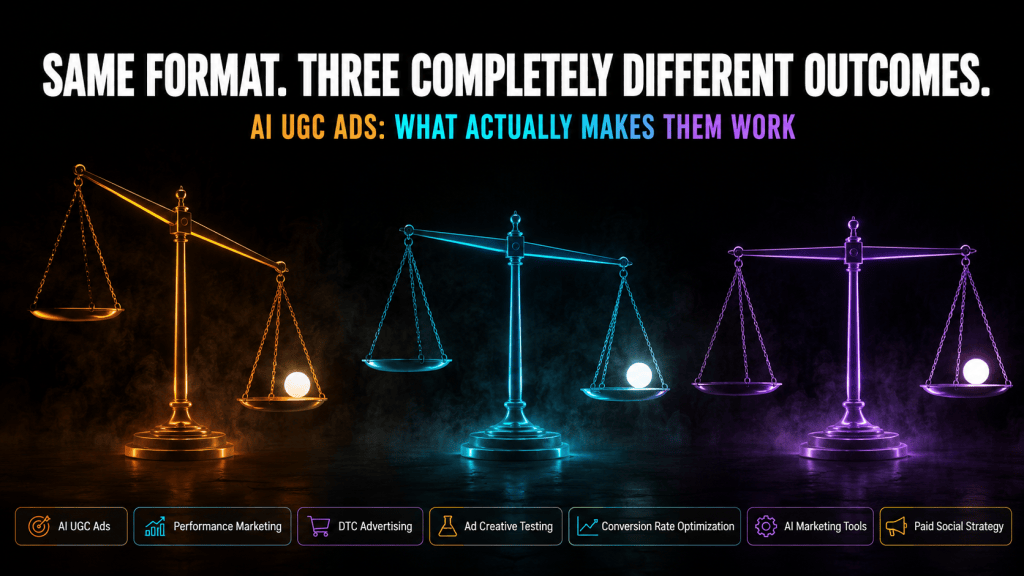
AI UGC ads have gone from a niche experiment to a standard line item in most performance marketing budgets over the past two years, but the actual mechanics behind why some of these ads convert and others quietly underperform remain poorly understood by a lot of the brands running them. This piece walks through the real drivers of performance, using data pulled from testing across multiple product categories, rather than the surface level “AI ads are cheaper and faster” pitch most coverage of this format stops at. If you want to build category aware ai ugc ads yourself, this workflow breaks down exactly how the reasoning behind angle selection actually works.
What AI UGC Ads Actually Are, Beyond the Marketing Pitch
Strip away the marketing language and AI UGC ads are a specific production method applied to an already proven ad format. UGC style ads, testimonial delivery, unboxing reveals, before and after framing, problem solution structure, have outperformed traditional studio commercials on paid social for years, largely because viewers process them as a peer’s genuine recommendation rather than a brand’s sales pitch. AI UGC ads replicate this exact format using a generated avatar and an AI written script instead of a real creator, which is what makes the cost and speed advantage possible in the first place.
This distinction matters because it clarifies what’s actually being tested when a brand runs an AI UGC ad. It isn’t testing whether AI generated video in general performs well. It’s testing whether a specific script, delivered by a specific avatar, in a specific format, reproduces the persuasive mechanics that made the underlying UGC format work before AI entered the picture at all. Missing this distinction is the root cause of most disappointing AI UGC ad results, since a poorly matched script delivered by a technically competent avatar still fails for the same reason a poorly matched script delivered by a real human creator would fail.
The Data Behind Why Some AI UGC Ads Convert and Others Don’t
Running structurally similar AI UGC ads across different product categories surfaces a consistent pattern worth understanding before building a testing program around this format. Trust dependent categories, supplements, personal finance products, health related items, carry real inherited audience skepticism built up over years of overpromising marketing in exactly those spaces. An AI UGC ad in this category that doesn’t directly acknowledge and resolve that skepticism tends to underperform regardless of how polished the avatar or how fluent the script reads on paper.
Visible result categories behave completely differently. Skincare, beauty, and fitness products carry a built in advantage that trust dependent categories don’t have access to, the product’s own demonstrated outcome does real persuasive work independent of who’s delivering the pitch. AI UGC ads in this category that lean into a clear before and after or a visible demonstration tend to close the performance gap with real creator content far more than ads relying purely on a spoken testimonial claim.
Low consideration categories, fashion accessories, small home goods, tolerate the lightest script structure of the three. The purchase risk is low enough that a casual, native feeling ad performs comparably to a heavily engineered one, sometimes better, since an over structured pitch for a low stakes purchase can actually read as trying too hard relative to what the decision actually requires.
Why Category Fit Matters More Than Avatar Realism
A common assumption in this space treats avatar realism as the primary lever determining whether an AI UGC ad performs well. The data doesn’t fully support this. A highly realistic avatar delivering a script that’s mismatched to its product category still underperforms a slightly less polished avatar delivering a script that correctly reasons through that category’s specific persuasion problem. This finding runs counter to a lot of the current marketing around AI UGC tools, which tends to emphasize avatar quality and rendering fidelity as the headline feature, while treating script quality as a secondary concern handled through a generic prompt.
The practical implication is straightforward. Before evaluating any AI UGC ad tool primarily on avatar realism, it’s worth checking whether the underlying script generation actually reasons through category and audience context, or whether it applies one generic structure regardless of what’s being sold. The second approach produces technically fluent scripts that read fine in isolation and convert inconsistently once real ad spend is behind them.
The Cost Structure That Actually Changes the Decision
The economic argument for AI UGC ads is real but frequently oversimplified. AI generated UGC typically costs 0.40 to 2.50 dollars per rendered video, against 150 to 500 dollars for a comparable real creator production. That’s roughly a 100x to 1000x cost difference depending on the specific comparison point, a gap large enough that it changes the entire calculus around testing volume rather than just reducing cost at a fixed volume.
Here’s the part that gets missed in most surface level coverage of this cost comparison. Even in categories where real creator UGC holds a genuine, measurable conversion advantage, trust dependent categories specifically, the cost gap is frequently large enough that AI UGC still wins on cost per conversion once the full math gets run. A meaningful conversion rate disadvantage on the AI side rarely approaches the same order of magnitude as the underlying cost gap, which means the format that costs less per video often still produces a lower cost per actual sale, even when it converts at a somewhat lower rate.
This reframes the practical decision most brands should actually be making. It isn’t a binary choice between AI UGC ads and real creator UGC. It’s a sequencing decision, using AI UGC’s cost advantage to test a wide range of angles cheaply and quickly, then committing the more expensive real creator production specifically to whichever angle has already demonstrated it converts, rather than committing to expensive production speculatively before any real signal exists.
The Fatigue Curve Most Testing Calendars Ignore
AI UGC ads and traditional creator content decay on genuinely different timelines once they’re actually running, and this difference has real implications for how a rotation schedule should be structured. AI generated UGC typically shows measurable performance decline within 7 to 12 days of a strong launch, noticeably faster than the 3 to 4 week window traditional creator content and studio ads generally follow before showing comparable decline.
The mechanism behind this gap is specific to AI generation. A reused AI avatar’s face and delivery pattern gets recognized by a viewer’s pattern matching system faster than a real creator’s naturally varying delivery does, since human creators carry small, unscripted inconsistencies between takes that a repeated AI avatar simply doesn’t replicate. A rotation calendar built around the slower decay curve that real creator content follows will quietly under rotate AI UGC content by two to three weeks, continuing to spend behind creative that’s already past its effective lifespan purely because the schedule was built for the wrong format’s timeline.
What a Genuinely Well Structured AI UGC Ad Actually Contains
Beyond the spoken line, a functional AI UGC ad script needs at minimum three additional components most casual approaches to this format skip entirely. A clear visual direction describing what should actually be happening on screen while the line is delivered, rather than a static shot with no supporting action. On screen text reinforcing the core message, since a meaningful share of social video gets watched with sound off, particularly in the first few seconds before a viewer decides whether to engage. A specific physical action for the avatar to perform, since a spoken claim paired with genuine physical engagement, picking up a product, pointing to a specific detail, tends to read as more credible than the identical line delivered with no supporting movement at all.
Treating script generation as purely a text task, producing only a spoken line and leaving visual direction, on screen text, and physical action entirely to chance, misses an entire dimension of what actually makes an ad function once it’s performed on camera rather than read silently off a page.
The Disclosure Requirement Most Brands Underestimate
AI UGC ads carry a compliance dimension that traditional creator content doesn’t face in the same way. The FTC’s rule on consumer testimonials, in effect since October 2024, sets civil penalties up to 51,744 dollars per violation specifically for AI generated testimonials presented as genuine consumer experiences without adequate disclosure. The EU AI Act’s Article 50 adds a separate transparency requirement specifically for AI generated and synthetic content. Traditional creator UGC still falls under standard influencer and testimonial disclosure rules, but doesn’t carry this additional AI specific transparency layer both frameworks apply exclusively to synthetic content.
Building a standard disclosure approach into the ad production process from the start, rather than deciding case by case as each ad ships, keeps compliance consistent as testing volume scales, and avoids the scenario where a brand discovers its disclosure practices have been inconsistent only after regulatory attention or platform enforcement forces the issue.
How to Actually Evaluate Whether an AI UGC Ad Approach Is Working
Most brands measuring AI UGC ad performance default to tracking total ads produced and basic engagement metrics, numbers that reliably measure output volume without measuring whether that output is actually testing anything genuinely new. A more useful measurement approach tracks four numbers together: thumbstop rate for initial hook strength, conversion rate for actual persuasive effectiveness within category context, cost per conversion for true efficiency once the full cost structure is counted, and the count of genuinely distinct structural angles being tested per cycle, not just total render volume dressed up as testing activity.
That last metric catches a specific failure mode worth watching for directly. A testing calendar can look highly active by render count while actually testing the same one or two underlying arguments repeatedly with cosmetic variation, different avatars, slightly different phrasing, wrapped around an identical persuasive structure. Reducing each ad to its core underlying argument and counting genuinely distinct arguments against total ads produced catches this pattern before it quietly narrows a testing program’s real learning velocity without anyone explicitly deciding that should happen.
Building a Practical Testing Cadence Around This Format
A reasonable operating cadence for a brand running AI UGC ads at real volume tests four to six structurally distinct angles per hero product on a rolling basis, rather than producing a large volume of surface variants around one or two already validated ideas. This target should be set before generation begins for a given cycle, not evaluated after the fact, since it’s trivially easy to satisfy a render count goal through surface variation alone if a genuine structural target isn’t locked in first.
Rotation cadence should be split by content type rather than applying one shared schedule across everything, given the fatigue curve difference described earlier. AI UGC content specifically should be reviewed for refresh within 7 to 12 days of launch, while any real creator content mixed into the same campaign can run on the longer 3 to 4 week cycle traditional content generally tolerates.
The Honest Limitations of This Format Worth Acknowledging
It’s worth closing with a direct acknowledgment of where AI UGC ads genuinely fall short rather than presenting this format as a universal replacement for real creator content. In deeply trust dependent categories with sophisticated, skeptical audiences, a real creator’s established credibility and track record can still provide persuasive value an AI avatar simply cannot replicate regardless of how well the underlying script reasons through category context. Categories requiring genuine product demonstration under conditions that are difficult to simulate convincingly, certain physical durability claims, specific sensory experiences, may also favor real creator content where an AI generated demonstration would read as less credible to a skeptical audience.
The practical conclusion most data actually supports isn’t choosing one format exclusively over the other. It’s using AI UGC ads for what the cost and speed advantage makes them genuinely good at, wide, fast, structurally diverse angle testing, while reserving real creator production specifically for the angles and categories where that investment demonstrably earns back its added cost through a real, measurable conversion advantage. Brands treating this as a binary either or decision are generally leaving real performance on the table in one direction or the other, either overpaying for real creator content in categories where AI UGC would have converted close enough at a fraction of the cost, or underinvesting in real creator content specifically in the trust dependent categories where its conversion advantage genuinely justifies the additional spend.
A Worked Example That Makes the Cost Math Concrete
It helps to walk through actual numbers rather than staying entirely abstract about the cost per conversion argument made earlier. Picture a trust dependent supplement brand testing a new product angle. A real creator UGC video for this angle might run 300 dollars and convert at, hypothetically, 3.2 percent based on the brand’s historical data for similar creative in this category. An AI UGC ad testing the identical underlying angle might convert somewhat lower, say 2.6 percent, reflecting the real conversion penalty AI UGC tends to face specifically in trust dependent categories, but costs roughly 1.50 dollars to produce.
Running the actual cost per conversion math: the real creator video costs 300 dollars to produce a piece of content converting at 3.2 percent, while the AI UGC version costs 1.50 dollars to produce content converting at 2.6 percent. Even with a real, measurable conversion disadvantage, the AI version’s cost per conversion comes out dramatically lower once the full spend behind each format gets factored in, since the 200x cost gap between the two formats vastly outweighs the roughly 19 percent relative conversion gap in this hypothetical. This is exactly the pattern described earlier in more abstract terms, made concrete with actual numbers that illustrate why the format converting at a lower rate can still be the economically superior choice once the complete picture is considered rather than conversion rate viewed in isolation.
Why Testing Volume Itself Is an Underrated Variable
Beyond the direct cost per conversion argument, there’s a second, less discussed advantage AI UGC ads provide that compounds over time in a way a single cost comparison doesn’t fully capture. Because AI UGC ads cost a fraction of real creator content to produce, a brand can realistically test four to six genuinely distinct angles per week for a hero product, a volume of structural experimentation that would be prohibitively expensive to sustain using real creator production alone given the per video cost involved.
This matters because angle discovery, finding which specific argument actually resonates with a given audience for a given product, is itself a high value activity independent of which format eventually delivers the winning angle at scale. A brand testing six angles weekly through AI UGC will typically identify a genuinely strong angle faster than a brand testing one or two angles weekly through real creator production alone, purely because more genuine attempts at solving the same underlying persuasion problem get made in the same time window. The real creator investment then gets applied more efficiently once directed at an angle that’s already demonstrated real signal, rather than being spent partly on exploration and partly on execution simultaneously the way an all real creator testing program inevitably has to.
What This Means for How Testing Budgets Should Actually Be Structured
The practical implication of everything covered in this piece points toward a specific budget allocation logic worth adopting directly rather than treating as an abstract principle. A reasonable starting split for a brand with an existing testing budget: allocate a meaningful majority of exploration budget toward AI UGC ads specifically for angle discovery across the full spread of five angle types, discovery, objection handling, social proof, demo, and native casual, while reserving a smaller, dedicated budget for real creator production applied specifically to angles that have already cleared a validation threshold through the cheaper AI testing layer.
This sequencing matters most in exactly the categories where the stakes are highest, trust dependent products where a wrong angle choice costs more in wasted ad spend and where the eventual real creator investment, once correctly targeted at a validated angle, carries the clearest expected return relative to its cost. In low consideration categories, where the underlying data shows the smallest performance gap between formats to begin with, the case for adding real creator production onto an already validated AI UGC angle weakens considerably, since the marginal improvement rarely justifies the added cost and production timeline in a category that already converts well enough on AI UGC alone.
Where This Leaves Anyone Currently Deciding Whether to Adopt This Format
For a brand still weighing whether to bring AI UGC ads into an existing paid social program, the practical starting point isn’t a wholesale replacement of existing creative production. It’s a controlled test run alongside whatever’s currently working, holding the underlying angle constant across both an AI generated and a real creator version where possible, to see how the specific gap described throughout this piece actually shows up on your own account and your own audience rather than relying purely on general category patterns. The numbers in this piece are directional, not a guarantee that any specific brand’s results will land exactly on these figures, since execution quality, audience specifics, and category nuances within a broader category label all introduce real variation. Running that controlled comparison directly is the only way to know with confidence whether the pattern described here applies to your specific situation, and it’s a small enough test to run before committing meaningfully to either direction.


Leave a Reply