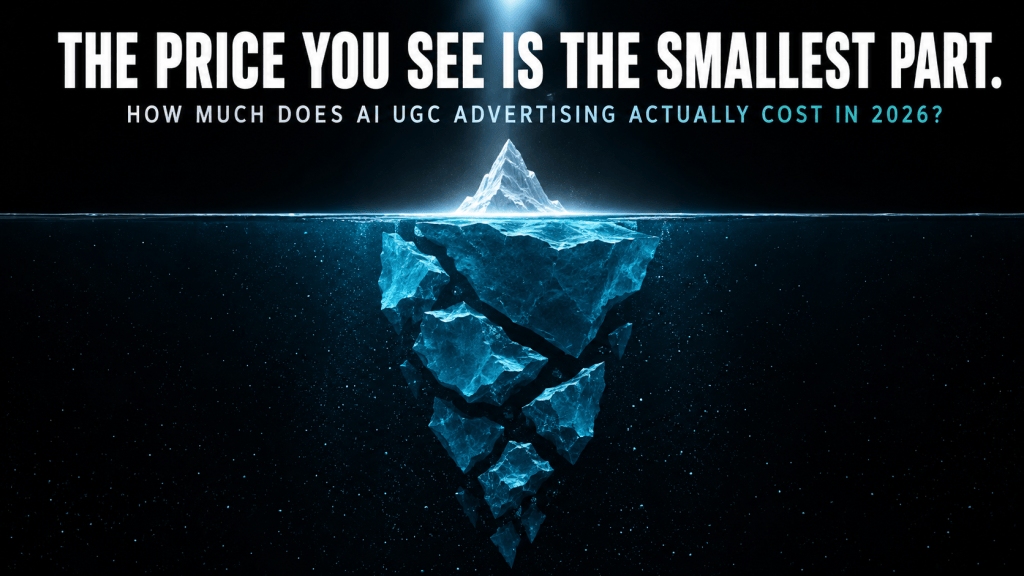
Most pricing pages for AI UGC tools show a single number and call it a day. That number is almost never the real cost of running this format at any real volume, and the gap between the advertised price and the actual cost is exactly where most brands get their budgeting wrong. This piece breaks down every layer of cost involved in AI UGC advertising in 2026, using real numbers rather than a single misleading headline figure, and answers the specific cost questions marketers are actually asking when they search for this topic.
What Does AI UGC Actually Cost Per Video?
The advertised per-video cost for AI-generated UGC-style ads typically falls between $0.40 and $2.50, depending on the platform, avatar quality tier, and whether hook or script generation is bundled into that price. This is a genuinely accurate number as far as it goes it’s just not the complete cost picture, since it only captures the rendering step and ignores everything that happens before and after a video actually gets generated.
How Does This Compare to Traditional Creator-Shot UGC?
A real-creator UGC video, hired specifically for one script, typically costs $150 to $500 and takes one to four weeks to produce, depending on the creator’s rate and how much revision the brand requests. That places the cost gap between traditional and AI-generated UGC somewhere between 100x and 1000x, depending on which end of each range you’re comparing. This gap is the actual reason AI UGC adoption has accelerated as fast as it has it isn’t a marginal efficiency improvement, it’s a fundamentally different cost structure that changes what a marketing team can realistically attempt with the same budget.
What Does the Rendering Cost Actually Include?
The advertised per-video price generally covers the AI avatar’s delivery, the underlying video generation model’s compute cost, and basic rendering. It typically does not include script or hook writing unless the specific platform bundles that step in, and it doesn’t include the labor cost of reviewing, selecting, or approving a finished video before it gets published. Understanding exactly what’s inside that advertised number, versus what still needs to happen around it, is the actual starting point for an accurate cost estimate.
Why Does the Advertised Price Rarely Match the Real Cost?
The advertised price assumes every render is usable on the first attempt, which isn’t how AI video generation actually works in practice. A platform charging a low per-video price but requiring three or four attempts to land something publishable is, in real terms, more expensive per usable video than a platform charging a higher price with a tighter first-attempt success rate. This single factor attempts-to-usable-video is the most commonly missing variable in cost comparisons between competing platforms, and it’s rarely disclosed anywhere on a pricing page.
How Much Does Scripting Actually Cost If It’s Not Included?
If a platform doesn’t include hook or script generation, that cost doesn’t disappear it shifts entirely onto the brand’s own labor budget. A marketer manually writing a script for each new angle typically spends thirty minutes to an hour per script once research, drafting, and revision are factored in. At even a modest internal hourly cost, five scripts a week adds up to a real, recurring labor expense that never appears on any platform’s invoice but is every bit as real as the rendering fee itself.
What Is Cost-Per-Genuinely-Distinct-Angle, and Why Does It Matter More Than Cost-Per-Video?
Cost-per-video is the number every platform advertises, and it’s also the least useful number for actually comparing platforms once a brand is testing at real volume. A team generating ten near-identical videos at a low per-video cost can be spending inefficiently in a way a simple price comparison completely misses, since none of those ten videos actually taught the team anything new about their audience. Cost-per-genuinely-distinct-angle total spend divided by the number of structurally different creative approaches actually tested, not total render count is the more accurate way to measure whether a testing budget is being spent well.
How Does Avatar Fatigue Add a Hidden Cost to AI UGC Campaigns?
A reused AI avatar’s face and delivery pattern gets visually “solved” by a viewer’s pattern-recognition system faster than a human creator’s naturally varying delivery does, which means AI UGC campaigns often show meaningful performance decline within 7 to 12 days faster than the 3-4 week window many marketers still plan budget around based on older ad-fatigue expectations. The hidden cost here is continued spend behind an angle-avatar combination that’s already past its effective lifespan, while the actual signal that decay has started sits visible in the data days before anyone typically reacts to it.
What Does It Cost to Fix an Avatar-Category Mismatch After the Fact?
A confident, polished avatar delivery style that performs well in a visible-result category like skincare can actively underperform in a trust-dependent category like supplements, since that category’s audience reads unearned confidence as overselling rather than expertise. The cost of this specific mismatch isn’t visible in any single metric until someone specifically checks qualitative signals like comment sentiment, which means a team can spend real budget for two to three weeks before the actual cause of underperformance becomes clear. Building a category-fit check into avatar selection from the start avoids this specific, easily-overlooked cost entirely.
Does Compliance Add Real Cost to AI UGC Advertising?
Yes, and this is one of the more commonly underestimated costs in this category. The FTC’s rule on consumer testimonials, effective since October 2024, carries civil penalties up to $51,744 per violation for AI-generated testimonials presented as genuine consumer experiences. The EU AI Act’s Article 50 adds separate transparency obligations for AI-generated content specifically. Neither of these frameworks was built exclusively with AI UGC in mind, but both apply directly to it, and building a disclosure review step into a brand’s own process is a real, if modest, cost that most cost breakdowns for this format skip entirely.
How Much Does Testing at Volume Actually Cost Per Week?
A reasonable weekly testing cadence for a hero product involves four to six structurally distinct angles, each requiring its own avatar selection and generation. At $0.40 to $2.50 per render, a batch of six angles might cost $2.40 to $15 in pure rendering fees genuinely inexpensive in isolation. The real weekly cost includes scripting time if not bundled, avatar-selection time, review time before publishing, and the compliance check described above, which together typically dwarf the rendering fee itself for any team taking this format seriously.
Is It Cheaper to Use One All-in-One Platform or Combine Multiple Tools?
This depends heavily on which specific gaps a brand’s current workflow has. A platform bundling hook generation, avatar selection, and direct publishing into one price removes several separate labor costs that would otherwise need to be paid for manually or absorbed as staff time. A brand combining a rendering-only platform with a separate scripting process or a separate publishing workflow is often paying more in aggregate, even if each individual tool’s advertised price looks cheaper in isolation, simply because the coordination and manual-handoff cost between tools is real and rarely accounted for in a side-by-side pricing comparison.
What’s the Actual Cost Difference Between a Free Plan and a Paid Tier?
Free plans in this category typically cover the core generation workflow at a capped volume, which is genuinely useful for validating whether a specific tool’s output quality and category-reasoning actually fit a brand’s needs before committing real budget. The cost difference moving to a paid tier is usually driven by render volume caps, avatar library access, and sometimes resolution or model-tier upgrades, rather than the core mechanics of the tool changing. Running a real test on the free tier before committing to a paid plan is one of the lowest-cost ways to validate a platform-fit decision before it becomes a recurring expense.
How Should a Brand Actually Budget for AI UGC in 2026?
A realistic budget needs to account for four separate cost categories rather than just the advertised per-video price: the rendering fee itself, scripting labor if not bundled into the platform, review and compliance labor regardless of platform, and a buffer for the attempts-to-usable-video ratio specific to whichever tool is chosen. Brands that budget only for the advertised rendering price consistently underestimate real cost by a meaningful margin, not because any platform is being dishonest about its pricing, but because the advertised number was never meant to represent the full cost of the format in the first place.
What Cost Mistakes Do Most Brands Make When Starting Out?
The most common mistake is treating cost-per-video as the only number that matters, which leads directly to comparing platforms on their advertised price alone and missing the scripting-labor, attempts-to-usable-video, and angle-diversity factors that actually determine real cost at volume. A second common mistake is underestimating avatar-fatigue and category-mismatch costs specifically, since neither shows up as a line item anywhere they show up as slowly declining performance that gets misattributed to generic ad fatigue rather than a specific, fixable creative decision.
Will AI UGC Advertising Get Cheaper Over Time?
Foundation video model costs have been trending downward as the underlying technology matures, and this trend is likely to continue, which puts gradual downward pressure on the rendering-fee component of this cost structure specifically. That said, the labor-cost components scripting, review, compliance, category-fit checking aren’t primarily driven by model cost at all, and are unlikely to shrink at the same rate, if they shrink at all. The realistic expectation is that the rendering-fee slice of the total cost keeps getting cheaper, while the actual determinant of whether a brand spends its budget well or poorly increasingly comes down to execution discipline rather than raw per-video price.
The Bottom Line on AI UGC Costs in 2026
The honest total cost of AI UGC advertising is meaningfully higher than any single platform’s advertised per-video price, once scripting labor, review time, compliance checking, and the real attempts-to-usable-video ratio are all accounted for honestly. None of this makes the format a bad investment the underlying 100x to 1000x cost advantage over traditional creator-shot UGC remains real and substantial even after every hidden cost above is added back in. It does mean that comparing platforms, or budgeting for this format at all, purely on the basis of a headline per-video price is the single most common way brands end up with a real cost picture that looks nothing like what they originally planned for.
How Does Catalog Size Change the Cost Calculation?
The math above shifts meaningfully once catalog size enters the picture. A brand with a single hero product running iterative angle testing has a fundamentally different cost profile than a brand with two hundred SKUs needing baseline video coverage across the entire catalog. For the hero-product case, the scripting-labor and angle-diversity costs described above dominate the total cost equation, since render volume itself stays relatively low and concentrated. For the large-catalog case, rendering fees start to matter more in absolute terms simply due to volume, even though the per-video cost stays the same, and the scripting-labor cost per product often needs to shrink dramatically, since writing a fully custom, deeply reasoned script for two hundred products individually isn’t realistic on any team’s time budget.
This is part of why large-catalog use cases often gravitate toward platforms optimized for fast, broad coverage over platforms optimized for angle depth not because angle depth doesn’t matter, but because the labor cost of applying deep angle reasoning to every single SKU in a large catalog would erase much of the cost advantage the format offers in the first place. A more realistic approach for large catalogs is applying deeper angle reasoning selectively to a handful of hero products while accepting broader, shallower coverage for the long tail.
What Does a Realistic Monthly Budget Actually Look Like?
Building a full monthly estimate makes the abstract cost categories above concrete. Assume a mid-sized DTC brand running one hero product through four to six angles a week, roughly twenty to twenty-four rendered videos a month at $0.40 to $2.50 each a rendering cost landing somewhere between $10 and $60 for the month, genuinely modest in isolation. Add scripting labor, if not bundled into the platform: twenty to twenty-four scripts at thirty to sixty minutes each translates to ten to twenty-four hours of labor monthly, which at even a conservative internal hourly rate adds several hundred dollars in real, if often uncounted, cost.
Add review and compliance time, typically a smaller but non-zero addition, and a reasonable allowance for the attempts-to-usable-video ratio, which can add anywhere from ten to fifty percent additional render volume depending on the specific platform’s first-attempt success rate. A realistic all-in monthly figure for this single-hero-product scenario often lands several multiples above the pure rendering-fee estimate most brands start their budgeting process with, which is exactly the gap this piece has been describing throughout.
How Does Team Size Change Which Costs Matter Most?
A solo marketer or very small team feels the scripting-labor cost most acutely, since there’s no dedicated copywriter to absorb that work separately from the person also handling avatar selection, review, and publishing. For this profile, a platform bundling hook generation directly into the rendering cost often produces the largest real cost savings, even if its advertised per-video price looks similar to a rendering-only competitor, since the bundled version eliminates an entire labor category the solo operator would otherwise have to personally absorb.
A larger team with a dedicated copywriter or creative strategist feels this cost differently the scripting-labor cost still exists, but it’s already being paid for as a fixed role rather than an incremental per-video cost, which changes the relative value of a bundled-scripting platform somewhat. For larger teams, the more consequential cost categories tend to shift toward coordination overhead across multiple stakeholders reviewing creative before publishing, a cost that platforms with built-in team workflows and approval flows are specifically designed to reduce.
Does the Underlying AI Video Model Affect Cost Significantly?
Foundation video model choice affects cost less than most comparisons suggest, once a model clears a basic quality and coherence threshold that most current-generation models meet. The layers built on top of the model hook generation, category-aware avatar matching, workflow completeness tend to determine both quality and real cost-efficiency more directly than which specific underlying model a platform uses. A platform running a slightly older model but excelling at angle generation and category matching will often produce a lower real cost-per-tested-angle than a platform running the newest available model with no scripting support at all, since the model only controls how the video looks, not how efficiently a testing program actually learns from its output.
What Cost Signals Should a Brand Watch For After Switching Platforms?
After migrating to a new platform, the cost signal worth tracking closely in the first month isn’t the rendering fee itself, which is usually visible and predictable from the pricing page. It’s the attempts-to-usable-video ratio on the new platform specifically, since this number varies meaningfully between tools and directly determines real cost-per-usable-render regardless of the advertised price. A brand that doesn’t track this ratio explicitly during a platform transition can end up with a real cost picture worse than the platform they switched away from, purely because the new platform’s first-attempt success rate turned out to be weaker than assumed going in.
How Should Brands Report AI UGC Costs Internally?
Most internal reporting on AI UGC spend defaults to reporting total render count and total rendering-fee spend, since those are the two numbers a platform’s own dashboard surfaces most readily. A more useful internal reporting structure adds two additional numbers: total scripting-labor hours spent, converted to a dollar figure at the team’s actual internal rate, and the ratio of genuinely distinct angles tested to total renders produced. Reporting all four numbers together, rather than just the two a platform’s dashboard happens to surface by default, gives stakeholders a far more accurate picture of whether a testing program’s actual spend is producing proportional learning, rather than just proportional output.
Putting the Full Picture Together
Pulling every layer covered here into one view: the advertised per-video price is real but incomplete, the true cost includes scripting labor, review time, compliance checking, and an attempts-to-usable-video buffer, and the specific weight of each cost category shifts depending on catalog size, team size, and which platform’s underlying workflow completeness matches a brand’s actual gaps. None of this changes the fundamental conclusion that AI UGC remains dramatically cheaper than traditional creator-shot production even once every hidden cost is added back in it just means the honest comparison point is the fully-loaded cost figure described throughout this piece, not the single number on any platform’s pricing page.
A Final Note on Comparing Quotes Across Platforms
When evaluating any specific platform’s pricing page against this framework, the single most useful question to ask directly is what the advertised number actually includes versus what it silently assumes will happen elsewhere in the workflow. A platform that’s transparent about its attempts-to-usable-video ratio, or that publishes real data on how its bundled scripting affects total cost relative to a rendering-only competitor, is giving a brand genuinely comparable information. A platform that only publishes a single per-video number, with no context about what that number excludes, isn’t being dishonest, but it is leaving the brand to do the fully-loaded cost math described in this piece entirely on their own which is exactly the calculation worth running before committing meaningful budget to any specific tool in this category.
 AI UGC Video Generator
Leave a comment