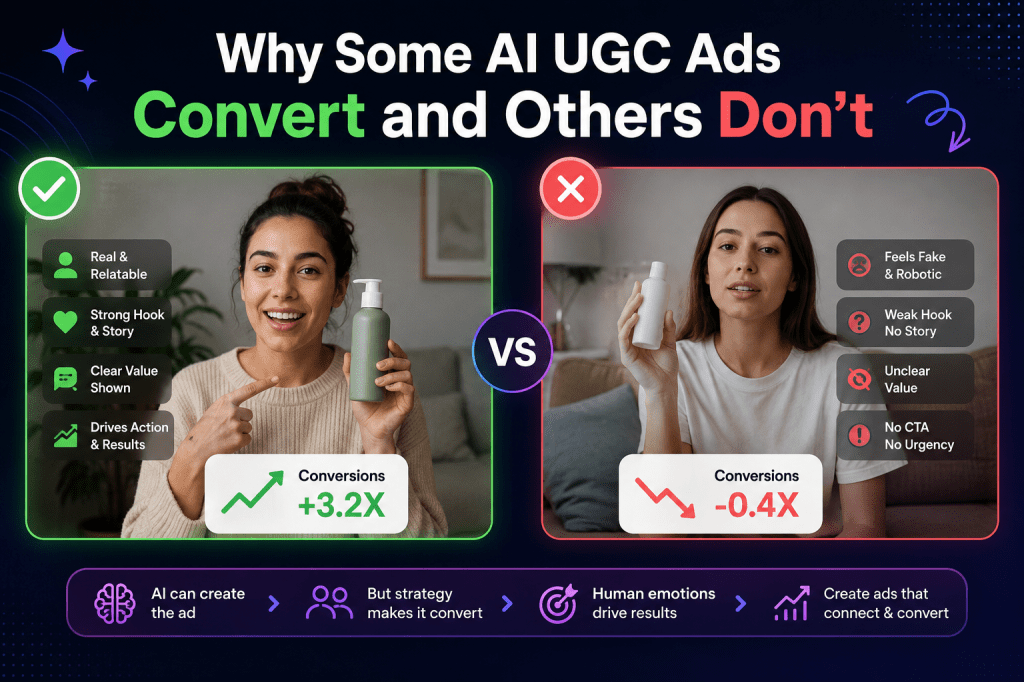
AI has changed the way brands create video advertising. What once required creators, cameras, studios, editors, and weeks of production can now be done in a fraction of the time with AI-powered tools. But there is an important distinction that many marketers discover quickly: creating an AI UGC video ad is easy; creating one that actually converts is much harder.
Thousands of brands are now experimenting with AI UGC Video ads for TikTok, Instagram, Facebook, YouTube Shorts, and other performance marketing channels. Some of these ads generate strong engagement, clicks, and purchases, while others look polished but fail to generate meaningful results.
So, what makes the difference?
The answer usually isn’t simply the AI tool being used. Conversion depends on how well the ad understands the audience, communicates the product’s value, creates curiosity, builds trust, and gives viewers a reason to act.
In this guide, we’ll break down why some AI UGC ads convert and others don’t, the most common mistakes brands make, and how to create AI UGC Video ads that feel authentic while being designed for performance.
What Are AI UGC Video Ads?
AI UGC Video ads are advertisements created with artificial intelligence using UGC-style formats. Instead of hiring a traditional creator to record a product testimonial or demonstration, brands can use AI avatars, AI-generated presenters, voice cloning, scripts, product visuals, and automated editing to produce videos that resemble authentic user-generated content.
The goal isn’t necessarily to make an advertisement look like a traditional commercial.
The goal is to make it feel like content that naturally belongs in the user’s feed.
A typical AI UGC video ad may include:
- A creator-style introduction
- A strong opening hook
- A product demonstration
- A personal experience or testimonial
- Product benefits
- Social proof
- A problem-and-solution narrative
- A direct or soft call to action
Modern AI UGC platforms can also help brands create multiple variations of the same concept, making it easier to test different hooks, avatars, scripts, formats, and messaging.
However, producing more videos doesn’t automatically mean producing better ads.
Why Do Some AI UGC Ads Convert?
The best-performing AI UGC ads usually have one thing in common: they are created around the audience’s problem rather than the technology used to make the video.
Consumers don’t care whether an ad was created using AI, a camera, or a professional production studio. They care about whether the content is relevant to them.
A successful AI UGC video answers questions such as:
- Why should I stop scrolling?
- What problem does this product solve?
- Can I trust this claim?
- What makes this product different?
- Will this product work for someone like me?
- What should I do next?
If your video answers these questions quickly and naturally, it has a much better chance of converting.
1. The Hook Is Weak
The first few seconds can determine whether someone continues watching or scrolls away.
This is especially important for short-form advertising, where users are exposed to an enormous amount of content every day.
A weak hook might start with:
“Hi everyone, today I’m going to talk about our amazing product.”
There is nothing particularly wrong with this sentence, but it doesn’t give the viewer a compelling reason to continue.
A stronger hook focuses immediately on a problem, curiosity gap, result, or unexpected statement.
For example:
“I wish I had discovered this before spending hundreds on skincare.”
Or:
“If your product videos aren’t converting, this might be the reason.”
Or:
“I tested this for seven days, and here’s what happened.”
The strongest hooks don’t feel like introductions. They feel like the beginning of a story.
How to Improve Your AI UGC Hook
When creating AI UGC Video ads, test multiple hook categories:
Problem-based hook:
“Still struggling with…”
Curiosity hook:
“I didn’t expect this to work…”
Result-based hook:
“This helped me…”
Contrarian hook:
“Stop doing this if you want…”
Review hook:
“I finally understand why everyone is talking about…”
Demonstration hook:
“Watch what happens when…”
The important part is not choosing one perfect hook. It’s creating several variations and discovering which message resonates with your audience.
2. The Ad Looks Too Much Like an Ad
This is one of the biggest reasons AI UGC Video ads fail.
UGC works because it can feel personal, informal, and relatable. When the content becomes overly polished, overly scripted, or overly promotional, viewers immediately recognize it as advertising.
For example, imagine an AI avatar standing in a perfectly designed studio and saying:
“Our revolutionary product provides exceptional value and superior performance for modern consumers.”
It sounds like marketing copy.
Compare that with:
“Okay, I honestly didn’t think I’d like this, but after using it for a week, I get why people recommend it.”
The second version sounds much closer to how a real person might communicate.
That doesn’t mean your AI UGC ad needs to look low quality.
Instead, it needs to feel native to the platform.
Use natural language, conversational pacing, relatable scenarios, and creator-style framing.
3. The Script Focuses on Features Instead of Benefits
Another common mistake is listing product features without explaining why those features matter.
For example:
“Our software includes AI video generation, AI avatars, voice cloning, and automated editing.”
These are features.
But a customer is more interested in the outcome:
“Instead of waiting days for a creator to send you a video, you can create multiple UGC-style ad variations in minutes.”
That communicates the benefit.
A good AI UGC script should translate:
Feature → Benefit → Outcome
For example:
Feature: AI voice cloning
Benefit: Create videos using a consistent brand or creator voice
Outcome: Produce more creative variations without recording every version manually
This approach makes your AI UGC Video ads more persuasive because the viewer can immediately understand the value.
4. There Is No Clear Problem-Solution Story
High-performing UGC advertisements often follow a simple storytelling structure.
Problem → Discovery → Solution → Result → CTA
Imagine a skincare brand.
The video starts:
“I kept buying expensive skincare products, but my skin still looked dry.”
Then the creator explains how they discovered the product.
Next, they demonstrate how they use it.
Then they describe the result.
Finally:
“If you’re dealing with the same problem, check it out.”
This structure works because it mirrors how people naturally tell stories.
Instead of saying:
“Buy our product because it has five amazing features.”
The ad says:
“I had a problem. I found something that helped. Here’s what happened.”
That is much easier to relate to.
5. The AI Avatar Doesn’t Match the Audience
AI avatars can make UGC production faster, but choosing an avatar randomly can hurt performance.
The person presenting your product should make sense for your target audience.
For example, a fitness product targeting young women may require a different creator persona than a B2B SaaS product targeting marketing managers.
Think about:
- Age
- Style
- Communication tone
- Gender
- Accent
- Language
- Lifestyle
- Personality
- Product category
The goal isn’t simply to choose the most realistic AI avatar.
The goal is to choose an avatar that your target customer can identify with.
6. The Voice Sounds Robotic
Visual realism alone isn’t enough.
If the voice sounds unnatural, viewers may immediately realize that the video is AI-generated.
Modern AI voice technology has improved significantly, but marketers still need to pay attention to:
- Pronunciation
- Pauses
- Sentence length
- Emotional delivery
- Speaking speed
- Emphasis
- Tone
A script written like a corporate press release will often sound robotic even when the AI voice itself is realistic.
Write the script like someone actually speaks.
Instead of:
“This innovative solution has significantly improved my overall productivity.”
Try:
“Honestly, this saved me so much time.”
Short sentences, natural expressions, and conversational language can make a major difference.
7. The Product Appears Too Late
One mistake marketers make is spending too much time building context before showing the product.
If viewers don’t understand what the video is about, they may leave before the product appears.
Your product doesn’t necessarily need to appear in the first second, but the viewer should understand the context quickly.
For product-focused AI UGC Video ads, combine the creator with product visuals whenever possible.
Show:
- The product
- How it works
- Before-and-after results
- Screenshots
- Product usage
- Packaging
- Key features
- Realistic product interactions
This makes the video more visually engaging and helps reinforce the message.
8. The Ad Doesn’t Demonstrate the Product
Talking about a product is less persuasive than showing it.
If you are selling software, show the interface.
If you’re selling skincare, show the application.
If you’re selling clothing, show the product being worn.
If you’re selling a kitchen product, demonstrate it in a real situation.
This is where AI-powered video production can become particularly useful. Brands can combine AI creators with product visuals and generated scenes to create different demonstrations without organizing a traditional shoot for every concept.
The rule is simple:
Don’t just tell viewers what your product does. Show them.
9. There Is Too Much Information
More information doesn’t necessarily create more conversions.
A common AI-generated advertising mistake is trying to include every product feature in a 30-second video.
The result is usually a rushed script with too many claims.
Instead, focus on one primary message.
For example:
“This tool helps ecommerce brands turn product URLs into UGC-style videos.”
That’s one clear value proposition.
You can create another ad focused on AI avatars, another on video production speed, and another on creative testing.
This gives you multiple creative angles instead of one overloaded advertisement.
10. The CTA Is Weak or Missing
Even a great video can fail to convert if viewers don’t know what to do next.
Your CTA should match the stage of the customer journey.
For awareness:
“See how it works.”
For consideration:
“Try it for yourself.”
For ecommerce:
“Shop now.”
For SaaS:
“Start creating free.”
Avoid making the CTA unnecessarily complicated.
The viewer should understand the next action immediately.
AI UGC Ads Need Testing, Not Guesswork
One of the biggest advantages of AI UGC Video ads is the ability to create variations quickly.
Instead of spending your entire budget producing one “perfect” ad, create multiple versions.
Test variables such as:
Hook
Version A: Problem-based
Version B: Curiosity-based
Version C: Result-based
Creator
Version A: Female creator
Version B: Male creator
Version C: Different age group
Script
Version A: Testimonial
Version B: Product demonstration
Version C: Problem-solution
CTA
Version A: “Try it today.”
Version B: “See how it works.”
Version C: “Start for free.”
This creates a structured creative testing system.
The goal isn’t to guess which ad will win.
The goal is to generate enough relevant variations to discover what your audience responds to.
How Tagshop AI Can Help Create Better AI UGC Video Ads
For brands that want to simplify the process, Tagshop AI can help turn the creative workflow into a more automated process.
Instead of manually handling scripting, creator selection, voiceovers, visuals, and editing separately, marketers can use AI-powered workflows to speed up production.
With features such as AI Video Agent, AI avatars, AI voice cloning, URL-to-video, AI Twin, AI Ad Clone, and AI product visuals, marketers can create different types of UGC-style advertising content from a single product idea.
The AI Video Agent is particularly useful for marketers who don’t want to manage every production step manually. You can describe what you want to create, provide your requirements, and use the AI-assisted workflow to help develop the video.
The URL-to-video workflow can also be useful for ecommerce brands. Instead of starting with a blank editing timeline, marketers can provide a product URL and use the available product information and assets as the starting point for video creation.
For creative testing, the ability to create multiple concepts and variations can be more valuable than simply generating one highly polished video.
A Simple Framework for High-Converting AI UGC Video Ads
If you need a repeatable structure, start with this framework:
1. Stop the Scroll
Open with a strong statement, question, problem, or result.
2. Introduce the Problem
Explain the challenge your audience recognizes.
3. Introduce the Product
Position your product as the solution.
4. Demonstrate It
Show the product in action.
5. Explain the Main Benefit
Focus on the outcome rather than listing features.
6. Add Proof
Use testimonials, reviews, results, demonstrations, statistics, or other credible evidence where appropriate.
7. Create a Clear CTA
Tell viewers what to do next.
A 20–30 second AI UGC Video ad can follow this structure without feeling overly complicated.
What High-Converting AI UGC Ads Have in Common
When you look at successful AI UGC Video ads, several patterns appear repeatedly.
They are audience-first
The ad is built around the viewer’s problem, not the brand’s desire to talk about itself.
They feel natural
The language resembles everyday conversation rather than corporate advertising.
They demonstrate the product
The viewer gets to see how the product works.
They communicate one strong message
The ad doesn’t try to explain everything at once.
They create curiosity
The viewer has a reason to continue watching.
They build trust
The content uses believable claims, demonstrations, social proof, and relatable storytelling.
They are tested
Successful brands don’t depend on one creative. They continuously test different hooks, creators, scripts, and angles.
Common AI UGC Mistakes to Avoid
Before launching your next campaign, check whether you’re making any of these mistakes:
❌ Starting with a generic introduction
“Hi guys, today we’re going to talk about…”
✅ Start with the problem or result
“I didn’t realize how much time I was wasting until I found this.”
❌ Listing every feature
✅ Focus on one meaningful benefit
❌ Making the avatar look perfect
✅ Make the content feel natural and relatable
❌ Using robotic scripts
✅ Write like people actually speak
❌ Creating only one version
✅ Test multiple creative variations
❌ Talking about the product without showing it
✅ Demonstrate the product whenever possible
❌ Using exaggerated claims
✅ Use clear, believable, supportable messaging
The Future of AI UGC Advertising
AI UGC is moving beyond simply replacing traditional video production.
The bigger opportunity is creative scalability.
Traditional UGC production can make testing expensive. If you need ten creators, ten scripts, and ten different shoots, production costs can quickly increase.
AI changes the economics of experimentation.
Brands can create more concepts, test different audiences, localize messaging, experiment with new hooks, and refresh creative more frequently.
That doesn’t mean AI will automatically create winning advertisements.
Instead, AI gives marketers the ability to iterate faster.
And in performance marketing, faster iteration can create a significant competitive advantage.
Final Thoughts
The reason some AI UGC Video ads convert while others don’t usually comes down to fundamentals rather than the AI technology itself.
A realistic avatar won’t save a weak hook.
A great voice won’t fix an unclear value proposition.
Beautiful visuals won’t compensate for a confusing CTA.
The best-performing AI UGC ads combine strong creative strategy with efficient AI production.
Start with the audience. Identify their problem. Create a compelling hook. Use natural language. Show the product. Focus on benefits. Build trust. Give viewers a clear next step.
Then create multiple variations and test them.
That is where AI UGC becomes more than a shortcut for making videos. It becomes a scalable creative testing system that can help brands discover what actually makes their customers stop, watch, click, and convert.
And as AI video technology continues to improve, the brands that win won’t necessarily be the ones producing the most AI videos.
They’ll be the ones producing the right AI videos for the right audience with the right message.


Leave a comment