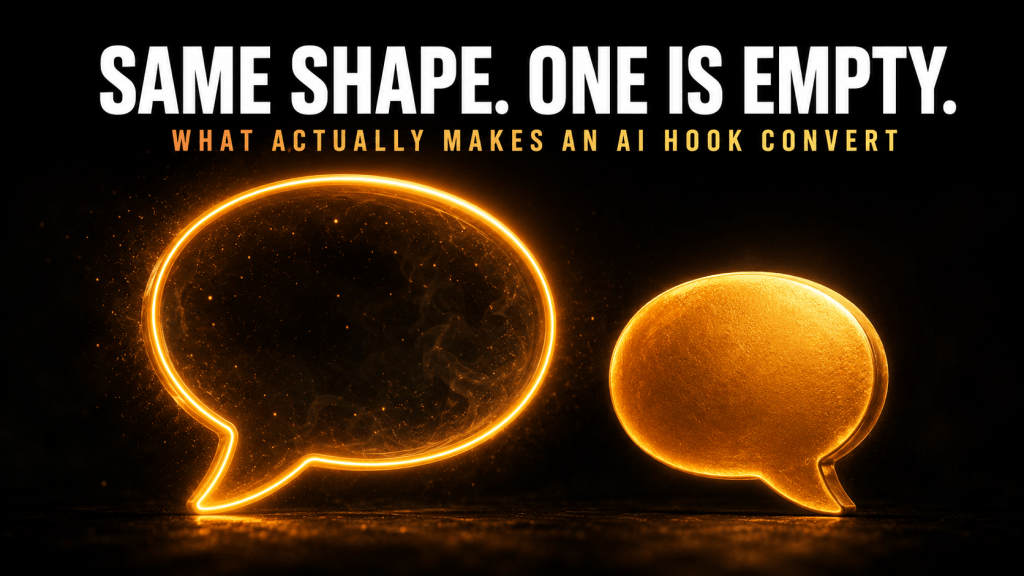
Most content about an AI hook generator describes what the tools do. Almost none of it examines what actually separates a hook that converts from one that just sounds clever. This piece takes a different angle: rather than another feature rundown, it breaks down the actual patterns behind why some AI-generated hooks convert and others don’t, using real search-demand data and a framework built specifically to catch the gap between a hook that earns attention and one that earns a sale.
Search demand for “AI UGC video generator” carries a notably high $350 cost-per-click according to Ahrefs data pulled this month, a signal of just how commercially loaded this specific search has become brands aren’t casually browsing this term, they’re actively evaluating tools with budget already allocated. That intensity is exactly why getting the actual mechanics of hook quality right matters more than picking any specific tool. An AI hook generator is only as useful as the underlying reasoning behind what it produces, and that reasoning is where most comparisons stop short.
Why “hook quality” gets evaluated the wrong way
Most evaluations of an AI hook generator focus on how clever or attention-grabbing the output sounds when read in isolation. That’s an incomplete test. A hook can sound genuinely sharp on a page and still fail once it’s actually delivered on camera, because reading a line and hearing it spoken by a presenter engage completely different parts of a viewer’s attention. The gap between a hook that reads well and a hook that performs well on video is one of the most consistently underestimated variables in this entire category.
The fix isn’t a better-written sentence. It’s evaluating a hook against what actually happens in the first three seconds of playback: does the visual match the words, does the delivery feel like a real reaction rather than a read-aloud script, and does the tension the hook creates require the specific product to resolve it, or does the video’s own explanation satisfy that tension on its own.
The four-part structure most AI hook generators skip
A functional hook isn’t one sentence. It’s four coordinated pieces: the spoken line, the visual opening, any on-screen text, and the presenter’s physical action during delivery. Most tools in this category, including a lot of general-purpose AI writing tools repurposed for this use case, only generate the spoken line and leave the other three components entirely up to guesswork during production.
That gap matters more than it sounds. A strong spoken line delivered against a flat, static visual with no supporting action undercuts its own effectiveness before it has a chance to land. A tool that specifies all four components what gets said, what the camera shows, what text reinforces the line, and what the presenter physically does is solving a fundamentally different, more complete problem than one that hands back a single sentence and calls it done.
What the actual workflow looks like in practice
Having gone through a few of these tools directly rather than just reading feature lists, the ones that handle this four-part structure properly tend to follow a similar underlying sequence, even when the interface looks different from one platform to the next.
Step 1: Drop in the basics
- Product name
- A short description doesn’t need to be polished
- Who it’s actually for
No long, agency-style creative brief required just to get a first result back.
Step 2: Let it pick the angle
- The system reads that product and audience info
- It matches against a set of proven creative angles discovery, objection-handling, social-proof, and a few others
- Ideally, it tells you why it picked what it picked, not just what it picked
This is the step that separates a tool that’s actually reasoning from one that’s just running everything through a single fixed template no matter what’s being sold.
Step 3: Review the actual breakdown
This is where the four-component structure shows up in practice. Each hook that comes back should be broken into:
- The line itself
- The visual it’s paired with
- Any on-screen text
- The physical action tied to the delivery
Along with some kind of strength or fit score not just an unranked wall of sentences to sort through manually.
Step 4: Take it further, or don’t
- Copy the hook out and use it wherever
- Or continue straight into the next production step without re-entering the same product details in a completely separate tool
That fourth step is worth pausing on, since it’s easy to overlook when comparing tools purely on hook quality. A hook that has to get manually copied, reformatted, and re-explained to a second tool before it can actually become a video adds real friction back into a process that’s supposed to be fast. The tools worth using are the ones where that handoff barely feels like a separate step at all.
A pattern worth naming: attention-capturing versus product-anchored hooks
Here’s a distinction that doesn’t show up in most hook-generator comparisons at all, and it’s arguably the single highest-leverage thing to check before scaling any AI-generated hook. Some hooks create curiosity or tension that resolves independently of the product being advertised call these attention-capturing hooks. Others create tension that only the specific product can resolve call these product-anchored hooks.
Both types can win on thumbstop rate, the percentage of viewers who stop scrolling in the first few seconds. Only one of them reliably converts that attention into anything. An attention-capturing hook like “I found out why my old skincare routine wasn’t working” can get resolved entirely by generic information the video itself explains, with the specific product barely entering the picture. A product-anchored hook like “I thought all serums were basically the same until I checked what’s actually in this one” can only get resolved by learning something specific to that exact product. Same opening pull, completely different downstream behavior.
A simple test worth applying before trusting any AI-generated hook
Read the hook line in isolation and mentally remove the brand and product entirely. Does it still feel like a complete, satisfying thought on its own? If yes, that’s a signal the hook is attention-capturing rather than product-anchored, and it’s worth treating any strong early metrics on that hook with real caution before scaling budget behind it. If removing the product breaks the hook’s own internal logic, that’s a stronger signal it’s genuinely anchored to what’s being sold.
This test takes about ten seconds and catches a mismatch that often doesn’t show up until conversion data arrives a week or two after a hook has already looked like a winner on early engagement metrics alone.
Why an AI hook generator’s category logic changes which pattern matters more
This distinction carries different weight depending on what’s being advertised. Trust-dependent categories supplements, personal finance, anything where the audience brings real skepticism into the ad are the least forgiving of attention-capturing hooks that resolve without the product mattering. An audience already primed to distrust anything that reads as produced will discount a hollow hook faster and more completely than a lower-skepticism audience would.
Visible-result categories like skincare and beauty sit in the middle, since the product’s own demonstrated result can partially compensate for a loosely anchored hook. Low-consideration, impulse categories like fashion are the most forgiving, since the purchase decision itself doesn’t require the same depth of product-specific resolution a considered purchase does.
The angle-reasoning gap between a generic tool and a purpose-built AI hook generator
A hook generator that reasons through a product’s category before suggesting an angle is doing something structurally different from one that applies a single template regardless of what’s being sold. A supplement brand needs objection-handling and specific-result framing, since that audience’s baseline skepticism requires a different persuasive structure than a fashion brand’s casual, native-feeling angle needs.
Most general-purpose AI writing tools adapted for this use case skip this reasoning step entirely, producing technically complete hooks that quietly underperform because the underlying angle never matched what the specific audience actually needed to hear. A tool built specifically around this reasoning, one that shows which angles it selected for a given product and which it explicitly rejected, gives a marketer something a black-box output never can: visibility into whether the logic actually makes sense for their specific situation.
Transparency as a quality signal, not a nice-to-have
Here’s a signal worth actively looking for when evaluating any tool in this category: does it explain its own reasoning, or does it just hand back a result. A tool that surfaces which creative angles it considered and rejected for a given product, along with a brief explanation of why, is doing something meaningfully more useful than one that returns a list of sentences with no visibility into the logic behind them.
This matters practically, not just philosophically. A marketer who can see that a supplement brief was matched to objection-handling angles specifically because the category carries high baseline skepticism can evaluate whether that reasoning actually fits their specific product and audience. A marketer staring at an unexplained list of sentences has no way to make that judgment, and ends up either trusting the output blindly or discarding it without understanding why it might have been right.
The cost economics behind why this category exists at all
Worth grounding this in the underlying numbers that made testing multiple hooks per product financially realistic in the first place. A real-creator UGC video, hired specifically for one script, typically runs $150 to $500 and takes one to several weeks depending on scheduling. An AI-generated equivalent runs anywhere from under a dollar to a few dollars per render, with turnaround measured in minutes rather than weeks.
That roughly two-to-three-order-of-magnitude gap in both cost and speed is the actual reason testing multiple structurally distinct hooks per product stopped being a luxury and became the competitive baseline for brands running paid social at any real volume. It’s also exactly why the angle-reasoning quality of the tool doing the generating matters more now than it did when producing even one variant was expensive enough to force careful, deliberate scripting by necessity.
A worked example showing the actual gap in practice
Picture two hooks generated for the same vitamin C serum. The first, an attention-capturing version: “I found out why my old serum was actually making my skin worse.” Structurally, this creates curiosity that a generic explanation about ingredient degradation or oxidation could resolve without the specific product ever becoming load-bearing to the answer. A viewer’s curiosity gets satisfied by the information itself, and by the time the product appears, there’s no remaining pull driving engagement toward it specifically.
The second, a product-anchored version built around a specific, checkable claim: “I switched serums three times before finding one with a stabilized formula that doesn’t oxidize as fast as the others.” This hook’s tension can only resolve by learning something specific to this exact product’s formulation. Same opening curiosity mechanism, same initial thumbstop appeal, completely different structural dependency on the product itself and, based on the pattern described above, a meaningfully different likely outcome once conversion data actually comes in.
Where this leaves brands evaluating tools in this category right now
The honest evaluation criteria for any AI hook generator in 2026 isn’t which one produces the cleverest-sounding sentence. It’s whether the tool reasons through category and audience before generating anything, whether it specifies all four components of a functional hook rather than just the spoken line, and whether its output passes the removal test does the hook’s tension actually require the specific product to resolve, or does it resolve on its own.
Tools built around this deeper reasoning, pairing category-aware angle generation with a full production pipeline into avatar selection and publishing, are solving a meaningfully different and more complete problem than tools that treat hook-writing as a standalone text-generation task. For brands evaluating this category, testing a hook against the product-anchoring check above before scaling any budget behind it is a far more reliable filter than judging output purely on how sharp it sounds on first read.
A note on where to actually test an AI hook generator yourself
If you want to see this reasoning in practice rather than take it on faith, tools built around category-aware hook generation let you paste in a real product brief and see exactly which angles get selected and why, before committing to anything. For teams evaluating this alongside broader workflow needs shared review, multi-stakeholder approval platforms built for collaborative UGC production are worth testing against the same removal-test criteria described above, since the underlying hook-quality question matters regardless of which specific workflow a team ultimately picks.
The bottom line
The category of AI hook generators has matured past the point where “does it write a hook” is a useful evaluation question. The real question is whether the hook it writes is structurally built to convert once a real viewer, not a reviewer reading it cold, actually encounters it mid-scroll. That comes down to category reasoning, four-component completeness, and whether the tension it creates genuinely depends on the specific product being sold. Everything else is secondary to getting that core mechanism right.
How this plays out across a full week of testing, not just one hook
It’s worth extending this beyond a single hook to what an actual weekly testing process looks like once the product-anchoring distinction becomes a deliberate part of the workflow. A team running four to six hooks per week against one hero product should be scoring each hook against the removal test before generation, not after results come in, since the entire point of the check is catching a hollow hook before it consumes real testing budget rather than explaining a disappointing result after the fact.
This changes what a “good week” of testing actually looks like. Instead of measuring success purely by which hook won thumbstop rate, a more useful weekly review separates hooks into two buckets before ranking anything: hooks that passed the product-anchoring test and hooks that didn’t. Within the passing bucket, thumbstop rate becomes a genuinely useful ranking signal, since every hook in that bucket has already cleared the more important bar of being structurally tied to the product. Ranking by thumbstop rate across both buckets combined, without first separating them, is exactly how a hollow but attention-capturing hook ends up looking like the week’s winner when it’s actually the week’s most expensive mistake.
What an AI hook generator should surface to make this check easy
The most useful tools in this category don’t just generate hooks they make the product-anchoring check fast enough to actually run every time, rather than something that gets skipped under deadline pressure. A tool that labels each generated hook by which creative angle it belongs to, discovery, objection-handling, social-proof, and so on, gives a reviewer an immediate shortcut: objection-handling and social-proof angles are structurally more likely to be product-anchored by design, since both mechanisms require a specific claim about the product to function, while pure curiosity angles need the closest scrutiny before scaling.
This labeling doesn’t replace running the actual removal test, but it does triage where scrutiny is most needed, which matters when a team is reviewing a full week’s batch of hooks rather than evaluating one in isolation with unlimited time.
Why this matters more now than it did even a year ago
As AI-generated hook quality has improved broadly across the category, the average hook produced by any reasonably capable tool now clears a basic coherence and grammatical-quality bar that used to be a genuine differentiator between tools. That shift moves the real competitive question up a level: coherent, well-written hooks are increasingly table stakes, and the actual differentiator has moved to whether a hook’s underlying structure is built to convert, not just whether it reads smoothly.
This is a meaningful shift from how this category was often evaluated even a year earlier, when simply producing a grammatically sound, on-topic hook was itself a notable achievement for many tools. Now that baseline competence is widely available, the product-anchoring distinction and the four-component completeness check described above are where genuine quality differences actually live.
A useful closing heuristic: judge any AI hook generator not by how impressive a single hook sounds in isolation, but by whether the tool makes it easy to run the checks that actually predict conversion category-specific reasoning, four-part decomposition, and product-anchoring as a routine part of using it, rather than as extra work bolted on by a careful marketer after the fact. The tools that build these checks into the workflow itself are the ones actually solving the problem this category exists to solve.


Leave a comment