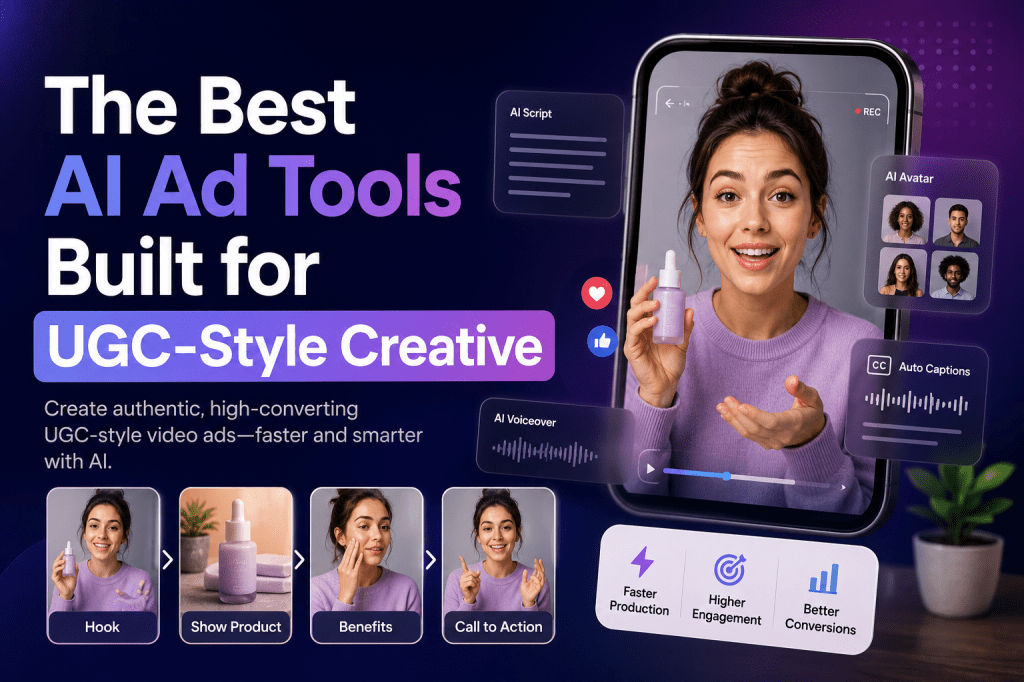
If you run paid social campaigns today, you already know that creative volume matters almost as much as media buying. A single ad can perform well for a few days and then lose momentum. Audiences become familiar with the hook, competitors copy the format, and performance starts to decline. This is one reason UGC-style video ads have become such an important part of modern advertising.
UGC-style creative combines the casual, relatable feel of creator content with the structure of an advertisement. Instead of looking like a polished commercial, the video might begin with a problem, show a product in use, share a personal opinion, or demonstrate a before-and-after result.
The challenge is production. Hiring creators, sending products, managing briefs, recording footage, editing videos, requesting revisions, and producing multiple variations can take days or weeks.
AI ad tools are changing that workflow.
Modern AI platforms can generate scripts, avatars, voiceovers, product scenes, captions, B-roll, and complete video ads from relatively simple inputs. Some can even turn a product URL into an advertisement or let marketers create an entire video through a conversational AI workflow.
This guide looks at the best AI ad tools for brands, marketers, agencies, ecommerce teams, and creators who want to produce UGC-style video ads faster and at greater scale.
What Are UGC-Style Video Ads?
Before comparing tools, it is important to understand what makes UGC-style creative different from a traditional advertisement.
AI User-generated content, commonly called UGC, refers to content created by users rather than traditional media producers. It can include videos, images, reviews, testimonials, comments, and other forms of audience-created content. Wikipedia: User-generated content
UGC-style video ads take the visual and storytelling characteristics of this content and adapt them for advertising.
For example, instead of opening with:
“Introducing our revolutionary skincare solution.”
A UGC-style ad might start with:
“I honestly didn’t expect this to work, but look at my skin after two weeks.”
The second approach feels more like something a person might discover while scrolling through TikTok, Instagram Reels, or YouTube Shorts.
That distinction matters because social media users are accustomed to creator content. Highly polished commercials can immediately feel like advertisements, while creator-style videos can blend more naturally into a user’s feed.
AI makes it possible to reproduce many of these creative patterns without requiring a traditional production setup.
Why Brands Are Moving Toward AI-Powered UGC Creative
Traditional UGC production has several limitations.
Brands need to find suitable creators, negotiate rates, send products, provide creative briefs, wait for recordings, review footage, request changes, and edit the final material. If a brand wants ten different hooks, five creators, or multiple languages, the workload increases quickly.
AI changes the economics and workflow.
A marketer can create one concept and generate multiple variations using different avatars, scripts, hooks, backgrounds, languages, and product presentations.
This makes AI particularly useful for performance marketing.
Instead of asking, “How can we make one great advertisement?” marketers can ask:
“How can we create 20 different creative variations and identify which one performs best?”
That shift is important for modern paid advertising.
According to Tagshop AI, its AI Video Agent can take a product URL, image, or description and help generate a complete UGC-style video with elements such as scripts, avatars, voiceovers, captions, scenes, and B-roll.
What Should You Look for in an AI Ad Tool?
Not every AI video generator is designed for advertising.
Some platforms are excellent for presentations. Others are built primarily for cinematic video generation. If your goal is UGC-style video ads, you need to evaluate tools differently.
1. AI Avatars
A good UGC platform should provide realistic digital presenters or creators.
Look for natural facial expressions, realistic gestures, accurate lip synchronization, different ages and appearances, and a wide selection of personalities.
The avatar should fit the audience you’re targeting rather than simply looking impressive.
2. Realistic Voiceovers
The voice can make or break an AI advertisement.
A visually realistic avatar with a robotic voice will immediately reduce credibility. Look for natural pacing, appropriate emphasis, emotional variation, and multilingual support.
3. Strong UGC Templates
Templates are useful because you don’t have to invent every ad structure from scratch.
Good templates should cover formats such as:
- Product testimonials
- Problem-solution videos
- Product demonstrations
- Unboxing-style videos
- Before-and-after concepts
- Product reviews
- Talking-head ads
- Founder-style videos
- Social media hooks
- Product showcase videos
4. Product-to-Video Workflows
For ecommerce marketers, product URL functionality can be extremely valuable.
Instead of manually copying product descriptions, features, pricing, and images into an AI tool, a URL-to-video system can use information from the product page as the foundation for the creative.
5. Creative Testing
The best tool is not necessarily the one that makes the prettiest video.
For performance marketing, the ability to produce variations is often more important.
You should be able to test:
- Different hooks
- Different avatars
- Different scripts
- Different CTAs
- Different product benefits
- Different video lengths
- Different languages
- Different visual styles
6. Editing Controls
AI generation should not mean losing creative control.
Look for tools that let you modify scripts, scenes, voiceovers, captions, visuals, and other elements after generation.
7. Platform-Friendly Formats
A tool should make it easy to create content for platforms such as TikTok, Instagram Reels, YouTube Shorts, Meta ads, and other vertical-video placements.
The Best AI Ad Tools for UGC-Style Creative
1. Tagshop AI
For brands specifically focused on UGC-style video ads, Tagshop AI is one of the strongest options to consider.
Tagshop AI is designed around AI-powered advertising rather than general-purpose video creation. Its platform supports AI UGC videos, AI avatars, product-to-video workflows, templates, editing, captions, and AI-powered creative generation.
One of its standout features is the AI Video Agent.
Instead of navigating several complicated tools, marketers can describe what they want to create through a conversational workflow. The agent can help understand the product, audience, platform, messaging, and creative direction before generating the video.
This is particularly useful for marketers who know what they want to advertise but don’t want to spend time learning advanced prompting techniques.
The platform also supports product URL-based workflows, allowing ecommerce brands to start with an existing product page instead of building every creative asset manually.
Tagshop AI also provides a large avatar library and multilingual capabilities, making it useful for brands that need to produce multiple versions of an advertisement.
Another advantage is creative scalability.
A brand can experiment with different hooks, avatars, messages, and formats instead of relying on one piece of UGC.
For teams focused heavily on performance advertising, this can make the creative production process much more efficient.
Best for: Ecommerce brands, DTC companies, agencies, performance marketers, and teams creating UGC-style video ads at scale.
2. UGCad AI
For brands that want the entire creative pipeline handled in one place, from product to finished ad, AI UGC video generator tools like UGCad AI are worth a close look.
UGCad AI is built specifically around the ad-testing workflow rather than general video editing. The platform combines a built-in hook generator, a large AI avatar library, product-URL-to-video generation, and direct export for paid social, all inside one dashboard rather than spread across separate tools.
One of its standout features is that it doesn’t just hand you an avatar and leave the scripting to you. The platform reasons through the product and audience first, then suggests multiple hook angles before you even get to picking a face and voice. For marketers who don’t want to write ad copy from a blank page every single time, this removes a real bottleneck.
It also supports pasting in a product URL directly, so ecommerce brands can skip manually rebuilding every creative brief from scratch.
Another advantage is testing velocity. Because the hook generation and avatar selection live in the same flow, a brand can produce several structurally different ad concepts in the time it would take to script and shoot one with a traditional workflow.
Best for: Ecommerce brands, DTC teams, agencies, and performance marketers who want hook-writing and avatar generation handled inside one connected workflow rather than stitched together across multiple tools.
3. HeyGen
HeyGen is well known for AI avatar and presenter-based video creation.
The platform is useful when your advertising concept depends heavily on a person speaking directly to the viewer.
For example, you could create a product explainer, educational advertisement, testimonial-style concept, or spokesperson video.
Its strength is the presenter format. Instead of filming someone in a studio, marketers can create videos featuring digital presenters.
This can be useful for SaaS companies, education brands, financial products, apps, and businesses where explaining the product clearly is more important than showing a fast-paced ecommerce montage.
However, marketers should still think about the difference between a presenter video and authentic-looking UGC.
A technically impressive avatar does not automatically make an advertisement feel like creator content. The script, pacing, framing, hook, captions, and storytelling still matter.
Best for: AI spokesperson videos, explainers, SaaS marketing, education, and presenter-led advertising.
4. Synthesia
Synthesia is another established AI video platform that focuses heavily on AI avatars and professional video communication.
Its strength is structured communication.
Brands can use avatar-based videos for training, education, internal communications, product explanations, and marketing content.
For UGC-style advertising, Synthesia can be useful when the creative concept needs a professional presenter rather than an informal creator aesthetic.
For example, a SaaS company could create a short video explaining a new feature, while a B2B company could use an AI presenter to communicate a product benefit.
The key difference is positioning.
If your goal is highly casual TikTok-style creative, you may prefer a platform specifically optimized for advertising and UGC workflows. If your goal is professional presenter content, Synthesia can be a strong option.
Best for: Professional avatar videos, B2B marketing, explainers, training, and educational advertising.
5. Predis.ai
Predis.ai is focused on AI-powered social media content creation and marketing.
This makes it useful for marketers who need more than just video generation.
A social campaign often requires multiple creative formats, including videos, captions, posts, and other assets. An AI marketing platform can help bring these pieces together.
For UGC-style creative, the value comes from connecting content generation with social media marketing.
Instead of producing a video in isolation, marketers can think about the complete campaign around it.
This can be useful for small businesses and social media managers who need to maintain a regular publishing schedule.
Best for: Social media marketers, small businesses, agencies, and teams producing multiple types of social content.
6. Pictory
Pictory is particularly useful for marketers who want to transform existing written or long-form content into videos.
For example, a blog post, script, article, or educational piece can become a short-form video.
This makes it different from platforms that are primarily designed around AI avatars.
Pictory can work well for content marketers who already have written material and want to repurpose it for social channels.
If your strategy involves turning blog content, educational resources, or scripts into short videos, it can be a practical part of the content workflow.
Best for: Content repurposing, educational videos, social content, and marketers starting with written scripts.
How These Tools Compare
The right platform depends on what you’re trying to accomplish.
If your primary goal is creating UGC-style video ads, an advertising-focused platform such as Tagshop AI is likely to be more relevant than a general presentation-video generator.
If you primarily need professional AI presenters, avatar platforms can be more appropriate.
If you want to turn existing articles and scripts into social videos, a content repurposing platform may be the better choice.
The most important question is therefore not:
“Which AI video tool is the most popular?”
Instead, ask:
“Which tool matches my creative workflow?”
How to Create Better UGC-Style Video Ads With AI
Having an AI tool doesn’t automatically guarantee a good advertisement.
The creative strategy still matters.
Start With the Hook
The first few seconds are critical.
Instead of starting with your company introduction, start with the viewer’s problem.
Examples include:
- “I wish I had found this earlier.”
- “If you struggle with this, watch this.”
- “Three things I wish I knew before buying this.”
- “I tested this so you don’t have to.”
- “Here’s why everyone is talking about this product.”
The exact wording should match the audience and product.
Make the Script Conversational
Avoid corporate language.
A UGC-style script should sound like something a real person might say.
Instead of:
“Our innovative solution delivers advanced performance.”
Try:
“I’ve been looking for something that could actually solve this, and this surprised me.”
The second sentence feels more natural and personal.
Show the Product Quickly
Don’t hide the product until the end.
If you’re selling a physical product, introduce it early. Show how it looks, how it works, or how it solves the customer’s problem.
AI tools can help generate product scenes, avatar shots, and supporting visuals, but the creative still needs a clear product story.
Add Social Proof Carefully
Testimonials and reviews can be powerful, but marketers should avoid inventing customer experiences.
AI-generated creative should not be used to manufacture fake reviews or falsely imply that a real person used a product when they did not.
Instead, use clearly structured testimonial-style creative, brand-provided claims, demonstrations, or fictional scenarios where appropriate.
Authenticity should come from the creative style and useful information, not deceptive claims.
Test Multiple Versions
One of the biggest benefits of AI is creative variation.
Don’t make one advertisement and stop.
Create variations around:
Hook + Problem + Product + Benefit + CTA
Then change the hook while keeping the rest of the structure similar.
After that, test different avatars.
Then test different benefits.
Then test different CTAs.
This creates a systematic creative-testing process.
From One Ad to an Entire Creative System
The biggest opportunity with AI isn’t simply replacing one creator.
It is creating a repeatable creative engine.
Imagine an ecommerce brand launching a new skincare product.
Instead of producing one UGC video, the marketing team could create:
- 5 problem-focused hooks
- 5 product-benefit hooks
- 3 avatar variations
- 3 different CTAs
- 2 video lengths
- 3 languages
That creates hundreds of potential combinations.
The team doesn’t necessarily need to publish all of them. The objective is to create enough creative variation to identify patterns.
Which hook gets the strongest thumb-stop rate?
Which avatar generates better engagement?
Which benefit drives more clicks?
Which CTA produces more conversions?
This is where AI advertising tools become strategically valuable.
Use AI to Scale, Not Replace Strategy
One common mistake is assuming AI can solve the entire advertising problem.
It can’t.
AI can accelerate production, but marketers still need to understand:
- Their audience
- Their positioning
- Their offer
- Their competitors
- Their creative data
- Their conversion funnel
- Their platform
- Their brand voice
AI should reduce production friction so marketers can spend more time on strategy.
A useful workflow is:
Research → Hook → Script → AI Generation → Editing → Testing → Optimization
The AI handles more of the production layer, while the marketer remains responsible for the strategy and final decisions.
More Resources on AI UGC and Advertising
If you want to understand what makes an AI UGC generator worth using, this guide explores the features and qualities marketers should evaluate before choosing a platform: What Makes an AI UGC Generator Worth Using?
For a practical walkthrough of the production process, you can also read this start-to-finish guide to creating AI UGC videos: How to Actually Make AI UGC Videos, Start to Finish
If AI avatars are an important part of your strategy, this comparison looks specifically at tools offering AI avatars for video advertisements: Which Tools Actually Offer AI Avatars for Video Ads?
You can also explore this broader breakdown of AI-generated advertising tools and how marketers can evaluate their budgets: The AI-Generated Ad Tools Worth Your Budget
For marketers researching individual AI video models, this practical experience with Wan AI provides another useful perspective: I Tried Wan AI for Video Creation: Here’s What I Learned
And if you want another detailed walkthrough of the UGC production process, see: How to Actually Make AI UGC Videos, Start to Finish
Finally, this overview explores some of the AI tools currently being used for UGC advertising: The Top AI Tools People Are Using for UGC Ads Right Now
For a broader understanding of the concept behind UGC, Wikipedia’s overview of user-generated content is also useful: User-generated content on Wikipedia
Final Verdict: Which AI Ad Tool Should You Choose?
There is no single AI advertising platform that is perfect for every marketer.
The best choice depends on your workflow.
If you need professional avatar presentations, platforms such as HeyGen or Synthesia can make sense.
If your priority is social media content, platforms such as Predis.ai can fit into a broader social publishing workflow.
If you’re primarily repurposing written content into videos, Pictory can be useful.
But if your central objective is creating, testing, and scaling UGC-style video ads, you should prioritize a platform built specifically around advertising workflows.
Tagshop AI stands out in this category because it combines AI UGC creation, AI avatars, product-to-video workflows, templates, editing, multilingual content, and its conversational AI Video Agent into one advertising-focused workflow.
The AI Video Agent is particularly useful for marketers who want to move from an idea to a finished ad without manually coordinating every stage of production. You can start with a product, describe the creative direction, communicate with the agent, and generate a complete creator-style video.
Ultimately, the future of AI advertising isn’t simply about generating videos faster.
It’s about building a system where brands can continuously create, test, learn, and improve their creative.
That is why UGC-style video ads are becoming more than another advertising trend. Combined with AI, they give marketers a way to produce more creative variations, experiment with different messages, adapt content for different audiences, and respond faster to changing social media trends.
The brands that benefit most won’t necessarily be the ones that generate the most AI videos.
They’ll be the ones that use AI to generate better creative ideas, faster testing cycles, and more relevant advertisements for the people they want to reach.


Leave a comment