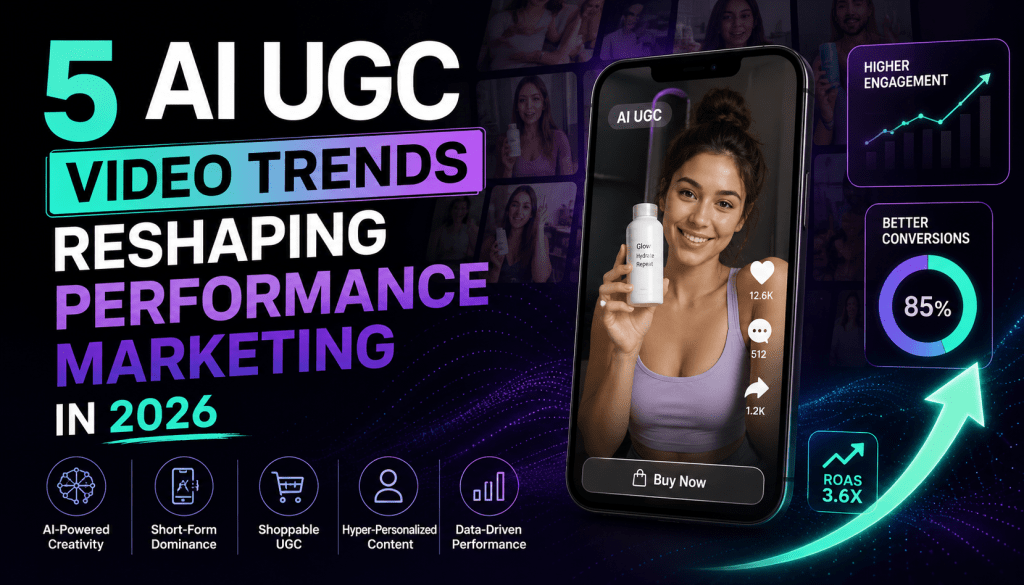
User-generated content (UGC) has quietly become the single most important creative format in paid social. It outperforms polished, studio-shot ads on almost every metric that matters click-through rate, cost per acquisition, watch time, and trust. But the way brands produce UGC has changed completely in the last two years, and 2026 is the year that shift has fully matured.
Where UGC used to mean sourcing real creators, negotiating usage rights, shipping products, and waiting weeks for raw footage to come back, it now increasingly means opening a laptop, writing a prompt, and generating a finished, ad-ready video in minutes. AI hasn’t just made UGC faster to produce it has changed who can produce it, how much of it gets made, and how quickly brands can react to what’s working.
This shift is not a minor efficiency gain. It’s restructuring entire marketing teams, reshaping how much budget goes toward creator relationships versus software, and forcing performance marketers to rethink what “authentic” even means when the “user” in user-generated content might be an AI avatar. Below are the five biggest trends driving this transformation in 2026, along with the tools leading the charge in each category.
1. AI Actors Are Replacing the Creator-Dependency Model
For nearly a decade, UGC ads meant one thing operationally: find real people, pay them, brief them, wait for them to film, and hope the footage matches what you had in mind. Even well-run creator programs came with structural bottlenecks sourcing takes time, usage rights need negotiating, revisions require another round of filming, and scaling to dozens of creative variations means dozens of separate relationships to manage.
That bottleneck is disappearing fast. AI-generated actors photorealistic digital presenters who can deliver a script, react on camera, and hold a product up to the lens exactly like a human creator would are now good enough to run in live paid campaigns. Combined with automated editing, built-in scripting, and campaign-ready export formats, these tools let performance teams launch and iterate ad variations in minutes instead of weeks, without a single creator ever being contacted.
This isn’t a hypothetical shift. Marketers who’ve moved from creator-dependent workflows to AI-generated ads consistently report being able to launch and test campaigns far faster than before, simply because the production loop no longer includes another human’s schedule.
Tool to watch: UGCad AI is built specifically for brands that want to skip the creator-hiring cycle entirely. Instead of briefing a creator and waiting for footage, teams describe the product, hook, and angle they want, and UGCad AI generates a realistic, ad-ready UGC-style video featuring an AI presenter. It’s a strong fit for teams that prioritize speed, scale, and rapid A/B testing over building long-term creator relationships especially useful for performance teams running dozens of hook and angle variations per week across TikTok, Reels, and Shorts.
2. Speed-to-Launch Is the New Competitive Edge
If there’s one theme underlying every other trend on this list, it’s velocity. The single biggest advantage AI UGC unlocks isn’t cost savings plenty of teams still spend similar budgets it’s how fast an idea can go from brief to live ad.
In a traditional UGC pipeline, a single creative concept might take a week or more: briefing a creator, waiting for filming, requesting a revision, then handing footage to an editor. By the time the ad is live, the trend or hook that inspired it may already be fading. AI-native workflows compress that entire cycle into hours. A marketer can write three different hooks in the morning, have finished video variations by lunch, and have live data on which one is winning by the next day.
This matters enormously for paid social, where creative fatigue happens fast and algorithms reward accounts that keep feeding them fresh, high-signal content. Teams that can produce ten tested variations a week will consistently outperform teams stuck producing two.
Tool to watch: UGCad AI Because it collapses scripting, filming, editing, and voiceover into a single AI-driven workflow, UGCad AI lets teams test meaningfully more creative variations per week than a traditional UGC pipeline could produce in a month. For performance marketers running iterative testing loops swap the hook, swap the CTA, swap the “creator” that kind of throughput is the whole game.
3. Commerce-Native UGC: Product Data Meets Video Creative
A newer and less-discussed trend in 2026 is the merging of UGC with commerce infrastructure. For years, UGC lived almost entirely in the top of the funnel a testimonial-style ad that drove a click, after which the shopper landed on a fairly standard product page. That’s changing. Brands are now wiring UGC directly into their product catalogs so that video and photo content becomes shoppable, taggable, and synced to live inventory and pricing.
Instead of a UGC video being a disconnected asset that lives only in an ad account, it becomes part of the storefront itself: shoppable Instagram and TikTok-style feeds embedded on-site, UGC galleries organized by product, and tagged content that lets a shopper go from “this looks authentic” to “add to cart” without leaving the page. As the volume of AI-generated UGC explodes, this layer actually merchandising and organizing that content becomes just as important as generating it in the first place.
Tool to watch: Tagshop AI Tagshop AI focuses on turning UGC and influencer content into shoppable, on-site experiences. It helps brands build shoppable Instagram and TikTok-style galleries, tag UGC directly to specific products in the catalog, and sync that content with live inventory so browsing feels social rather than transactional. As brands generate more AI UGC video than ever with tools like UGCad AI, Tagshop AI becomes the natural next step in the pipeline turning a flood of raw creative into an organized, shoppable, conversion-driving layer on the site itself rather than letting it live only as ad creative that disappears after the campaign ends.
4. Hyper-Personalization at Scale (Avatars + Voice Cloning)
Generic, one-size-fits-all UGC is quietly losing ground to hyper-personalized variants of the same core ad. Instead of producing a single “creator” video and running it everywhere, brands are now generating dozens of variants from one creative brief different AI avatars, different cloned voices, different scripts tailored to specific audience segments, funnel stages, or even languages.
What this looks like in practice: the same product story gets localized into ten languages with native-sounding voiceovers, tested with a younger-skewing avatar for one segment and an older-skewing one for another, and reworded with a discount-led hook for retargeting audiences versus a discovery-led hook for cold traffic. None of this requires re-shooting anything. It’s the same underlying video concept, re-rendered dozens of times with different presenters, voices, and copy.
This kind of personalization used to be reserved for the biggest brands with the biggest production budgets. Now it’s accessible to teams of any size, because the marginal cost of generating “one more version” of a UGC ad has dropped close to zero. The brands winning with this trend aren’t necessarily the ones with the best single ad they’re the ones running the most well-targeted variants of a good ad simultaneously.
5. Creative Is Now the Targeting Signal
Perhaps the most structural shift happening in 2026 isn’t about production at all it’s about distribution. Ad platforms like Meta’s Advantage+ and Google’s Performance Max have moved away from relying primarily on manually defined audiences and interest targeting. Instead, these systems now analyze the creative asset itself the visual cues, spoken audio, on-screen captions, pacing, and even the implied context of a scene to decide who should see the ad.
This changes what “good” UGC creative actually means. It’s no longer enough for a video to look authentic to a human scrolling past it; it also has to be legible to the algorithm deciding its distribution. Clear spoken hooks in the first few seconds, accurate on-screen captions, natural pacing, and unambiguous visual context all help these AI-driven systems match the ad to the right audience automatically often more precisely than manual targeting ever could.
For brands producing AI-generated UGC at scale, this means creative quality and creative structure now directly influence media efficiency, not just engagement. A poorly captioned or ambiguously framed AI UGC video may struggle even with a strong hook, simply because the algorithm can’t parse it as easily as a clean, well-structured one.
The Takeaway
AI UGC video is no longer an experimental format sitting alongside traditional creator content it has become the default performance-creative engine for 2026. The brands pulling ahead are the ones treating it as a full system rather than a single tool, combining:
- Generation – tools like UGCad AI for fast, scalable, AI-actor-driven UGC video that removes the creator-sourcing bottleneck entirely.
- Merchandising – tools like Tagshop AI for turning that growing volume of UGC into shoppable, on-site experiences that drive conversion, not just awareness.
- Personalization at scale – generating dozens of avatar, voice, and language variants from a single creative brief to match every audience segment.
- Platform-native optimization – building creative that’s structured to be read correctly by algorithmic targeting systems, not just by human viewers.
The common thread across all five trends is that UGC has stopped being treated as a one-off campaign asset and started being treated as an always-on production system one that runs continuously, tests constantly, and feeds both paid media and on-site commerce at the same time. Brands still running UGC the old way one creator, one video, one placement are going to find themselves outpaced by competitors who’ve turned it into an AI-powered pipeline.


Leave a comment