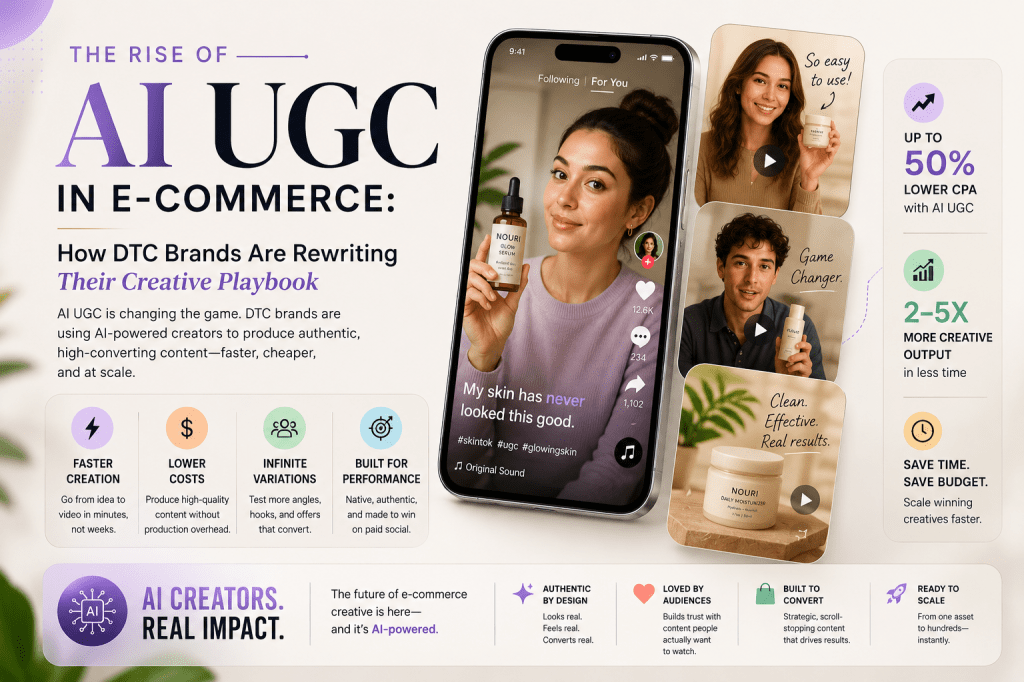
For most of the last decade, the playbook for direct-to-consumer advertising followed a predictable shape. A brand would identify a product worth pushing, source a handful of UGC creators, brief them, wait one to two weeks for footage, edit the results, and hope the ad angle they’d bet on was still relevant by the time it finally reached an ad account. It worked, but it was slow, and slow creative has always been the quiet tax that performance marketing teams pay without fully accounting for it.
That playbook is changing fast, and the shift has a name now: AI UGC. Understanding what it actually is, how it works, and where it genuinely helps (versus where the hype outruns the reality) has become a real strategic question for any e-commerce or DTC brand running paid social in 2026.
The Bottleneck Nobody Talks About Enough
Ask any performance marketer what actually limits their ad account’s growth, and the honest answer is rarely “budget.” It’s creative supply. Meta and TikTok’s algorithms reward accounts that continuously feed them new variants different hooks, different angles, different visual treatments of the same core offer. An account testing three ad variants a month is competing against one testing thirty a week, and the volume gap alone often decides who finds a winning angle first.
Traditional UGC production was never built for that pace. Sourcing a creator, negotiating a brief, waiting on delivery, and handling revisions is a process measured in days and dollars per asset typically somewhere between $150 and $500 per video once you account for a creator’s time, plus another one to four weeks before that asset is even ready to test. For a brand trying to ship dozens of variants a week, that math simply doesn’t close.
This is the actual reason AI UGC moved from a curiosity to a default line item in serious DTC marketing stacks. It isn’t that AI content is inherently better than human-shot footage in plenty of cases it still isn’t. It’s that AI collapses the cost and timeline of producing a testable variant down to something that finally matches the pace the algorithm actually rewards.
What “AI UGC” Actually Means
The term itself is a small contradiction user-generated content, by definition, comes from users, and AI UGC comes from neither a user nor a creator in any traditional sense but the phrase has stuck because the output is designed to mimic exactly what real UGC looks like: a person (real or synthetic) talking directly to camera about a product, filmed in a way that feels native to a TikTok or Instagram feed rather than a polished commercial.
A typical AI UGC video is built from a handful of layered technologies working together. There’s an AI avatar either a stock digital human or a personalized “twin” trained on someone’s actual face and voice delivering the message. There’s synthetic voice generation, increasingly capable of cloning a real person’s voice from a short sample. There’s a script layer that writes the actual ad copy, usually following proven direct-response structures. And there’s a rendering and post-production layer that handles captions, B-roll, and export formatting.
None of this is trying to deceive anyone into thinking a real creator filmed the ad most platforms are moving toward disclosure requirements for exactly this reason. What it’s trying to do is produce something that performs the way real UGC performs: personal, slightly imperfect, native to the feed, and cheap enough to make at real volume.
If you want a deeper technical breakdown of how the full generation pipeline actually works avatars, voice, script, and render this guide on what AI UGC actually is goes through each layer in more detail than fits here.
The Shift From Prompt-Only to Product-Grounded Generation
The single biggest quality leap in this category over the past year or two has had almost nothing to do with avatars looking more realistic, and everything to do with where the generation process actually starts.
Early AI video tools worked from a blank text prompt: describe the product, describe the angle, and hope the output matches what you had in mind. The problem was structural a prompt-only tool has no actual knowledge of your product beyond what you type, so the output is often generically product-shaped rather than accurate to what you’re actually selling. A supplement brand might get a bottle that looks nothing like their real packaging.
A fashion brand might get a garment that resembles their product only in the loosest sense.
The more useful generation of tools flipped that starting point entirely. Instead of a blank prompt, you provide something real a product URL, an existing photo, a reference video and the system extracts actual visual and descriptive data from it. The output reflects the real product, not an AI’s best guess at what a product in that category might look like. This single change is responsible for most of the credibility AI UGC has earned with skeptical marketers who tried the earlier, prompt-only generation and walked away unimpressed.
Real UGC vs AI UGC: An Honest Comparison
Neither format is objectively superior they solve different problems, and the brands getting the most value out of AI UGC right now are almost universally using both, not choosing one over the other entirely.
Real UGC still wins decisively in a few specific situations. Anything depending on genuine personal trust a founder-led testimonial, a category where the audience specifically wants a real human’s lived experience (parenting products, medical-adjacent categories, professional services) benefits from the fact that it is real, and audiences can often sense the difference even when they can’t articulate why. Real creators also handle novel, complex physical demonstrations better than any current AI avatar can.
AI UGC wins on nearly every other dimension that matters for volume-driven testing: speed (minutes instead of weeks), cost (often a fraction of a dollar per render versus hundreds of dollars per creator video), script control (you write exactly what gets said, with no negotiation), and localization (a single asset can be re-voiced into dozens of languages in the time it takes to click a button, versus recoordinating with local creators market by market).
The practical pattern that’s emerged among the most sophisticated DTC teams: use AI UGC as the discovery engine, testing dozens of angles weekly to find what resonates, then hand the 2-3 winning angles to real creators for a premium, higher-trust version once you already know the angle converts. This comparison of AI UGC against real UGC walks through the tradeoffs in more depth, including where the line actually sits by product category.
How to Actually Get Started Without Wasting the First Month
Most brands trying AI UGC for the first time make the same mistake: they treat it as a creative-discovery tool before they’ve done the strategic thinking that should come first.
The right sequence starts with an angle you already have some conviction about ideally one that’s already shown some signal in a real ad account, even a weak one rather than starting from a blank concept and hoping AI generation reveals a winning strategy from nothing. AI UGC is best used to scale and test variations of something you already believe in, not to discover strategy from zero.
From there, pick your simplest, best-selling product to start with. Complex products with a learning curve or multi-step usage tend to need more iteration to get the script and visual sequencing right; a straightforward product gives you a cleaner first test of the tool itself before you throw a harder case at it.
Generate several variants of the same core angle rather than a single video a lone video tells you almost nothing, since you have no baseline for comparison. Vary one element at a time across the set (the hook, the avatar, the visual pacing) so that whatever wins actually tells you which lever drove the result, not just that “one of them worked.” And critically, review every single output before it goes live. AI-generated content can occasionally produce something subtly wrong a mismatched product detail, an odd phrasing, a visual glitch and catching that before a real ad account sees it is still, and will remain, a human responsibility.
For a full walkthrough of this exact workflow, from first product URL to a launched, tested ad set, this step-by-step guide to creating AI UGC video ads covers the process end to end, including the specific script structure and testing matrix that tends to produce usable results fastest.
The Tooling Landscape, Briefly
The category has moved quickly enough that meaningfully different approaches have emerged among the tools available, and picking one is less about which is “best” in the abstract and more about which approach matches your actual starting point.
Some platforms remain firmly prompt-first, and are strongest for general creative exploration where you don’t have a specific product asset to anchor the generation. Others ugcad.ai among them are built specifically around the product-grounded approach described earlier, pulling real data from a submitted product URL rather than working from description alone, and pairing that with features like structure-cloning, where the format of an already-proven ad gets rebuilt around a different product instead of generating from a blank page each time. Still others specialize narrowly in avatar realism or multi-language voice generation as their core differentiator.
None of this is a case for any single tool being universally correct. It’s worth testing two or three options directly against your own product catalog before committing, since output quality in this category still varies meaningfully by product type and category what performs well for a skincare brand’s talking-head format doesn’t necessarily transfer to a kitchen gadget’s demo-heavy needs. For a broader survey of the current field, this roundup of AI UGC generators compares the major options head-to-head.
Where Brands Get This Wrong
A few recurring mistakes are worth naming plainly, since they explain most of the disappointing first experiences people report with this category.
The most common is treating a single generated video as a conclusive test. Without a genuine set of variants isolating one changed variable at a time, “this ad worked” tells you almost nothing actionable you don’t know if it was the hook, the avatar, the angle, or pure noise. A second common mistake is over-scripting the avatar with formal, brand-manual-style language rather than natural spoken phrasing; AI delivery reads as stiff exactly in proportion to how stiff the script itself is. And the third, perhaps most damaging mistake, is skipping platform disclosure requirements Meta, TikTok, and YouTube are actively rolling out labeling requirements for synthetic content, and treating this as optional is both a compliance risk and, increasingly, something audiences themselves expect to be told.
Where This Is Heading
The trajectory over the next year or two points toward the distinction between AI UGC and real UGC mattering less and less to the audience watching it, even as it continues to matter enormously to the brand producing it because the economics and speed advantages compound the longer a team has been building a genuine testing discipline around the format.
Render times are shrinking from minutes toward seconds, which will eventually make the process genuinely iterative in a way it isn’t quite yet. Platform-native integrations are emerging that will eventually collapse the gap between “generate” and “test live” into a single workflow rather than a separate export-and-upload step. And the brands treating this as a core creative capability now building real institutional knowledge about what inputs produce what outputs, rather than treating it as a one-off experiment are the ones most likely to have a durable creative-output advantage over brands that wait until the category feels fully mature to take it seriously.
The Bottom Line
AI UGC isn’t a replacement for every kind of ad creative, and treating it as one misses both its actual strengths and its real limitations. What it has genuinely solved is the specific, expensive bottleneck that most performance marketing teams have quietly lived with for years: the gap between how much creative testing an algorithm rewards and how much creative production traditional workflows could realistically supply.
If your ad account has felt creative-constrained rather than budget-constrained, this is worth testing directly against your own product catalog rather than judging from general impressions of the category. The tools differ enough from each other that a single test on one platform won’t tell you much about AI UGC as a whole but the underlying shift, from scarce and slow creative to fast and genuinely testable creative, is one worth taking seriously regardless of which specific tool you land on.


Leave a Reply