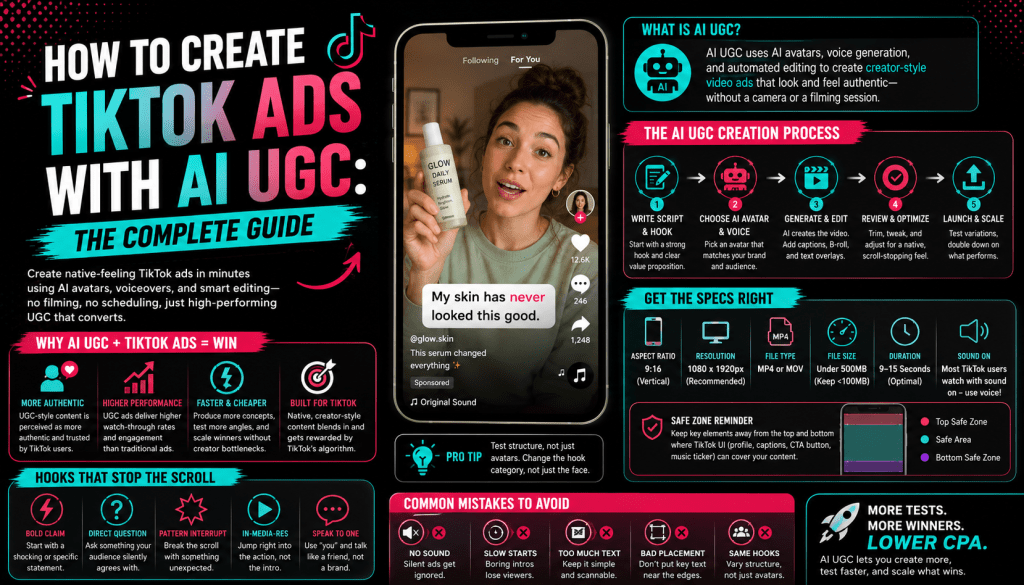
AI UGC lets brands produce TikTok-style, creator-look video ads without booking a filming session using AI avatars, voice generation, and automated editing to turn a product idea into a native-feeling ad in minutes instead of weeks. This guide covers exactly how the process works, the technical specs your ad needs to meet, how to structure a hook that actually holds attention, and the mistakes that quietly sink otherwise solid AI UGC AD campaigns.
Why AI UGC and TikTok ads are such a strong match
TikTok’s entire feed experience is built around native, creator-style content and its advertising system rewards ads that blend into that experience rather than interrupting it. UGC-style content is TikTok’s best-performing ad type by a wide margin, and it drives a large share of overall brand engagement on the platform. TikTok users also report finding UGC-style content noticeably more authentic than traditional branded ads, which explains why watch-through rates for UGC-style creative tend to run meaningfully higher than for polished, studio-produced ads.
This authenticity advantage isn’t unique to human-filmed content. What actually earns attention in the first few seconds is pacing, tone, and a native-feeling presentation not literally whether a human or an AI avatar is delivering the message. That’s the core reason AI-generated UGC has grown so quickly as a production method for TikTok ads specifically: it can replicate the same native, casual feel that makes UGC work, without the scheduling and cost overhead of booking a real creator for every single concept.
What “AI UGC” actually means
AI UGC refers to video ads generated using AI tools rather than filmed by a human creator typically using an AI avatar or a digital presenter to deliver a script, paired with AI-generated voiceover, automated captions, and templated editing. The goal is to produce something that looks and feels like an authentic, creator-made video, even though no camera or actor was involved in production.
This differs from traditional UGC (sourced from a real freelance creator) and from influencer marketing (which depends on an existing creator’s personal audience). AI UGC is closer in spirit to traditional UGC both are meant to look native and personal but it removes the human production bottleneck entirely.
Step 1: Get the technical specs right before anything else
Before writing a single hook, it’s worth locking in TikTok’s current ad specifications, since a spec violation is one of the most common reasons a submitted ad gets rejected or displays poorly.
Core video specs for TikTok In-Feed ads:
- Aspect ratio: 9:16 (vertical) is strongly recommended square and horizontal formats are technically accepted but tend to underperform meaningfully because they display with black bars and don’t fill the screen the way native content does
- Resolution: 1080 x 1920px is the recommended target; 540 x 960px is the technical minimum
- File format: MP4 or MOV
- File size: Under 500MB (keeping exports closer to 100MB or less avoids slow uploads and transcoding issues)
- Duration: TikTok technically supports much longer videos, but ads in the 9–15 second range consistently show the strongest completion rates and engagement that short window is where most successful TikTok UGC ads live
Safe zones matter more than most teams expect. TikTok’s interface profile icon, like/comment/share buttons, captions, the CTA button, and the music ticker sits on top of your video and can cover a meaningful portion of the frame. A rough rule of thumb: keep side margins clear (roughly 80px), and keep critical content your product, your key claim, your CTA away from the very top and very bottom of the frame, where UI elements are most likely to sit. Placing your product name, price, or a key visual detail near the bottom edge is one of the most common and avoidable production mistakes.
Sound matters more on TikTok than on almost any other platform. The overwhelming majority of TikTok users watch with sound on, which is unusual compared to feed-based video on other platforms. A silent AI UGC ad is at a real disadvantage voiceover and audio pacing should be treated as core to the ad, not an afterthought layered on at the end.
Step 2: Structure the hook before anything else
The first 1–3 seconds of a TikTok ad determine whether a viewer keeps watching or scrolls past, and this matters even more for AI UGC ads, since the format lives or dies on feeling native rather than looking like a commercial.
A few hook structures consistently perform well across product categories:
- Bold, specific claim — a surprising, concrete statement about the product or result, stated immediately rather than built up to
- Direct question — one the target viewer would silently answer “yes” to
- Pattern interrupt — a visual or verbal moment that breaks the expected scrolling rhythm (an unexpected reaction, an unusual camera angle, a mid-action start)
- In-media-res opening — starting as if the viewer walked in partway through something already happening, rather than a slow, scene-setting introduction
A common mistake with AI UGC specifically is generating many video variants that use different AI avatars but keep the identical opening line and pacing that’s producing more videos, not more genuinely different tests. Structural variation, where the hook category itself changes between variants, produces far more useful data than swapping only the presenter.
Step 3: Write for how TikTok viewers actually watch
TikTok viewers scroll fast and decide quickly, which means AI UGC ad scripts benefit from a different rhythm than longer-form video content:
- Lead with the payoff, not the setup. Don’t build slowly to the product reveal TikTok viewers have usually already decided whether to keep watching before a slow build pays off.
- Keep sentences short and conversational. AI-generated voiceover reads more naturally, and holds attention better, when scripted in short, spoken-style sentences rather than formal written copy.
- Show the product early and often. Ambiguity about what’s actually being advertised is a fast way to lose a scrolling viewer.
- End with a single, clear action. A cluttered CTA with multiple asks tends to underperform a single, specific instruction.
Step 4: Choose the right AI UGC production approach
Once the script and structure are set, there are a few practical approaches to generating the actual video:
- AI avatar presentation — a digital presenter delivers the script on camera, styled to look like a natural, handheld-style creator video
- Product-focused generation — the AI avatar interacts with or demonstrates the product directly, useful for unboxing-style or demo-style ad structures
- Template-based generation — starting from a pre-built structure (proven hook placement, pacing, and scene flow) and substituting in new product details, rather than building the structure from scratch each time
Whichever method is used, the same underlying rule applies: matching the AI avatar’s tone, energy, and delivery style to the platform matters more than raw visual polish. An avatar that reads as overly formal or corporate will undercut the native feel that makes UGC-style ads work in the first place, regardless of how realistic the avatar itself looks.
Step 5: Localize and adapt for different markets
If a campaign is running across multiple regions, AI-generated voiceover makes it possible to adapt a validated ad structure into new languages without re-filming anything. The more efficient approach is to validate a winning structure in one market first, then localize only the confirmed winners rather than translating an entire creative library upfront before knowing which structures actually resonate.
Step 6: Measure the right metrics at the right time
Different metrics become meaningful at different points after a TikTok ad launches, and reading them in the wrong order is a common reason a genuinely strong ad gets pulled too early:
- 3-second view rate / thumbstop rate — available almost immediately, and tells you specifically whether the hook is earning attention
- Watch time / completion rate — available within a day or two, and tells you whether the middle of the ad holds interest once the hook has worked
- Click-through rate — takes longer to stabilize, and reflects both the ad and the strength of the CTA
- Cost per result / ROAS — the slowest metric to stabilize, since it depends on downstream factors like the offer and landing page, not just the ad itself
Checking cost-per-result before checking hook-level metrics is one of the most common ways a well-structured AI UGC ad gets judged unfairly a weak early CPA number doesn’t necessarily mean the ad failed; it may just mean the account hasn’t accumulated enough conversion data yet.
Choosing the right ad format for AI UGC content
Not every TikTok ad format suits AI-generated UGC content equally well.
In-Feed ads are the most common format and the best default starting point for AI UGC they appear natively in the For You feed, support the full range of durations and specs covered above, and give advertisers direct control over targeting and budget through TikTok Ads Manager.
Spark Ads boost an existing organic TikTok post rather than uploading a separate ad creative, and they display under the original account’s profile rather than the advertiser’s brand account. This format works well when an AI UGC video has already been posted organically and shown early signs of traction boosting a post that’s already proven itself organically tends to outperform boosting an untested one.
TopView ads appear the moment a user opens the app full-screen and impossible to miss but they’re a reservation-based buy rather than an auction, typically requiring assets submitted several business days ahead of the flight date, and they carry stricter creative review. This format is generally better suited to a validated, high-confidence AI UGC concept than to early-stage structural testing.
For most brands starting out with AI UGC, In-Feed ads remain the most practical format to test structural variants quickly, with Spark Ads used to amplify whichever concepts show strong organic signals first.
Common mistakes to avoid
Treating AI avatars as a substitute for a strong script
A polished AI presenter delivering a weak, unstructured script will still underperform a rougher-looking video with a genuinely strong hook and clear structure. The avatar’s realism is not the primary performance lever.
Ignoring safe zones during export
A perfectly scripted ad that gets its key claim or CTA covered by TikTok’s UI elements loses much of its intended impact always preview the final export with TikTok’s interface overlay in mind, not just as a clean, uncovered video file.
Running silent or poorly mixed audio
Given how overwhelmingly TikTok is a sound-on platform, deprioritizing voiceover quality or pacing is a disproportionately costly mistake relative to how little attention it usually gets in production.
Producing surface variation instead of structural variation
Generating ten AI UGC videos that all share the same hook and pacing, just with different avatars, tests the same idea ten times rather than genuinely expanding what’s been learned.
Skipping the testing loop entirely
AI UGC’s biggest practical advantage is production speed, but that advantage is wasted if a brand generates one ad and runs it indefinitely rather than using the speed to run a genuine, ongoing testing cycle.
Frequently asked questions
Do AI UGC ads perform as well as ads filmed by real creators on TikTok?
Performance is driven more by hook strength, structure, and native feel than by whether the presenter is human or AI-generated. For general product demonstration and testing at volume, AI UGC ads can perform comparably; trust-heavy product categories still tend to favor a real, identifiable presenter.
What video length works best for TikTok ads made with AI UGC?
TikTok supports videos well beyond a minute, but ads between 9 and 15 seconds consistently show the strongest completion rates, and that range works well for AI UGC ads specifically since it matches the fast, native pacing viewers expect on the platform.
Do TikTok viewers know when an ad uses an AI avatar?
Not always, and TikTok doesn’t require on-screen disclosure purely for using an AI-generated presenter in most standard ad formats though brands should always check current platform policy, since disclosure requirements around AI-generated content continue to evolve.
What’s the biggest technical mistake brands make with AI UGC TikTok ads?
Ignoring safe zones during export. A well-structured ad can still underperform if its CTA, price, or key visual detail ends up covered by TikTok’s interface elements once it’s live in the feed.
How many AI UGC ad variants should a brand test at once?
There’s no fixed number, but testing several variants that each change a single structural element the hook, the proof format, or the tone produces far more useful data than testing many variants that only change the presenter while keeping everything else identical.


Leave a Reply