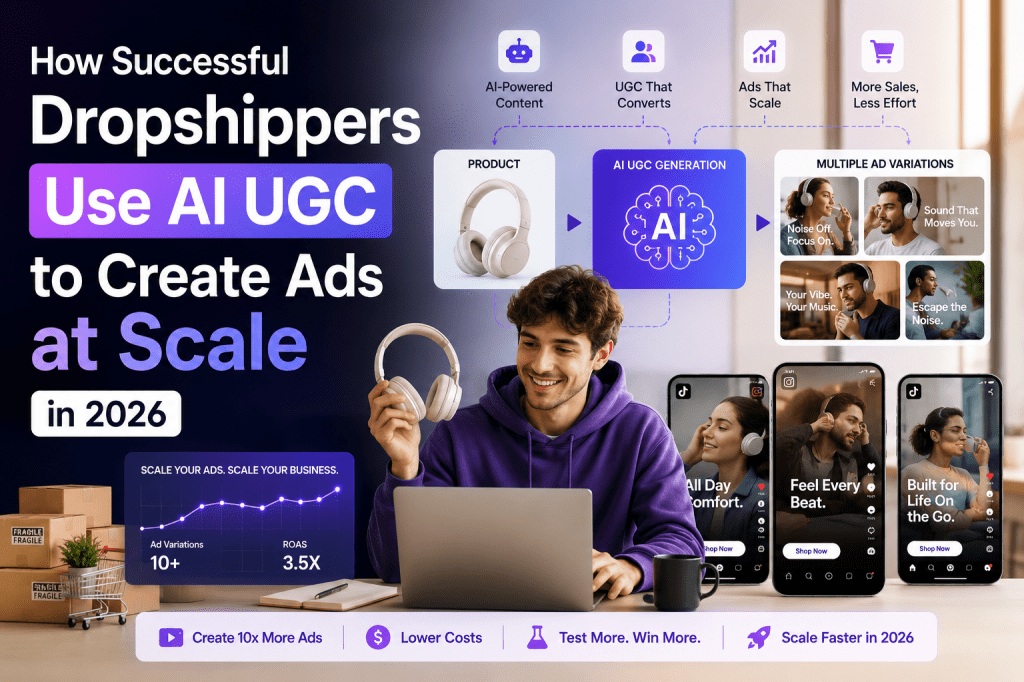
In 2026, the biggest advantage in dropshipping isn’t finding the next winning product—it’s creating enough content to test and scale that product before competitors do.
A few years ago, launching a dropshipping campaign meant hiring creators, negotiating rates, waiting days for revisions, and spending hundreds or even thousands of dollars before a single ad went live. Today, successful dropshippers are taking a different approach. They’re using AI UGC to create dozens of ad variations in hours instead of weeks.
The result? Faster testing, lower content costs, and significantly more opportunities to find winning creatives.
I’ve worked with ecommerce brands and performance marketers who struggled to keep up with the demand for fresh ad creatives. The pattern was always the same: the product wasn’t the problem. The bottleneck was content production. Once AI-powered UGC entered the picture, everything changed.
If you’re a dropshipper, SaaS marketer, creator, or small business owner looking to scale advertising without scaling production costs, this guide is for you.
By the end, you’ll understand exactly how top-performing dropshippers use AI UGC video generators, the frameworks they follow, and the mistakes you should avoid.
Why AI UGC Matters More Than Ever in 2026
The ecommerce landscape has become brutally competitive.
Consumer attention spans are shrinking. Advertising costs continue to rise. Platforms like TikTok, Instagram Reels, Facebook, and YouTube Shorts reward fresh content and punish creative fatigue.
The challenge isn’t launching ads.
The challenge is launching enough ads.
Successful dropshippers often test:
- Multiple hooks
- Different audience angles
- Various video lengths
- Alternative product benefits
- Several creator styles
A single product can require 20–50 creative variations before a clear winner emerges.
Creating those variations manually is expensive.
This is where AI UGC changes the game.
What Is AI UGC?
AI UGC (Artificial Intelligence User-Generated Content) refers to AI-generated videos designed to look and feel like authentic creator content.
Instead of hiring multiple creators, marketers can generate videos using:
- Product images
- Product URLs
- AI avatars
- AI voiceovers
- Automated scripts
- AI-generated scenes
The goal isn’t to replace authenticity.
The goal is to create scalable, testable content that mirrors the style consumers already engage with.
Think of AI UGC as having a virtual creative team available 24/7.
The Economics Behind AI UGC
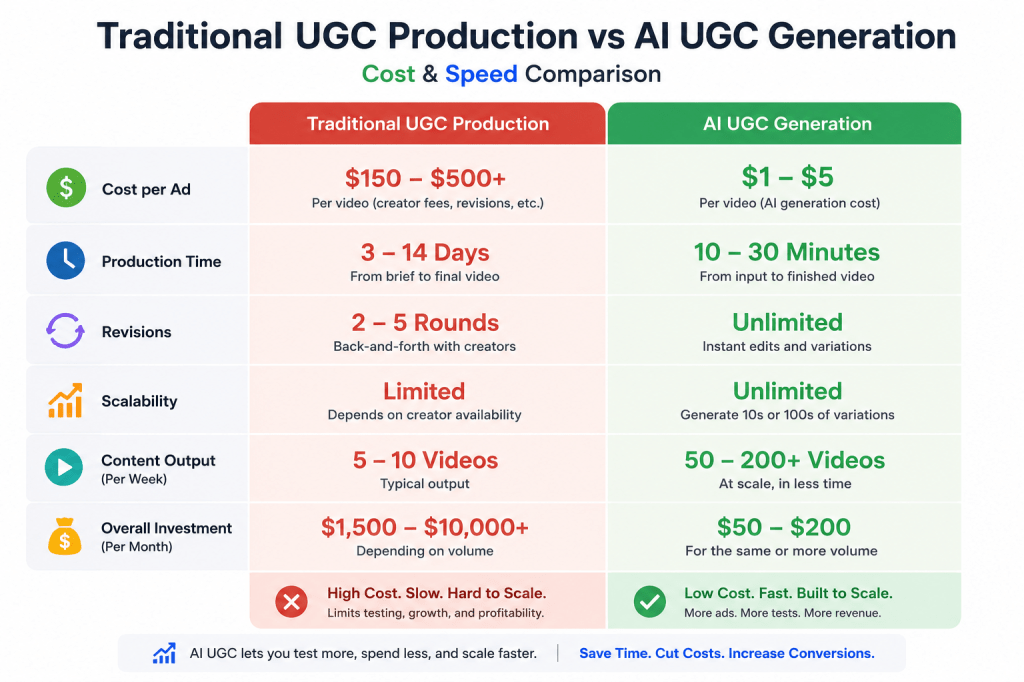
Let’s compare a traditional workflow against an AI-powered workflow.
| Method | Cost Per Video | Turnaround Time | Scalability |
| UGC Creator | $150–$500 | 3–14 Days | Limited |
| Agency Production | $500–$2,000+ | 1–3 Weeks | Moderate |
| AI UGC Generator | Few Dollars | Minutes | Extremely High |
For dropshippers operating on tight margins, this difference can determine whether a campaign scales or fails.
How Successful Dropshippers Use AI UGC to Scale Faster
The best dropshippers don’t simply generate one video and hope it works.
They build systems.
Step 1: Generate Multiple Hooks First
The opening three seconds determine whether viewers continue watching.
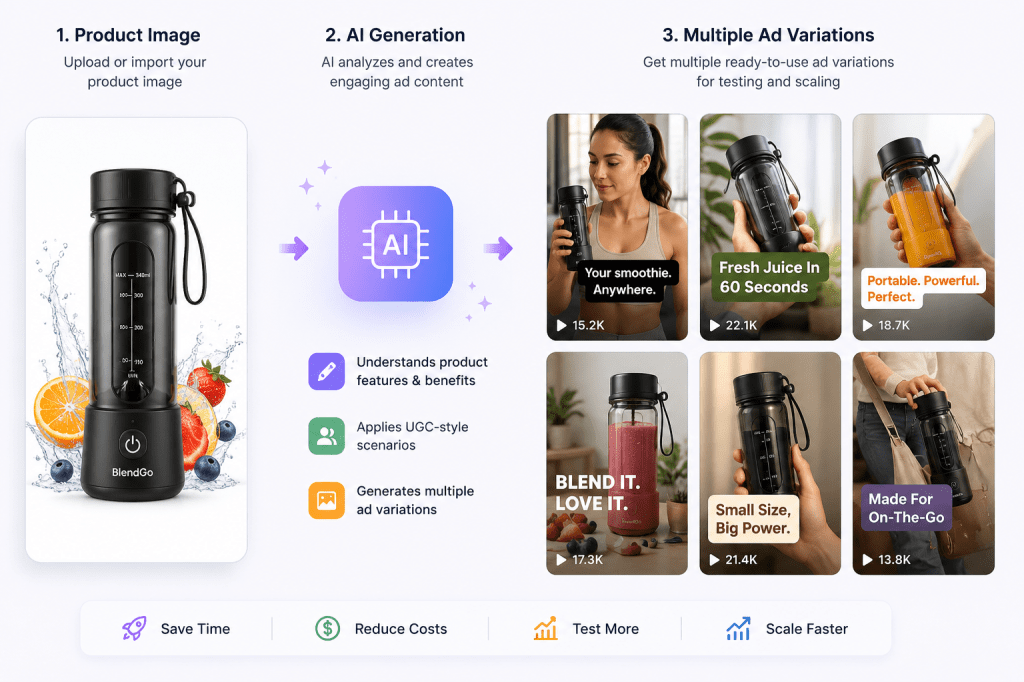
Top-performing dropshippers create multiple hook variations such as:
- “I wish I found this product sooner.”
- “This solved a problem I had for years.”
- “TikTok made me buy this—and here’s why.”
- “Don’t buy this until you see this.”
Instead of testing one concept, they test ten.
Even small hook changes can dramatically improve click-through rates.
Step 2: Create Different Creator Personas
One common mistake is using a single style of content.
Winning brands create multiple creator perspectives:
- Product reviewer
- Lifestyle influencer
- Everyday customer
- Problem-solution storyteller
- Industry expert
Different audiences respond to different personalities.
A product that performs poorly with one creator style may become profitable with another.
Pro Tip
Many successful dropshippers generate 20–30 AI UGC videos before spending heavily on ads. Creative testing is often cheaper than audience testing.
Ask yourself:
What if your next winning ad is simply one hook away from success?
Step 3: Focus on Benefits, Not Features
New dropshippers often showcase product specifications.
Experienced marketers focus on outcomes.
Instead of saying:
“Includes a 5,000mAh battery.”
They say:
“Charge your phone for days without searching for an outlet.”
People buy solutions, not specifications.
AI UGC tools make it easy to generate multiple benefit-focused angles quickly, allowing marketers to discover which emotional trigger converts best.
Step 4: Use AI UGC for Continuous Testing
The biggest brands never stop testing.
When an ad performs well, they don’t celebrate for long.
They create:
- New hooks
- New thumbnails
- New voiceovers
- New testimonials
- New story structures
This prevents ad fatigue and keeps campaigns profitable longer.
Many seven-figure dropshipping stores now rely on AI-generated content pipelines to maintain a constant flow of fresh creatives without increasing production costs.
Common AI UGC Mistakes That Kill Ad Performance
AI UGC can dramatically increase creative output, but it isn’t magic. I’ve seen brands generate hundreds of videos and still struggle because they make a few avoidable mistakes.
Mistake #1: Creating Generic Videos
Consumers have become better at recognizing generic content.
If every video sounds the same, your ads blend into the feed.
Instead of creating broad messages, focus on:
- Specific pain points
- Clear customer outcomes
- Unique product use cases
- Real-world scenarios
The more specific your message, the more relatable it feels.
Mistake #2: Ignoring Platform Behavior
A TikTok user behaves differently than a Facebook user.
Successful dropshippers adapt:
- TikTok → Fast-paced, trend-driven content
- Instagram Reels → Lifestyle-focused storytelling
- Facebook → Problem-solution and testimonial ads
- YouTube Shorts → Educational and demonstration content
One video rarely performs equally across every platform.
Mistake #3: Testing Too Few Variations
Many marketers create three videos and call it testing.
Top-performing stores often test:
- 10+ hooks
- 5+ creator styles
- Multiple CTAs
- Different visual sequences
The winning ad often appears after dozens of creative experiments.
A Simple AI UGC Scaling Framework
When a product starts gaining traction, successful dropshippers typically follow this framework.
Phase 1: Validation
Goal: Determine whether the product has potential.
Create:
- 5 hooks
- 3 creator personas
- 2 benefit angles
Total: 30 ad combinations
Run small-budget tests and identify top performers.
Phase 2: Optimization
Take the best-performing creative and expand it.
Test:
- Different opening scenes
- New CTAs
- Alternative voiceovers
- Regional messaging variations
The objective is improving conversion rates without changing the core concept.
Phase 3: Scaling
Once profitability is established:
- Launch additional AI UGC variations weekly
- Refresh creative every 7–14 days
- Build creator-style content libraries
- Expand to additional platforms
This creates a sustainable growth engine rather than relying on one viral ad.
Beginner vs Intermediate AI UGC Strategies
For Beginners
If you’re just starting:
- Focus on one product.
- Generate 10–15 AI UGC videos.
- Test multiple hooks.
- Track engagement metrics carefully.
- Improve based on results.
Avoid overcomplicating the process.
Simple execution beats complex planning.
For Intermediate Marketers
If you’re already running ads:
- Create creative testing frameworks.
- Build content production workflows.
- Automate script generation.
- Develop creator-style content libraries.
- Refresh winning ads continuously.
At this stage, efficiency becomes your competitive advantage.
The AI UGC Tools Successful Dropshippers Use
The AI content ecosystem has matured significantly over the last few years.
Today, marketers use AI tools for:
Script Creation
AI helps generate:
- Hooks
- Ad scripts
- Product descriptions
- Testimonial angles
AI UGC Video Generation
Modern AI video tools can create:
- Creator-style videos
- Product showcases
- Review-style content
- Problem-solution advertisements
Platforms like Tagshop AI allow marketers to generate AI UGC videos from product images and prompts, reducing production time from days to minutes.
Creative Testing
AI can help marketers:
- Generate multiple ad variants
- Rewrite messaging
- Create localized versions
- Scale winning concepts faster
The goal isn’t replacing human creativity.
It’s multiplying it.
Pro Tip
Don’t use AI to replace strategic thinking.
Use AI to remove repetitive work so you can spend more time understanding customers.
That’s where real growth happens.
Why AI UGC Works So Well for Dropshipping
Think about how consumers browse social media today.
They’re not looking for polished commercials.
They’re looking for recommendations.
They’re looking for proof.
They’re looking for authenticity.
Traditional ads often feel like advertisements.
Good AI UGC feels like content.
That distinction matters.
When viewers stop feeling like they’re being sold to, engagement increases naturally.
This is why AI UGC has become one of the fastest-growing creative formats in ecommerce.
What the Future of AI UGC Looks Like
The next generation of AI UGC will be even more personalized.
We’re already seeing tools capable of:
- Dynamic video generation
- Personalized messaging
- AI creators with unique personalities
- Automated creative optimization
- Real-time ad adaptation
Imagine generating different ad versions for different customer segments automatically.
That’s where the industry is heading.
Brands that build AI-powered creative workflows today will have a major advantage tomorrow.
AI UGC Ad Scaling Checklist
Use this checklist before launching your next campaign:
- Identify the product’s primary pain point.
- Generate at least five unique hooks.
- Create multiple creator personas.
- Focus on benefits rather than features.
- Test multiple CTAs.
- Adapt content for each platform.
- Monitor engagement metrics.
- Refresh creatives regularly.
- Scale winning concepts quickly.
- Continue testing even after success.
Frequently Asked Questions
How do successful dropshippers use AI UGC?
They use AI UGC to create multiple ad variations quickly, test creative concepts at scale, reduce production costs, and identify winning advertisements faster.
Is AI UGC better than traditional UGC?
Not necessarily. Traditional UGC can still perform exceptionally well. However, AI UGC offers speed, scalability, and affordability that traditional content production often cannot match.
Can AI UGC improve Facebook and TikTok ad performance?
Yes. AI UGC allows marketers to test more hooks, formats, and messaging angles, increasing the chances of finding high-performing creatives.
How many AI UGC ads should I test?
Most successful advertisers test at least 10–30 variations before scaling budgets. More testing generally leads to better insights.
What is the biggest benefit of AI UGC for dropshipping?
Speed. Brands can create, test, and optimize content significantly faster than traditional production methods.
Internal Link Opportunities
- AI UGC Video Maker: Complete Guide
- How to Create High-Converting UGC Ads
- Best AI Video Generators for Ecommerce
- AI Product Photography Guide
- TikTok Ad Creative Best Practices
- Facebook Ad Testing Framework
- AI Marketing Automation Strategies
External Link Opportunities
- Google Ads Creative Best Practices
- Meta Ads Performance Resources
- TikTok Creative Center
- HubSpot Marketing Research
- Shopify Ecommerce Reports
Final Thoughts
The most successful dropshippers in 2026 aren’t winning because they have secret products.
They’re winning because they can create, test, and optimize content faster than everyone else.
AI UGC gives brands the ability to generate dozens of creative variations, discover winning messages quickly, and scale profitable campaigns without massive production budgets.
If you’re just getting started, focus on testing more hooks and creator styles. If you’re already running campaigns, build a repeatable AI-powered creative system that continuously produces fresh content.
The brands that master AI UGC today will be the ones setting the pace for ecommerce growth tomorrow.
Now I’d love to hear from you: What’s your biggest challenge with creating ad creatives at scale? Share your experience in the comments, and don’t forget to download our AI UGC testing checklist to streamline your next campaign.
Happy scaling.


Leave a Reply