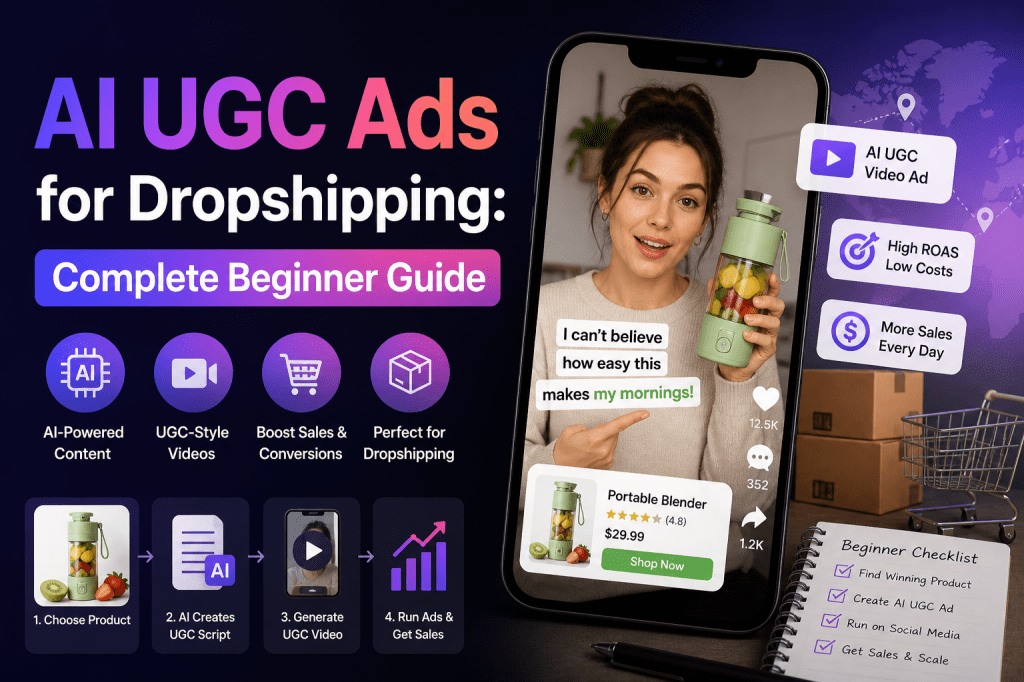
Ask any dropshipper what their biggest challenge is, and the answer is almost always the same: ads.
Not finding products. Not setting up a store. Not even fulfillment. It’s the content — specifically, the kind of authentic, trust-building video content that actually makes strangers on the internet click “Buy Now.”
Traditional UGC (user-generated content) has long been the secret weapon of successful dropshippers. Videos that look and feel like real customer testimonials, unboxings, and lifestyle clips consistently outperform polished brand ads because they feel real. They trigger trust. And in dropshipping, trust is everything.
The problem? Getting real UGC as a new dropshipper is painful. You don’t have customers yet. You can’t afford to send free products to a dozen influencers. And hiring UGC creators on platforms like Fiverr or Billo adds up quickly — especially when you’re testing multiple products.
Enter AI UGC video ads — the game-changer that’s giving beginners the same creative firepower as established brands, at a fraction of the cost and time.
This complete beginner guide will walk you through exactly what AI UGC video ads are, why they work so well for dropshipping, and a step-by-step process to launch your first campaign — even if you’ve never made a video in your life.
What Are AI UGC Video Ads?
AI UGC video ads are short-form video advertisements that are created using artificial intelligence to replicate the authentic look and feel of user-generated content. Instead of hiring real creators or waiting for customers to post reviews, AI tools generate realistic video content featuring AI avatars, synthetic voiceovers, and natural-sounding scripts — all designed to mimic the trust-building energy of genuine customer testimonials.
Think of it this way: imagine a real customer picking up your product, talking directly to the camera about how it solved their problem, and recommending it to their followers. Now imagine being able to create that exact type of content — in multiple formats, with multiple personas, for any product — in under an hour.
That’s what AI UGC video ads make possible.
For dropshippers specifically, this is revolutionary. You can:
- Create video ads before your first sale
- Test multiple products simultaneously without buying inventory for shoots
- Produce content that looks like authentic customer reviews from day one
- Run paid ads on TikTok, Meta, and YouTube with professional-quality creative
- Iterate quickly based on performance data without expensive re-shoots
Why AI UGC Video Ads Work So Well for Dropshipping
Dropshipping is a competitive space. You’re often selling the same or similar products as dozens of other stores — which means your creative is frequently your only real differentiator.
Here’s why AI UGC video ads give dropshippers a unique edge:
They Build Instant Trust With Cold Audiences
Cold traffic — people who have never heard of your brand — is the hardest audience to convert. Traditional product ads often fail because they look like ads. AI UGC video ads look like content from a real person, which lowers the viewer’s guard and makes them far more receptive to the message.
They’re Platform-Native
TikTok, Instagram Reels, and Facebook feeds are dominated by short, vertical, person-to-camera content. AI UGC video ads blend seamlessly into these environments. They don’t interrupt the experience — they feel like part of it.
They Dramatically Lower Your Testing Costs
In dropshipping, finding a winning product often requires testing 10–20 products before finding one that scales. Traditional video production for each product is financially prohibitive. AI UGC video ads reduce creative production costs to near zero — meaning you can afford to test more products, more creatives, and more audiences.
They Scale With Your Business
When you find a winning product and ad, AI UGC tools let you produce fresh variations of that creative quickly — new hooks, new avatars, new CTAs — to combat ad fatigue and keep your campaigns performing as you scale.
Understanding the Anatomy of a High-Converting AI UGC Video Ad
Before you start creating, you need to understand what makes a great AI UGC video ad. Every high-converting piece follows a reliable structure:
1. The Hook (0–3 Seconds)
This is the most critical part of your entire ad. If your hook doesn’t stop the scroll, nothing else matters. Great hooks for dropshipping AI UGC ads typically:
- Call out a specific, relatable problem (“I can’t believe how long I dealt with back pain before finding this”)
- Make a bold claim (“This $20 gadget replaced something I was paying $80 a month for”)
- Create curiosity (“POV: You just discovered the product you didn’t know you needed”)
2. The Problem Agitation (3–12 Seconds)
After the hook, briefly expand on the pain point. Make the viewer feel understood. This is where emotional connection is built — and emotion is the real engine of purchasing decisions.
3. The Product Reveal (12–25 Seconds)
Introduce the product naturally, as if the avatar discovered it themselves. Show or describe what it is, what it does, and why it’s different. Avoid technical jargon — speak like a real person would to a friend.
4. The Proof Element (25–40 Seconds)
Add a specific result, outcome, or detail that adds credibility. Numbers work especially well here: “I’ve used it every day for three weeks,” “My order arrived in four days,” or “I’ve already bought two more as gifts.”
5. The Call to Action (40–50 Seconds)
Tell the viewer exactly what to do. Be direct and create light urgency. “Link in bio,” “Check the comments for the link,” or “They’re running a limited-time discount right now” are all proven CTA formats.
Step-by-Step: Launching Your First AI UGC Video Ad Campaign
Step 1: Choose a Product With Strong Visual Appeal and a Clear Problem-Solution Story
Not every dropshipping product is equally suited to AI UGC video ads. The best products for this format have:
- A clear, relatable problem they solve
- A visible transformation or benefit
- A wow factor that translates well to short-form video
Examples: posture correctors, kitchen gadgets, pet accessories, sleep aids, fitness tools, beauty devices, and organizational products all tend to perform well with AI UGC ad creative.
Avoid products where the benefit is too abstract or where the video format doesn’t naturally showcase value.
Step 2: Research Your Target Customer’s Language
Scroll TikTok, Reddit, Amazon reviews, and Facebook groups related to your product. Look for the exact words and phrases real customers use to describe their problems and their satisfaction after solving them.
This research is gold. When your AI UGC video ad uses the same language your target customer uses in their own head, it creates an instant feeling of resonance — “this person gets me.”
Write down 10–15 phrases from your research. These become the raw material for your scripts.
Step 3: Write Three to Five Script Variations
Don’t just write one script. Write at least three to five variations testing different hooks, problem framings, and CTAs. This sets you up for proper creative testing from the start.
Use the anatomy outlined above — hook, problem, reveal, proof, CTA — as your template. Keep scripts conversational, natural, and concise. A good AI UGC video ad for dropshipping runs 30–55 seconds.
Sample Script Framework:
Hook: “Okay I have to talk about this because I almost didn’t buy it and I’m so glad I did.”
Problem: “I’ve been dealing with [problem] for [time period] and I tried everything — nothing worked.”
Reveal: “Then I found [product] and honestly I was skeptical but I figured why not.”
Proof: “It’s been [X days/weeks] and [specific result]. I’ve already ordered a backup.”
CTA: “The link is in my bio — they’re doing free shipping right now so definitely worth checking out.”
Step 4: Generate Your AI UGC Video Ads
With your scripts ready, it’s time to bring them to life. Select AI avatars that closely match your target customer demographic — age, gender, style, and energy should all align with who you’re selling to.
Key settings to pay attention to:
- Avatar selection: Choose someone who looks like your ideal customer, not a polished model
- Background: Home settings, casual environments, and natural lighting all reinforce authenticity
- Voice and pacing: Natural, conversational, with slight variation in pace — not robotic or perfectly metered
- Text overlays: Add bold captions for viewers watching without sound — this is a large percentage on mobile
Generate multiple variations using different avatars or scripts for each concept.
Step 5: Add Native Platform Elements
Before publishing, add the finishing touches that make your AI UGC video ads feel native to each platform:
- Trending audio (for organic posts on TikTok/Reels)
- Bold, readable caption text
- Emoji and casual punctuation in on-screen text (where appropriate)
- Platform-native aspect ratio (9:16 vertical for TikTok, Reels, Shorts; 1:1 square for Facebook feed)
These small details are what separate AI UGC content that blends in from content that obviously looks AI-generated.
Step 6: Launch and Test Strategically
When running your first paid campaigns with AI UGC video ads, start simple:
- Budget: Begin with a modest daily budget ($20–$50/day on Meta or TikTok) and let the platform optimize
- Audience: Test broad targeting — let your creative do the qualifying
- Ad sets: Run 3–5 variations simultaneously to identify hooks and scripts that perform
- Duration: Give each ad set at least 3–5 days of data before making decisions
Track your key metrics: video completion rate, click-through rate, cost per click, and ultimately cost per purchase. Kill underperformers, double down on winners, and produce fresh variations of your best creatives every 3–4 weeks.
Mistakes Beginners Make With AI UGC Video Ads
Learning from common pitfalls saves you time, money, and frustration. Here are the most frequent beginner mistakes:
Copying competitors directly: Using another brand’s script or concept might seem like a shortcut, but it almost always results in weaker performance and potential platform issues. Create original scripts inspired by your customer research.
Ignoring the hook: Beginners often spend most of their creative energy on the product description section and neglect the first three seconds. The hook is everything. Write ten hooks before you settle on three.
Using avatars that don’t match the audience: An avatar that looks nothing like your target customer creates unconscious disconnection. Always match the messenger to the market.
Running one creative and waiting: One video ad is not a test. You need multiple variations running simultaneously to generate meaningful data. Create at least three to five variations from the start.
Giving up too early: Beginners often kill campaigns after two or three days without allowing enough time for the platform algorithms to optimize. Give your ads sufficient time and budget to find their audience.
Forgetting mobile optimization: Over 90% of social media content is consumed on mobile. Every AI UGC video ad should be designed, reviewed, and optimized on a phone screen before launch.
Organic vs. Paid: How to Use AI UGC Video Ads on Both Channels
One of the most underutilized strategies in dropshipping is combining organic and paid AI UGC content into a unified approach.
For organic TikTok and Instagram: Post AI UGC videos as if they’re coming from a brand account that genuinely loves the product. Focus on entertainment and information value first, sale second. Consistency matters — post three to five times per week minimum to build algorithmic momentum.
For paid Meta and TikTok ads: Be more direct. Your targeting means these viewers are already likely interested — so your hook can be more specific and your CTA more prominent. Test aggressive offers (free shipping, limited-time discounts) in your paid AI UGC video ads.
The winning combination: use organic AI UGC to build awareness and social proof, then retarget organic video viewers with direct-response paid AI UGC ads. This two-step funnel can dramatically lower your cost per acquisition compared to cold traffic alone.
Scaling Your Dropshipping Store With AI UGC Video Ads
Once you find a winning product and a winning AI UGC video ad, the path to scaling is clear:
- Increase daily ad budget by 20–30% every few days (rather than dramatic jumps that reset algorithms)
- Produce new creative variations weekly to combat ad fatigue
- Expand to additional platforms once Meta or TikTok is profitable
- Build a content library of proven hooks, scripts, and avatars to draw from for every future product launch
- Test new products faster using the creative frameworks that worked for your first winner
The goal is to build a repeatable system — a creative production engine powered by AI UGC that lets you launch, test, and scale faster than competitors relying on traditional content methods.
Conclusion: Your First AI UGC Video Ad Is Closer Than You Think
Dropshipping success comes down to two things: the right product and the right creative. AI UGC video ads solve the creative side of the equation — giving beginners access to high-quality, authentic-looking content that converts cold traffic into paying customers.
You don’t need a production team. You don’t need a roster of influencers. You don’t even need a single real customer yet. With the right strategy and the right tools, you can launch your first AI UGC video ad campaign today.
Speaking of the right tools — Tagshop AI is hands down the best platform to start with. Designed specifically for brands and entrepreneurs who want to produce professional-grade AI UGC video ads without a steep learning curve, Tagshop AI gives you access to realistic AI avatars, effortless script-to-video production, and multi-platform output — everything a dropshipping beginner needs to compete and win.
Stop waiting for customers to create your content. Start creating the content that brings your customers to you.
Try Tagshop AI today and launch your first AI UGC video ad campaign — your winning product deserves winning creative.


Leave a Reply