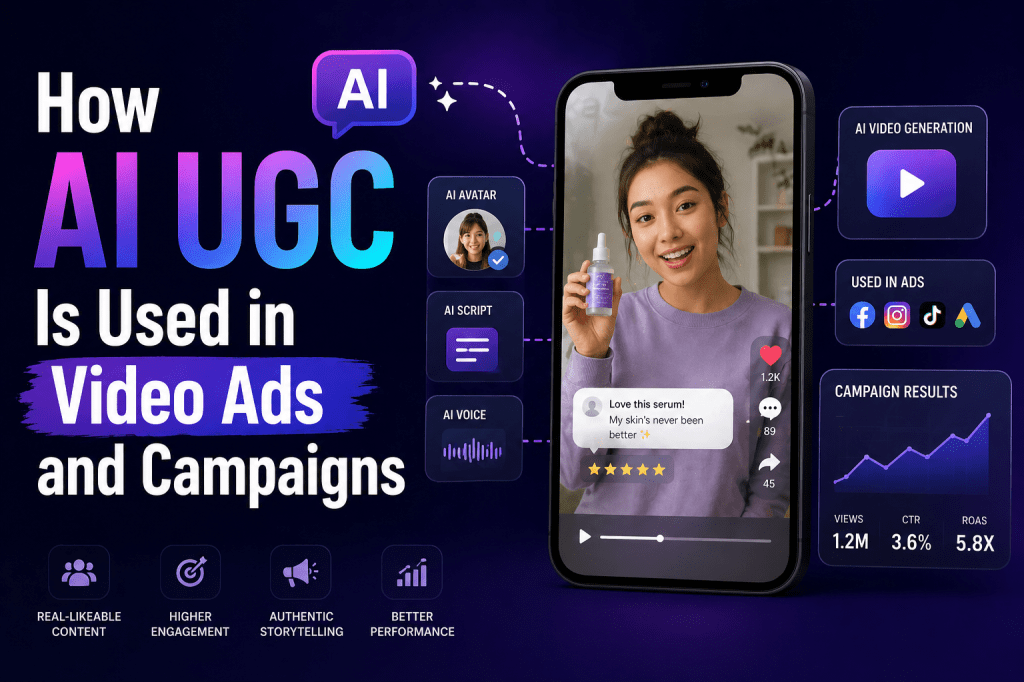
There’s a quiet revolution happening inside marketing departments, creative agencies, and brand studios right now — and most consumers haven’t noticed it yet. The video ads showing up in their feeds, the testimonial-style clips on product pages, the authentic-looking lifestyle content embedded in email campaigns — a growing portion of it is being created not by real customers with cameras, but by AI UGC video generators.
This isn’t a dystopian development. It’s a practical one. For years, marketers have known that user generated content outperforms polished brand ads. Authentic, relatable, human-feeling video drives higher engagement, more trust, and better conversion rates than anything a traditional production studio can deliver. The problem was always scale. Getting real customers to consistently produce high-quality video content is expensive, slow, and unpredictable.
AI UGC video generators solve that problem — and they’re rapidly becoming one of the most strategically important tools in the modern marketer’s toolkit.
What AI UGC Actually Means in a Marketing Context
The term “UGC” — user generated content — has been a cornerstone of digital marketing strategy for over a decade. It refers to any content created by real people rather than brands, and its marketing power comes from a simple psychological truth: we trust other people more than we trust companies.
AI UGC refers to content that replicates the look, feel, and energy of genuine user generated videos, but is produced using artificial intelligence. An AI UGC video generator can create clips that resemble a real person talking directly to the camera, a customer unboxing a product, a lifestyle shot in a relatable home environment — all without a human creator ever pressing record.
The distinction between real UGC and AI UGC is becoming increasingly blurry, and that’s largely intentional. The goal isn’t to deceive audiences — it’s to produce content at scale that maintains the authenticity and human quality that makes UGC so effective in the first place. Used responsibly and transparently, AI UGC is simply a faster, more scalable path to the same creative destination.
The Scale Problem That AI UGC Solves
If you’ve ever run a UGC-driven campaign, you know the operational headaches involved. You need to source creators, negotiate rates, brief them on your brand, wait for submissions, review the content, request revisions, handle licensing, and then finally publish. A single campaign might take six to eight weeks from brief to live. And if you’re running multiple campaigns simultaneously across different products, markets, or demographics, the complexity multiplies fast.
An AI UGC video generator compresses this entire process into hours. A brand can input a product description, define a target persona, choose a visual style, and generate dozens of variation ads in a single afternoon. Those variations can then be tested against each other — different hooks, different tones, different visual environments — and the best performers can be scaled immediately.
For performance marketing teams running paid social campaigns, this speed-to-market advantage is enormous. The difference between launching a campaign in two days versus two months is often the difference between capitalizing on a trend and missing it entirely. AI UGC gives marketers the creative velocity to keep pace with the speed of social media itself.
How Brands Are Using AI UGC Video Generators in Real Campaigns
The applications of AI UGC in video advertising are broader than most people realize. Let’s look at the specific ways brands are putting these tools to work right now.
Spokesperson and Talking-Head Ads
One of the most common formats in performance advertising is the direct-to-camera spokesperson video — someone looking into the lens, speaking conversationally about a product, and delivering a clear call to action. This format works because it mimics personal recommendation, which is one of the highest-trust forms of communication.
AI UGC video generators can now produce convincing spokesperson content at scale. Brands select from a library of AI-generated personas, write a script, and produce a realistic video in which a lifelike human presents their product naturally and persuasively. The output looks remarkably similar to what a real content creator would film in their apartment — because it’s designed to. These ads consistently outperform traditional branded video in A/B tests, particularly on platforms like TikTok, Instagram Reels, and YouTube Shorts where the UGC aesthetic is native.
Product Testimonial Simulations
Testimonial videos are among the highest-converting content formats in e-commerce advertising. Hearing someone describe how a product changed their skin, improved their sleep, or solved a persistent problem creates the kind of social proof that drives purchase decisions far more reliably than product features or price.
With an AI UGC video generator, brands can create testimonial-style videos that convey genuine enthusiasm and specificity without waiting months for organic customer submissions. These videos are often used in mid-funnel ad campaigns — targeting audiences who are already aware of the brand but haven’t yet converted — where social proof is the final nudge a potential customer needs.
Localization and Multi-Market Campaigns
Global campaigns have always faced a localization challenge. Content that resonates in the United States doesn’t always translate emotionally or culturally to audiences in Germany, Japan, or Brazil. Hiring separate creator teams in every market is prohibitively expensive for most brands.
AI UGC solves this beautifully. A single campaign concept can be generated in multiple languages, with culturally appropriate personas, regional visual contexts, and localized product messaging — all from the same AI UGC video generator workflow. What previously required international creator networks can now be executed by a single content team in a single afternoon.
Rapid Creative Testing for Paid Social
In paid social advertising, the creative itself is often the primary variable between a campaign that delivers a two-times return and one that delivers a five-times return. Marketers know this, which is why creative testing — running multiple ad variations simultaneously to identify the highest performer — is standard practice for serious performance teams.
The challenge is that generating creative variations is expensive and slow when you’re relying on traditional production. AI UGC video generators remove that constraint entirely. A brand can test 20 different hooks, 5 different personas, 3 different visual styles, and 4 different calls to action — simultaneously — and have statistically significant performance data within days. The creative feedback loop that used to take quarters now takes weeks.
The Emotional Intelligence of Modern AI UGC Tools
Early AI video tools felt robotic. Movements were stiff, expressions were blank, and the uncanny valley effect made viewers uncomfortable without knowing exactly why. The latest generation of AI UGC video generators has largely solved these problems.
Modern tools understand emotional register. They can produce content that feels excited, calm, concerned, satisfied, or curious — and they match that emotional tone to the visual cues: facial expression, pacing, vocal inflection (in tools that include audio generation), and body language. The result is content that doesn’t just look like UGC — it feels like UGC.
This emotional intelligence is particularly important in categories like health and wellness, personal finance, parenting, and beauty — spaces where the emotional connection between creator and viewer is what drives trust and ultimately conversion. Brands operating in these categories have historically been the most dependent on authentic creator partnerships, and they’re now among the fastest adopters of AI UGC, precisely because the tools have matured enough to replicate that emotional resonance.
Creative Diversity Without Creator Fatigue
One of the underappreciated challenges of traditional UGC campaigns is creator fatigue. Even your most enthusiastic brand advocates can only produce so much content before their enthusiasm wanes or their audience tunes out. And the homogeneity problem is real — if you’re working with a small pool of creators, your content starts to look and feel similar over time, reducing its effectiveness.
An AI UGC video generator doesn’t get tired. It doesn’t have a consistent aesthetic that bleeds into every piece of content it produces. It can generate a video that looks like it was filmed in a cozy kitchen, another that feels like a city apartment, another that has the bright, airy quality of a fitness influencer’s home studio — and all three can represent the same product, the same message, and the same campaign without any creative tension between them.
This diversity is strategically valuable. Different audience segments respond to different visual environments and creator types. AI UGC allows brands to match their content aesthetic to their audience segment in a way that’s simply not practical with a limited creator roster.
Ethical Considerations and Transparency Standards
It would be incomplete to discuss AI UGC in advertising without addressing the ethical questions it raises. As these tools become more powerful and more widely used, the conversation around disclosure and transparency is becoming increasingly important.
The core question is straightforward: should audiences know they’re watching AI-generated content? Most brand marketers and platform operators are moving toward “yes” — not just because it’s ethically sound, but because transparency builds long-term trust in ways that deception erodes. Several major platforms are already developing disclosure requirements for AI-generated advertising content, and best-practice brands are getting ahead of this by labeling their AI UGC proactively.
The good news is that transparency doesn’t appear to significantly reduce effectiveness. Research and early campaign data suggest that audiences, particularly younger demographics, are comfortable with AI-generated content as long as the product claim is genuine and the brand’s intent is clear. What audiences object to isn’t the technology — it’s the feeling of being manipulated. Transparent use of AI UGC sidesteps that concern entirely.
Integration Into Broader Campaign Ecosystems
The most sophisticated marketers aren’t using AI UGC video generators in isolation. They’re integrating AI-generated content into multi-channel campaign ecosystems where video ads, landing pages, email sequences, and social proof elements all work together.
A typical integrated approach might look like this: an AI-generated spokesperson video runs as a paid ad on Meta or TikTok, driving traffic to a product page that features AI-generated testimonial content alongside real customer reviews. Email retargeting sequences include short-form AI UGC clips embedded directly in the HTML. Retargeting ads served to non-converters use a different AI-generated persona with a different emotional hook — perhaps more urgency-focused than the original awareness content.
This kind of ecosystem thinking — using AI UGC as a connective tissue across touchpoints rather than a single ad format — is where the real performance gains are being realized. The consistency of message, the variety of execution, and the speed of iteration all compound when AI UGC is embedded throughout the funnel rather than deployed at a single point in it.
What to Look for in an AI UGC Video Generator
Not all AI UGC tools are built the same way, and the differences between them matter significantly depending on your use case. When evaluating an AI UGC video generator for your campaigns, there are a few key capabilities worth examining closely.
The realism of the generated personas matters most for direct-response advertising. If your ad format requires a believable human presence, you need a tool that handles facial expression, natural motion, and lip sync with precision. Test every tool you consider with a detailed script before committing to a workflow.
Customization depth determines how well you can align the output with your brand’s visual identity. Can you control background environments? Clothing? Lighting tone? The best tools offer enough flexibility to ensure your AI UGC feels like an extension of your brand rather than a generic template.
Output speed and volume capacity define whether a tool can support your content operations at scale. A tool that takes 30 minutes to generate a single clip is useful for occasional projects but not for a high-volume performance marketing workflow where you’re producing and testing dozens of ads per week.
Finally, platform compatibility — how easily the output integrates with your existing ad management, CMS, and analytics stack — determines how much operational friction you’ll encounter in deployment.
Conclusion: Making AI UGC Work at Scale With Tagshop AI
The trajectory is clear. AI UGC video generators are moving from experimental curiosity to essential infrastructure for brands that take content marketing seriously. The speed, scale, cost efficiency, and creative diversity they enable are not incremental improvements over traditional UGC production — they are a categorical change in what’s possible.
But generating great AI UGC content is only half the equation. Publishing, managing, and optimizing that content across your digital channels is where many brands still lose time and performance. That’s where Tagshop AI becomes an indispensable part of the workflow.
Tagshop AI is purpose-built for brands that want to collect, organize, and deploy user generated content — including AI-generated UGC video — across their e-commerce storefronts, social channels, and marketing campaigns. Instead of manually uploading video assets to individual platforms and tracking performance in disconnected spreadsheets, Tagshop provides a centralized hub where your AI UGC content can be tagged, made shoppable, embedded on product pages, and measured for its actual impact on conversion.
For brands using AI UGC video generators to scale their content output, pairing that capability with Tagshop AI’s publishing and analytics infrastructure is the complete solution — from generation to performance. You create fast, you publish smart, and you optimize continuously.
The brands winning in digital advertising right now aren’t the ones with the biggest budgets. They’re the ones with the fastest creative engines and the smartest content operations. AI UGC, powered by the right tools and published through the right platform, gives any brand a genuine path to both.


Leave a Reply