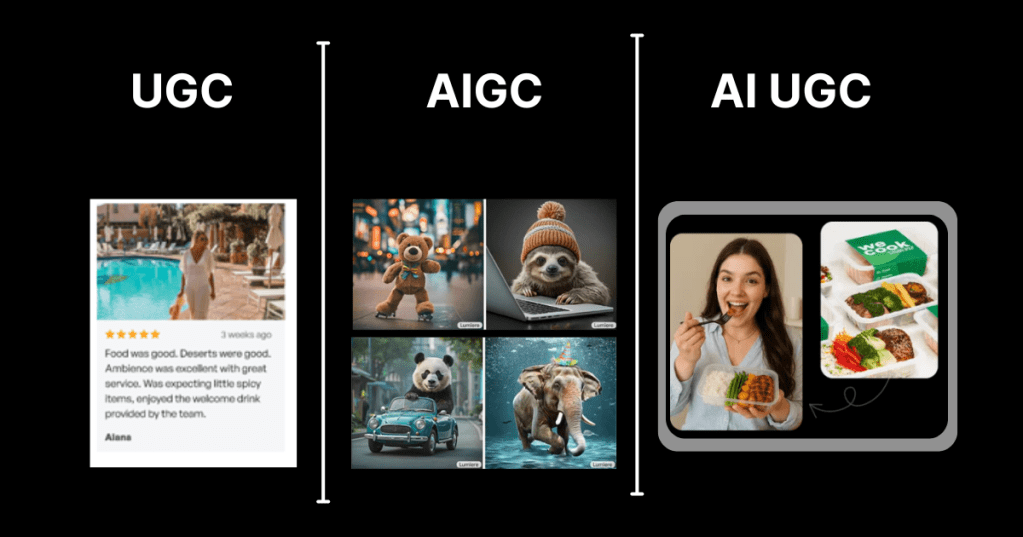
In the fast-evolving world of digital marketing, content is no longer just content—it’s a strategy, an identity, and often, the heartbeat of a brand. From the early days of social media when authentic, user-shared content was the gold standard, to today’s rise of AI-generated videos that replicate human creativity at scale, the landscape has expanded into fascinating new territories. Three key terms define this shift: UGC, AIGC, and AI UGC.
Although they share similarities, each represents a distinct approach to creating and leveraging content. Understanding the difference between them is crucial for brands, creators, and marketers who aim to build trust while scaling production efficiently.
Let’s dive deep into what makes UGC, AIGC, and AI UGC unique—and how they intersect to shape the future of digital storytelling.
Understanding UGC (User-Generated Content)
User-Generated Content (UGC) refers to any type of media—videos, photos, reviews, testimonials, or social posts—created by real users rather than by the brand itself. It’s authentic, spontaneous, and thrives on social proof.
Think of a customer recording a short TikTok review of their new skincare product, an Instagram post showing off their favorite fashion brand, or a YouTube unboxing video. None of these are paid ad productions; they are genuine expressions from everyday consumers who share their experiences. And that’s exactly why UGC works so well.
Why UGC Works
People trust people more than they trust ads. This isn’t new—but what’s remarkable is how consistently this truth drives results across platforms. According to Nielsen research, 92% of consumers trust user-generated recommendations more than traditional advertising. UGC succeeds because it:
- Builds credibility through authentic voices
- Drives engagement and emotional connection
- Encourages participation in brand storytelling
- Performs better in paid ads due to relatability
Brands love UGC because it feels organic, even when integrated into campaigns. In fact, most successful direct-to-consumer (DTC) brands rely heavily on UGC-style videos to boost clicks and conversions—especially on platforms like TikTok, Instagram, and Facebook.
The Limitation of Traditional UGC
As powerful as UGC is, it has challenges. Creating quality user content requires collaboration with real creators, often through influencer partnerships or UGC marketplaces. These collaborations can be time-consuming and inconsistent. Brands must handle multiple creators, revisions, and content rights. Additionally, scaling UGC across campaigns and platforms can be expensive.
That’s where automation and AI innovation come in, setting the stage for AIGC and AI UGC.
Understanding AIGC (AI-Generated Content)
AI-Generated Content (AIGC) is any type of media—text, image, or video—created entirely by artificial intelligence. Instead of a human writing the copy or filming the video, software tools use machine learning models to generate creative outputs autonomously.
AIGC spans across multiple domains:
- Text generation (like blogs, ad copy, and captions)
- Image generation (using AI tools like Midjourney or DALL·E)
- Video generation (from image-to-video or URL-to-video AI tools)
- Voice and music creation
- Interactive avatars and virtual influencers
While UGC represents real people creating content, AIGC represents machines that imitate human creativity.
Benefits of AIGC
The rise of AIGC is fueled by scalability and speed. With advances in generative AI, brands can now create massive amounts of content with minimal effort. The benefits include:
- Efficiency: AI can create hundreds of variations of ads or visuals in minutes.
- Cost-effectiveness: No human creators or production costs are required.
- Consistency: AI ensures brand guidelines are followed automatically.
- Personalization: AI can tailor content for different audiences using data-driven insights.
For example, AI video generators like Tagshop AI or Synthesia can transform product URLs or text scripts into fully generated promotional videos featuring realistic human avatars. This replaces traditional studio shoots and creator hiring with an entirely automated process.
The Challenge of AIGC
The obvious drawback is authenticity. While AIGC is efficient and scalable, it lacks human emotion. Viewers are quick to detect when content feels artificial, disjointed, or emotionally flat. For marketers, this presents a paradox: How do you balance efficiency and authenticity?
That’s where AI UGC enters—combining the human element of UGC with the automation and scalability of AIGC.
What is AI UGC (AI-Powered User-Generated Content)?
AI UGC is the fusion of real user-generated style and tone with AI’s generative capabilities. In essence, it allows marketers to produce content that looks, feels, and sounds like real UGC—but is created or enhanced by AI.
This new category of content creation bridges the best of both worlds:
- The authenticity and familiarity of UGC
- The speed and efficiency of AIGC
Imagine you’re a skincare brand. Instead of hiring 10 creators to record testimonial-style videos, you use an AI UGC video generators like Tagshop AI. The tool takes your product URL, identifies highlights from your product landing page, writes a natural-sounding UGC script, and generates a realistic AI avatar delivering the video. The final result? A TikTok-style testimonial that closely resembles human-created content—complete with personality, voice, and relatable tone.
Why AI UGC is Disrupting Digital Marketing
AI UGC is transforming how brands create AI user-generated content. The key reason—it blends realism with efficiency. Unlike traditional UGC, you don’t depend on real people every time. Yet unlike standard AIGC, you don’t lose emotional believability.
Key benefits include:
- Scalability with authenticity: Brands can produce hundreds of realistic user-style videos quickly.
- Consistency: AI ensures messaging stays aligned across different campaigns.
- Localization: AI voices and avatars can adapt across languages and regions.
- Reduced costs: No creator fees or production logistics.
- Faster testing: AI UGC allows marketers to A/B test creatives at scale.
In short, AI UGC represents the next generation of UGC-style marketing—built for automation, personalization, and adaptability at speed.
The Core Differences Between UGC, AIGC, and AI UGC
| Aspect | UGC (User-Generated Content) | AIGC (AI-Generated Content) | AI UGC (AI-Powered UGC) |
|---|---|---|---|
| Created by | Real human users or creators | Artificial Intelligence | Artificial Intelligence trained to mimic human UGC |
| Authenticity | High | Medium to low | High (simulated) |
| Scalability | Limited | Very high | High |
| Cost efficiency | Moderate to high (depending on creators) | Very cost-effective | Cost-effective |
| Emotional relatability | Strong | Weak | Moderate to strong |
| Creative control | Low for brands | Full control | Balanced control |
| Speed of creation | Slow to moderate | Instant | Fast |
| Use case examples | Product testimonials, reviews, unboxing videos | Blog writing, AI avatars, generated visuals | AI-generated TikTok ads, AI influencer videos, simulated reviews |
How Brands Are Using These Together
Many forward-thinking brands aren’t choosing between UGC, AIGC, or AI UGC—they’re combining them strategically.
For example:
- UGC for social proof: Real customer videos or reviews remain essential for trust-building.
- AIGC for efficiency: AI helps with copywriting, image creation, and editing to fuel campaigns quickly.
- AI UGC for scalability: Brands use AI UGC tools to simulate high-performing UGC formats across multiple platforms.
Consider a DTC skincare brand running a social campaign. They might begin with genuine UGC from customers, use AIGC to design matching visuals or captions, then scale further using AI UGC videos that mimic the most engaging tone of their top-performing creators. This hybrid model allows them to maintain authenticity, efficiency, and creative momentum simultaneously.
Why AI UGC is the Future of UGC Marketing
The future of social media marketing lies in realism that scales. Consumers crave authenticity, but brands crave efficiency. AI UGC is the perfect middle ground.
Several emerging trends highlight this shift:
- AI real creators: AI avatars now represent entire influencer personas capable of producing realistic UGC at scale.
- AI voiceovers and scripting: AI models can replicate natural human speech patterns for ad-style monologues and testimonials.
- Personalized videos: AI UGC tools can generate custom variations of the same video targeted to different demographics or languages.
- Cost-efficient content libraries: Marketers can build entire video content databases generated via AI UGC for ongoing campaigns.
Through these innovations, AI UGC empowers brands to act more nimbly in fast-paced digital spaces like TikTok and Instagram Reels—without sacrificing relatability.
Key Takeaways for Marketers
- Choose UGC when building trust.
Real customer voices remain invaluable when authenticity and community are your goals. - Use AIGC when scaling quickly.
When campaigns require mass content production or precise creative control, AIGC tools are unbeatable. - Adopt AI UGC as your hybrid model.
Combine the familiarity of UGC with the convenience of AI to create believable, scalable storytelling. - Focus on storytelling, not just automation.
The technology is powerful, but the narrative drives engagement. AI should enhance human emotion, not replace it. - Experiment and analyze performance.
Use data to identify what type of content format truly resonates with your audience.
Final Thoughts
The difference between UGC, AIGC, and AI UGC goes beyond semantics—it reflects the evolution of content creation itself. Where UGC represented the rise of authenticity, AIGC symbolized the power of automation. AI UGC now stands as a bridge between both, redefining how brands tell stories at scale.
As AI tools grow more advanced, the line between human and machine creativity will continue to blur. But one truth remains: authenticity sells. The challenge for modern brands isn’t whether to choose people or AI—it’s how to use both intelligently.
In the next few years, successful marketers won’t just create content. They’ll design systems—blending real voices with synthetic storytellers—to deliver consistent, relatable, and high-performing campaigns across every platform.
UGC made content relatable. AIGC made it efficient.
AI UGC is making it unstoppable.
 AI UGC Video Generator
Leave a comment